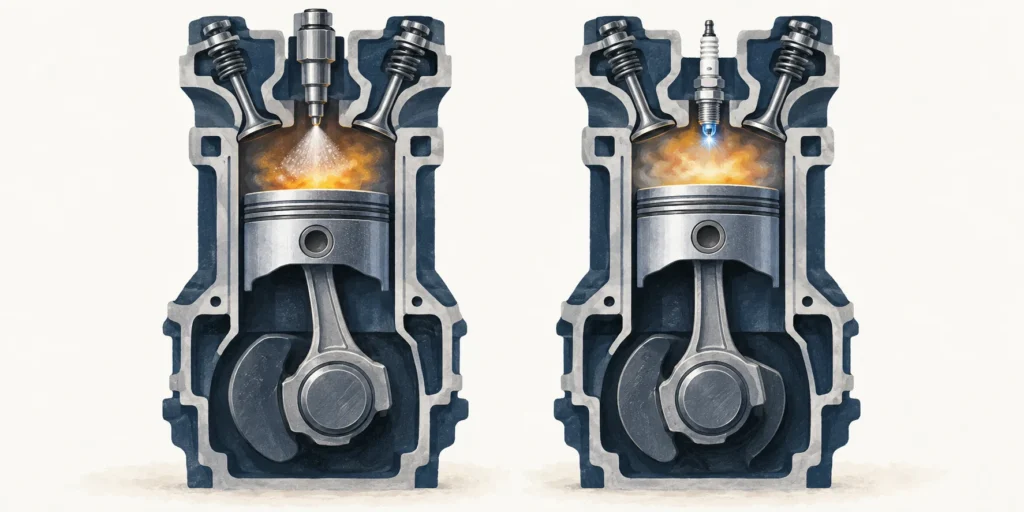
Diesel engines ignite fuel through compression heat; petrol engines usually use spark plugs. Journey pattern, emissions equipment and actual costs change the comparison.
A conventional diesel engine ignites injected fuel using the heat created by compressing air. A petrol engine normally uses a spark plug to ignite an air–fuel mixture. Diesel cars often use less fuel than comparable petrol cars, but journey pattern, emissions equipment and the actual costs determine the practical trade-off. [1][2][4]
This guide compares conventional diesel and petrol passenger cars in Britain. It explains the fuel and engine differences; a specific car still needs comparison with another of similar size, performance and condition.
In a diesel engine, compression raises the air temperature enough for the injected fuel to ignite. In a typical petrol engine, the fuel and air mixture is ignited by a spark plug. Both turn combustion energy into mechanical movement; they differ in how combustion is initiated. [1][2]
That is why petrol and diesel are not interchangeable descriptions of a fuel system. The engine and its fuel supply are designed around their intended fuel and combustion process. [1][2]
Journey pattern matters for a diesel filter
A diesel particulate filter, or DPF, traps soot in the exhaust. Regeneration burns off accumulated soot. Repeated short, low-speed journeys can prevent regeneration from completing, increasing the risk of a blocked filter. Annual mileage alone does not describe that pattern: many brief trips and regular longer runs are different uses. [3]
For an actual car, use its handbook and service information. Do not apply one universal speed, engine revs or drive duration to every model, or treat a warning light as a diagnosis from an article. [3]
A worked fuel-cost comparison
Hypothetical assumptions, not current pump prices or test results: diesel consumption 8 litres per 100 miles at £1.60 per litre; petrol consumption 10 litres per 100 miles at £1.50 per litre.
Diesel: 8 litres × £1.60/litre = £12.80 per 100 miles. Petrol: 10 litres × £1.50/litre = £15.00 per 100 miles. The difference is £2.20 per 100 miles, or £220 over 10,000 miles if those assumptions stay constant.
Illustrative fuel cost for the same 100 miles — scale starts at £0
Diesel: £12.80
Petrol: £15.00
Bar lengths use the same £0–£15 scale and the hypothetical inputs above. This compares fuel only.
The diesel fuel is dearer per litre in this example, yet the diesel journey costs less because fewer litres are used. That £220 annual saving does not automatically cover a higher purchase price, servicing, repairs, insurance, depreciation or zone charges. Use actual figures before turning a fuel comparison into a purchase decision.
Emissions are more than one number
CO₂ relates to climate impact, while nitrogen oxides and particulate matter raise different air-quality questions. A lower fuel bill or CO₂ figure is not proof of the lowest local air pollution. Engine design, age and working emissions-treatment equipment matter. [1][4]
In Britain, check the particular vehicle against the rules for the places you drive. The clean-air-zone checking service uses the registration number; London and Scotland have separate services. Neither “diesel” nor “petrol” alone determines a specific charge. [5]
Try three comparisons
1. Diesel is dearer per litre: must its journey cost more?
No. With the hypothetical inputs above, 8 × £1.60 is £12.80, below 10 × £1.50 = £15. Compare consumption and litre price together.
2. Lots of short trips add up to high mileage: is that enough to dismiss DPF concerns?
No. Trip pattern still matters. Short, low-speed use can interfere with regeneration even when the mileage total looks substantial. [3]
3. Does the £220 illustrative fuel saving prove diesel is cheaper to own?
No. It covers only fuel at those fixed assumptions. Compare the actual cars’ other ownership costs and suitability as well.
Frequently asked questions
Are both types internal combustion engines?
Yes. The conventional engines compared here both burn fuel internally; the key ignition distinction is compression heat versus a spark. [1][2]
Is there one annual mileage at which everyone should choose diesel?
No single number follows from this comparison. Fuel prices, actual consumption, purchase and running costs, journey pattern and vehicle condition all change the result.
Sources
Sources checked on 12 October 2026. Worked examples and exercises were written for this article.
AI tools assisted with drafting and the featured editorial illustration. The illustration is not a photograph, measurement or test result. Claims were checked against the linked sources; no independent human expert review is claimed.
A full hybrid charges its battery while driving; a plug-in hybrid can also charge from an external supply and usually offers more electric-only driving.
A boat usually suggests a smaller watercraft and a ship a larger seagoing vessel. Usage overlaps: ferries may be called boats and submarines retain boat terminology.
Pelican crossings have far-side pedestrian signals and a flashing phase. Puffin signals are beside you, with sensors and no flashing amber for drivers.