Pelican crossing vs puffin crossing: what’s the difference?
Pelican crossings have far-side pedestrian signals and a flashing phase. Puffin signals are beside you, with sensors and no flashing amber for drivers.
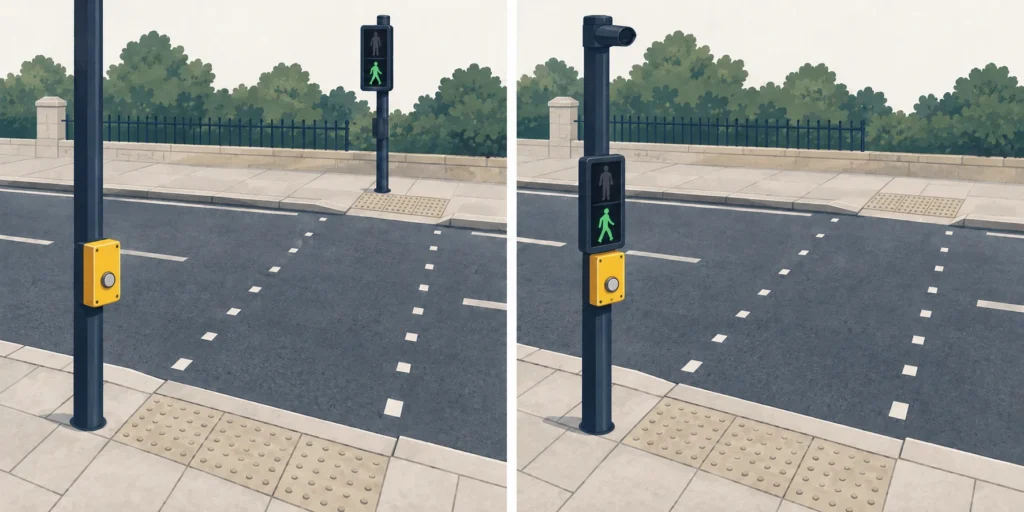
A pelican crossing has pedestrian signals on the far side and flashing phases: flashing green for pedestrians, and flashing amber for drivers. A puffin crossing puts the pedestrian signal beside you and uses sensors to manage the crossing; it has neither of those flashing phases. [1][2][3]
This comparison covers standard standalone crossings in Great Britain. Start by identifying whose signal you are reading: a green pedestrian figure and an amber traffic light give instructions to different road users.
Pelican and puffin compared
Where to look and what changes
Feature
Pelican
Puffin
Pedestrian signal
Across the road, on the far side
Beside the waiting pedestrian, above the push-button box [1][2]
At a pelican: starting and finishing are different
Press the button and wait for the steady green pedestrian figure. Check that traffic has stopped before crossing carefully. If the green figure starts flashing while you are still on the pavement, do not start. If you are already crossing, you should have time to finish safely. [1]
For drivers, red means stop. During flashing amber, you must give way to any pedestrians on the crossing. Only when there are none may you proceed cautiously. A straight pelican crossing divided by an island counts as one crossing: watch for people coming from the other side of the island too. [3]
At a puffin: look beside you
The red and green figures are above the control box on your side of the road, positioned so that you can face approaching traffic while watching the signal. Press the button and wait for green. There is no flashing green figure to interpret. [1][2]
Sensors detect people crossing and can vary the time provided. They can also cancel a pedestrian call if the person walks away. Do not infer a fixed number of seconds from the crossing’s name. [2]
Pedestrian signals: the important transition
Pelican: steady green → flashing green → red. Do not begin on flashing green.
Puffin: steady green → red. Red means do not begin; traffic can still be held at red to let people already crossing clear the road.
This is a sequence explanation, not a timed simulation. For drivers there is no puffin flashing-amber phase. [1][2][3]
If a puffin’s red pedestrian figure appears just as you are about to start, wait and use the button again. If you were already crossing, the traffic remains held during the clearance period. Drivers must give way to anyone still crossing even when their traffic signal turns green. [2][3]
A worked driver decision
Imagine you are stopped at a pelican crossing. The vehicle signal changes to flashing amber, but a pedestrian is still crossing towards your side. Continue waiting. The flashing amber has not removed your duty to give way. If the crossing becomes empty, you may proceed cautiously. [3]
At a puffin, do not look for that amber opportunity: there is no flashing-amber phase. Wait for the green traffic signal and ensure the way is clear. This distinction changes what the driver does, not just where a pedestrian sees a light. [2][3]
Try three crossing situations
1. You reach the kerb while a pelican’s green figure is flashing?
Wait; do not start crossing. Flashing green is for people already crossing to finish, not for a late start. [1]
2. A driver sees flashing amber but someone is still on the pelican?
The driver must give way. Proceeding cautiously is allowed only when no pedestrians are on the crossing. [3]
3. A puffin figure turns red after you have already started?
Keep crossing carefully. The red figure prevents new starts; the clearance period holds traffic for people already crossing. [2]
Frequently asked questions
Does a green traffic light remove the need to check for pedestrians?
No. Drivers must give way to anyone still crossing after their signal turns green. [3]
Does every crossing with a central island work as one crossing?
Do not generalise. The rule described here concerns a pelican crossing going straight across the road with a central island. Other layouts need their own signals and instructions. [3]
Sources
Sources checked on 11 October 2026. Worked examples and exercises were written for this article.
AI tools assisted with drafting and the featured editorial illustration. The illustration is not a photograph, measurement or test result. Claims were checked against the linked sources; no independent human expert review is claimed.
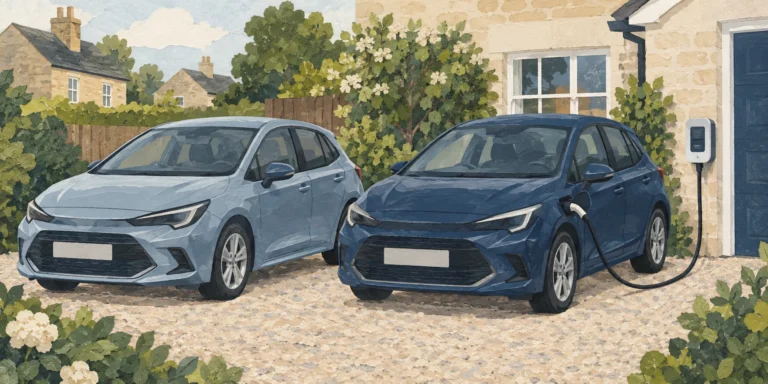
A full hybrid charges its battery while driving; a plug-in hybrid can also charge from an external supply and usually offers more electric-only driving.
A boat usually suggests a smaller watercraft and a ship a larger seagoing vessel. Usage overlaps: ferries may be called boats and submarines retain boat terminology.
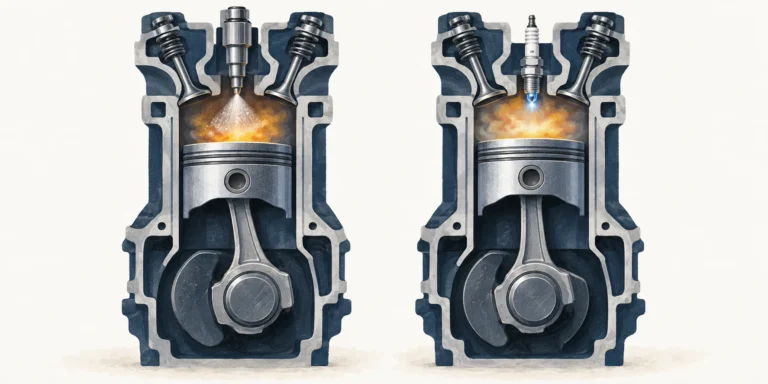
Diesel engines ignite fuel through compression heat; petrol engines usually use spark plugs. Journey pattern, emissions equipment and actual costs change the comparison.