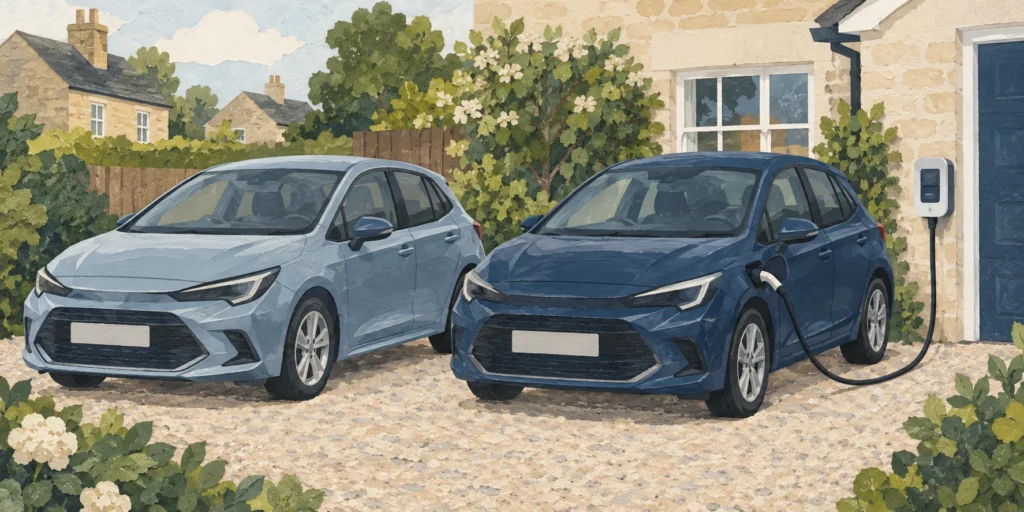
A full hybrid charges its battery while driving; a plug-in hybrid can also charge from an external supply and usually offers more electric-only driving.
A full hybrid (HEV) combines an engine and electric motor, charging its battery while driving rather than from a plug. A plug-in hybrid (PHEV) adds external charging and usually a larger battery, allowing longer electric-only driving when charged. Both retain a combustion engine; neither is the same as a battery-only electric car. [1][2][3]
Here, “hybrid” means a non-plug-in full hybrid. A mild hybrid is another type: its motor assists the engine rather than providing the full hybrid’s independent electric driving. The exact engine, motor and driving-mode arrangement varies by model. [1][3]
Full hybrid and plug-in hybrid compared
Charging and driving differences, without a universal range claim
Feature
Full hybrid (HEV)
Plug-in hybrid (PHEV)
External charging
No mains charging inlet for the traction battery
Can recharge the traction battery from an external supply [1][2][3]
Battery role
Smaller energy store for hybrid operation
Usually a larger store enabling longer electric running [2][3]
Electric-only driving
Possible when conditions allow, generally in shorter portions
Longer electric-only potential when sufficiently charged [1][2][3]
On-board charging
Engine/generator and regenerative braking
Hybrid charging/recovery as well as plugging in [1][2]
Petrol engine
Remains part of the powertrain
Also remains; supports journeys beyond available electric operation [2][3]
Useful daily question
How does this model behave on my normal route?
Can I charge regularly, and how much of my route suits electric running? [2][3]
Self-charging still needs an energy source
A full hybrid’s battery can gain energy through the engine and generator, and through regenerative braking. Regeneration recovers part of the energy available when the car slows; it does not manufacture energy. The phrase “self-charging” describes the absence of a plug-in routine, not unlimited driving without refuelling. [1]
A plug-in hybrid can start a journey with energy taken from an external electricity supply as well as fuel in its tank. That extra charging route is the practical difference. If you rarely plug it in, you make less use of the feature that enables extended electric driving; the precise fuel consequence depends on the particular vehicle and route. [2][3]
Where the battery’s energy can come from
HEV: engine/generator and recovered braking energy → battery → electric motor.
PHEV: those hybrid paths, plus external electricity → charging system → battery → electric motor.
This is a simplified energy-path explanation, not a wiring diagram or a claim that every powertrain connects its parts in the same way. [1][2]
Match the charging routine to the journey
Imagine two drivers with the same regular commute. One can use a compatible charger at home or work and intends to recharge most days. The other has no dependable charging opportunity. For the first driver, the plug-in system’s longer electric operation may be useful; for the second, the full hybrid avoids adding a charging task that cannot reliably be completed. This describes the trade-off, not a promise that one vehicle costs less overall. [2][3]
Before comparing a particular model, write down the round-trip distance, realistic charging opportunities and its electric-driving conditions. Weather, driving style and available charge affect range. A quoted test range is a comparison figure, not a guarantee that the engine will stay off throughout your own journey. [2]
A worked energy example with units
Use an invented PHEV with 10 kWh of usable battery energy and assume constant consumption of 20 kWh per 100 km. The simple range calculation is 10 ÷20 ×100 = 50 km, about 31 miles. These are teaching assumptions, not figures for a named car or a forecast of your range.
A 30 km round trip would use 30 ×20 ÷100 = 6 kWh in that model, leaving 4 kWh. The calculation concerns energy available for driving, not electricity drawn at the charger: charging losses would need separate information. It also assumes the journey can run electrically throughout, with no engine intervention.
This makes the useful question concrete. “Can I restore the energy my usual trip uses?” is more informative than “Is the badge hybrid?” You still need the actual model’s usable battery, charging specification and operating limits before applying the idea to a real car.
Test three everyday scenarios
1. A car has no plug-in charging: can it still drive electrically?
Yes, if it is a full hybrid and conditions allow. No charging cable does not mean no electric motor. A mild hybrid is a different case. [1][3]
2. A plug-in hybrid’s usable electric charge is low: is it necessarily stranded?
No. It retains an engine and can continue in hybrid operation when its other operating requirements are met, including having fuel. Low electric range is not the same as having no propulsion energy at all. [2][3]
3. What if the hypothetical consumption rises to 25 kWh per 100 km?
With the same 10 kWh usable energy,10 ÷25 ×100 = 40 km, about 25 miles. The 30 km trip now uses 7.5 kWh. That demonstrates sensitivity to consumption, not a tested winter range.
Frequently asked questions
Does plug-in mean fully electric?
No. A PHEV retains a combustion engine. A battery electric vehicle is a separate category that has no such engine for propulsion. [2][3]
Does electric-only driving prove zero total emissions?
No. It describes the driving mode. It does not by itself measure emissions from making the vehicle, producing electricity or the vehicle’s other journeys. This guide makes no whole-life emissions calculation.
Sources
Sources checked on 14 October 2026. Worked examples and exercises were written for this article.
AI tools assisted with drafting and the featured editorial illustration. The illustration is not a photograph, a measured technical diagram or evidence of an actual test.
A boat usually suggests a smaller watercraft and a ship a larger seagoing vessel. Usage overlaps: ferries may be called boats and submarines retain boat terminology.
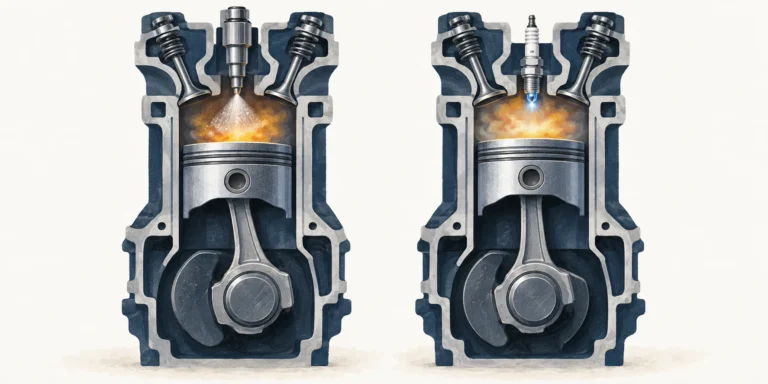
Diesel engines ignite fuel through compression heat; petrol engines usually use spark plugs. Journey pattern, emissions equipment and actual costs change the comparison.
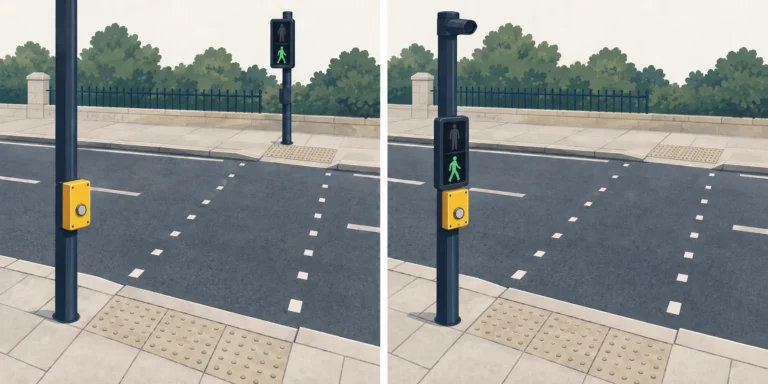
Pelican crossings have far-side pedestrian signals and a flashing phase. Puffin signals are beside you, with sensors and no flashing amber for drivers.