A pony is not a baby horse. In common British usage, adult ponies stand 14.2 hands high or under; horses stand above that, with separate rules for some competitions.
A pony can be fully grown: it is not a baby horse. In common British introductory usage, an adult pony stands 14.2 hands high or under, while a horse stands above that. A foal is a young horse or pony under one year old. Competition categories have their own measurement rules. [1][2]
A named breed standard gives more specific information [3]
Read hands as hands and inches
The abbreviation hh means hands high. One hand is four inches, and the measuring point is the withers, at the top of the shoulder region, rather than the ears. [1]
In the notation 14.2 hh, the final 2 means two additional inches. The worked conversion is (14 × 4) + 2 = 58 inches. It is not 14.2 multiplied by four. Similarly, 14.3 hh is 59 inches, and 15.0 hh is 60 inches. These are unit conversions, not measurements taken from the illustration.
A hands-and-inches number line
14.1 hh: 57 inches.
14.2 hh: 58 inches.
14.3 hh: 59 inches.
15.0 hh: 60 inches: four extra inches have made the next whole hand.
A worked yard-record example
Consider two invented records. Record A says “10 years old, 13.2 hh”. Its age does not prevent it being a pony: 13.2 hh is 54 inches and falls below the introductory adult-height boundary. Record B says “8 months old”. That record describes a foal; without its adult height, do not use its current size to settle its eventual adult category. [1]
For an information sheet, keep two fields: age or life stage, and adult height or relevant registration category. That avoids the mistaken sequence “foal, then pony, then horse” as though every animal must grow through all three labels.
Breed descriptions add detail; they do not replace measurement
A concrete British example is the Shetland pony. Its breed standard sets a maximum of 42 inches (107 cm) for registered stock and describes a strong body with well-sprung ribs and abundant mane and tail hair. These are features of a particular breed standard, rather than proof that every short, hairy animal is the same breed. [3]
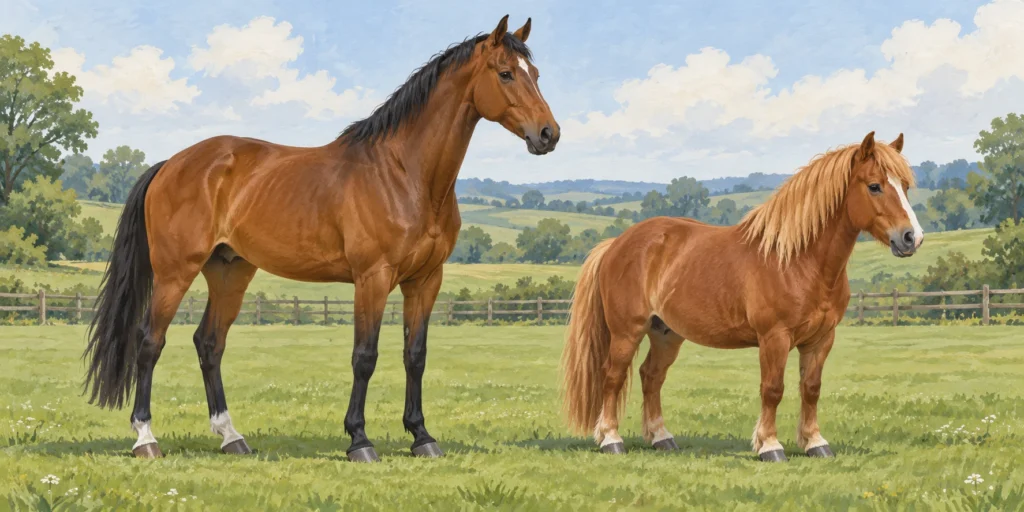
The cover contrasts a taller horse with a compact adult pony. Their build makes the comparison readable, but the picture is not a breed certificate or a scale drawing. A thick mane alone cannot supply an age, a recorded height or a competition category.
Why a show entry needs a more precise answer
For the current British national showjumping pony-measuring scheme cited here, the 148 cm category uses maximum accepted measurements of 148.9 cm without shoes or 149.9 cm with shoes. Registration and competition measurements are metric. Those scheme-specific limits should not be replaced with an informal hands conversion. [2]
For an actual entry, identify the discipline and category, then use the required measurement evidence and current rules. The everyday distinction answers a vocabulary question; it does not itself establish eligibility.
Check three records
1. A 10-year-old animal is 13.2 hh: is pony an age mistake?
No. In this hypothetical record it is an adult, and 13.2 hh falls within the common pony-height convention. Pony does not mean young. [1]
2. Does 14.2 hh mean 14 hands plus two tenths of a hand?
No. Read it as 14 hands plus 2 inches: 56 + 2 = 58 inches. The first digit after the point is an inches remainder, not a decimal fraction.
3. Can I use the cover to decide a show category?
No. The image has no measured scale. A show category needs the measurement and registration conditions required by that scheme. [2]
Frequently asked questions
Is horse sometimes used to include ponies?
Yes. Everyday terms such as horse riding can include riding ponies too. Read whether horse is being used broadly or in a specific height comparison. [1]
Is every pony a Shetland?
No. Shetland is a particular named breed with its own standard; pony is the broader term used in this comparison. [3]
Sources
Sources checked on 17 October 2026. The worked examples and self-checks were written for this article.
AI tools assisted with drafting and the featured editorial illustration. The illustration is not a photograph, a measured diagram or evidence of an actual test.
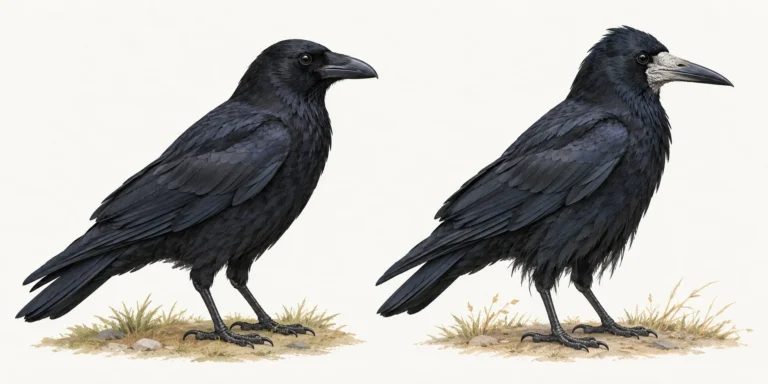
An adult rook has a pale bare patch around the base of its slimmer bill; a carrion crow has an all-black face and a heavier black bill. Young rooks and…
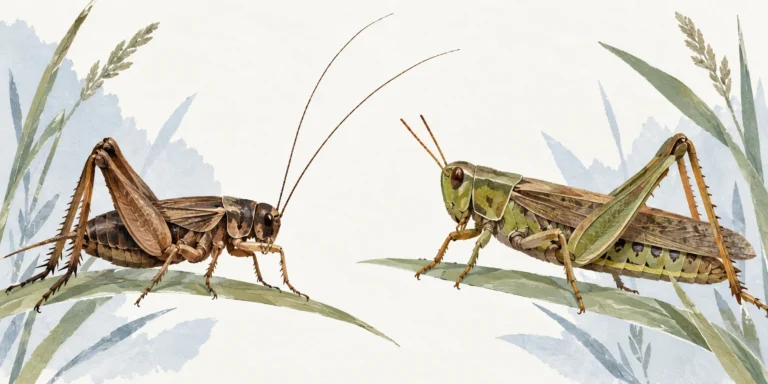
Crickets, including British bush-crickets, tend to have long antennae; grasshoppers have shorter antennae. Both jump, and colour alone is an unreliable guide.
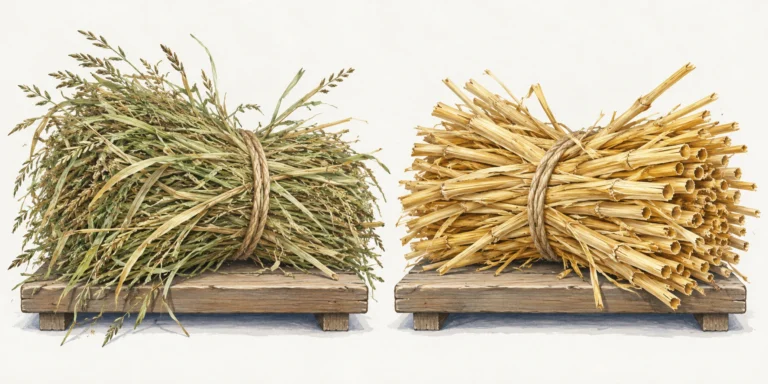
Hay is dried grass or other forage plants kept mainly as animal feed. Straw is the stalk material left from harvested cereals, often used for bedding, although it can also…