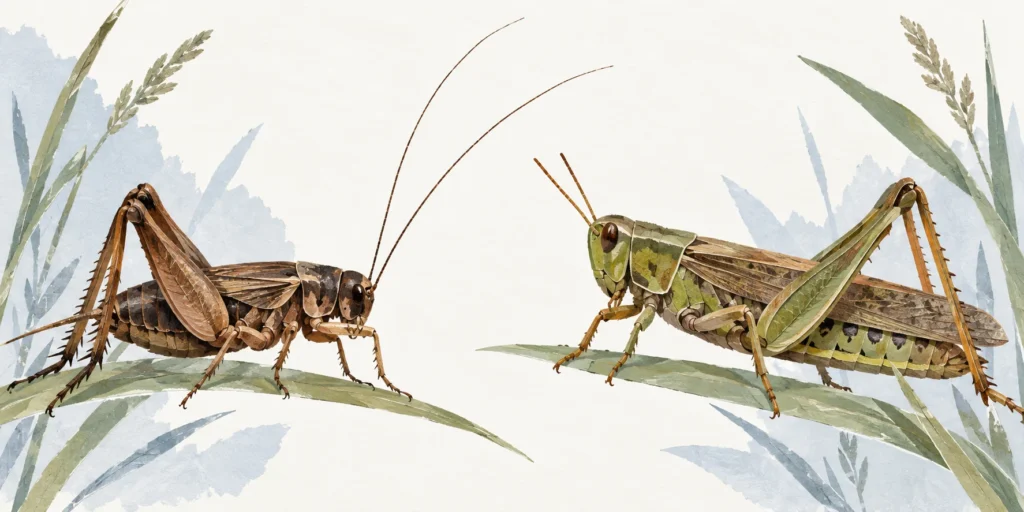
Crickets, including British bush-crickets, tend to have long antennae; grasshoppers have shorter antennae. Both jump, and colour alone is an unreliable guide.
Start with the antennae: crickets, including bush-crickets, tend to have long feelers, while grasshoppers have shorter ones. Both have powerful hind legs for jumping. In a British garden, “green means grasshopper” is an unreliable shortcut; some crickets are green and grasshopper colours vary. [1][2]
Imagine two photographs from a British garden. In the first, the feelers extend well beyond a brown insect’s body. That supports the cricket or bush-cricket side of the comparison. It does not tell you the species. In the second, a green insect has visibly short antennae: grasshopper is the better starting point. [1][2]
Now crop the antennae out of both photographs. The useful distinction has disappeared. Describing the first as brown and the second as green does not recover the missing evidence. For a useful identification photograph, keep the head, entire antennae, body and hind legs in view.
Use sound and timing as supporting clues
A familiar chirp is produced by rubbing body parts, but the parts differ between the groups. These are typical mechanisms, not a promise that every insect will be calling when you find it. One British bush-cricket attracts a mate by drumming on a leaf rather than making the familiar wing song. [1]
Time of day is also a supporting clue. Some true crickets are daytime insects, so seeing one in sunshine does not turn it into a grasshopper. At species level, the song and the shape of the pronotum—the area immediately behind the head—can be more useful than overall colour. [1][2]
A three-step observation route
See the antennae: long or short relative to the body?
Add context: body shape, visible legs and any song.
Keep the conclusion proportionate: group first; species only with enough detail.
If the key feature is hidden, record that uncertainty rather than guessing from colour.
Try the identification checks
A green insect has antennae longer than its body. Must it be a grasshopper?
No. Long antennae support the cricket/bush-cricket side. Colour does not override that clue, and a species name still needs more evidence. [1][2]
An insect jumps. Have I distinguished the two groups?
No. Enlarged jumping hind legs are a shared feature. Look for the antennae and supporting details. [1]
I hear nothing at midday. Can I rule out a cricket?
No. Silence at one moment is not an identification feature, and activity patterns have exceptions. [1]
Frequently asked questions
Is a bush-cricket just a green grasshopper?
No. Bush-crickets belong on the long-antenna side of this comparison. A green body is not enough to distinguish them from grasshoppers. [1][2]
Sources
Source pages checked on 25 October 2026. The examples and self-checks were written for this article with AI assistance and checked against the listed material.
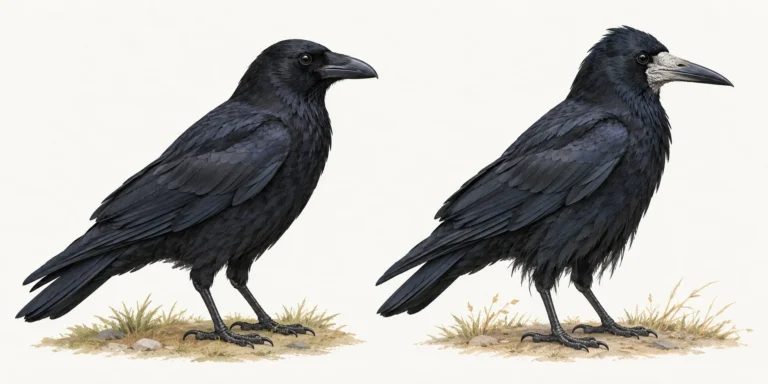
An adult rook has a pale bare patch around the base of its slimmer bill; a carrion crow has an all-black face and a heavier black bill. Young rooks and…
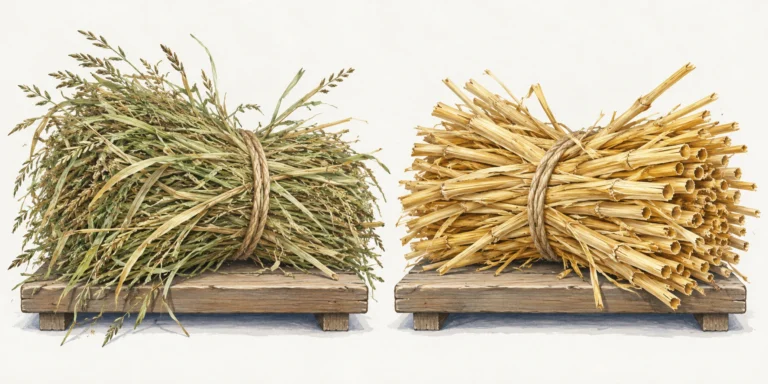
Hay is dried grass or other forage plants kept mainly as animal feed. Straw is the stalk material left from harvested cereals, often used for bedding, although it can also…
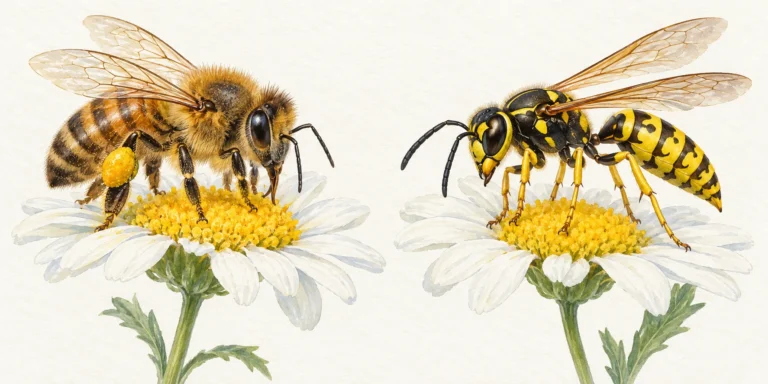
Familiar bees are usually hairier and collect pollen for their young; common social wasps are sleeker and feed their larvae mainly on other insects. Colour alone is not enough.