Cement vs mortar: what’s the difference?
Cement is a binding ingredient, commonly supplied as a fine powder. Mortar is a mixture containing sand, a binder and water, used between masonry units. Cement can be the binder in mortar, but the two names are not interchangeable.
In this comparison
The main differences
| Feature | Cement | mortar |
|---|---|---|
| What the word names | A binder ingredient [1] | A masonry mixture [2] |
| Sand | Not the same thing as a sand-containing mortar mix | A component of the mixture [2] |
| Water and form | Forms a binding paste when mixed with water [1] | Applied as a paste which then sets [2] |
| Role in brickwork | Can provide the binder within cement mortar [2] | Fills joints between bricks or blocks [2] |
An ingredient is different from a complete mixture
For cement mortar, cement, sand and water form the mixture. Calling the whole joint material “cement” hides the sand and other components. Equally, adding water to cement alone does not supply the sand required by that mortar description. [2]
Not all mortar is cement mortar
Mortar is the broader term. Lime mortar uses lime as its binder rather than requiring Portland cement. That distinction matters when reading a material description: “mortar” names a category, while “cement mortar” identifies one type within it. [2]
A practical reading example
Imagine a fictional materials list with two separate entries: “cement” and “masonry mortar”. The first names an ingredient; the second names a mixture for masonry joints. They should not be merged into one line merely because both might look grey. This identifies the words on the list; it does not establish a mix ratio, material quantity or suitable specification for a particular wall.
Read the contents, not just the colour
On a product description, distinguish the binder from the mixture and note whether sand is already included. If the text only identifies cement, do not assume it describes a complete mortar. This is a way to interpret the description, not a recipe for site mixing.
Try the distinction
A description says cement, sand and water. What mixture is being described?
Cement mortar. Cement is one ingredient within it. [2]
A specification calls for lime mortar. Does the word mortar guarantee Portland cement?
No. Mortar can use lime as its binder. The subtype matters. [2]
Does a grey powder alone prove that you have complete mortar?
No. Appearance alone does not identify the contents. Read whether the description names cement or a prepared mixture.
Frequently asked questions
Does cement simply mean hardened mortar?
No. Cement names the binder; mortar names the mixture, whether it is being discussed before use, as fresh paste or after setting. [1] [2]
Does this distinction tell me which mortar to use for repairs?
No. Understanding ingredient and mixture names does not establish the specification for a particular building.
Sources
Source pages checked on 26 November 2026. Fictional examples and self-checks were written with AI assistance and checked against the listed material.
- Cementitious Materials — MPA The Concrete Centre / Sustainable Concrete.
- Mortar — MPA The Concrete Centre / Sustainable Concrete.
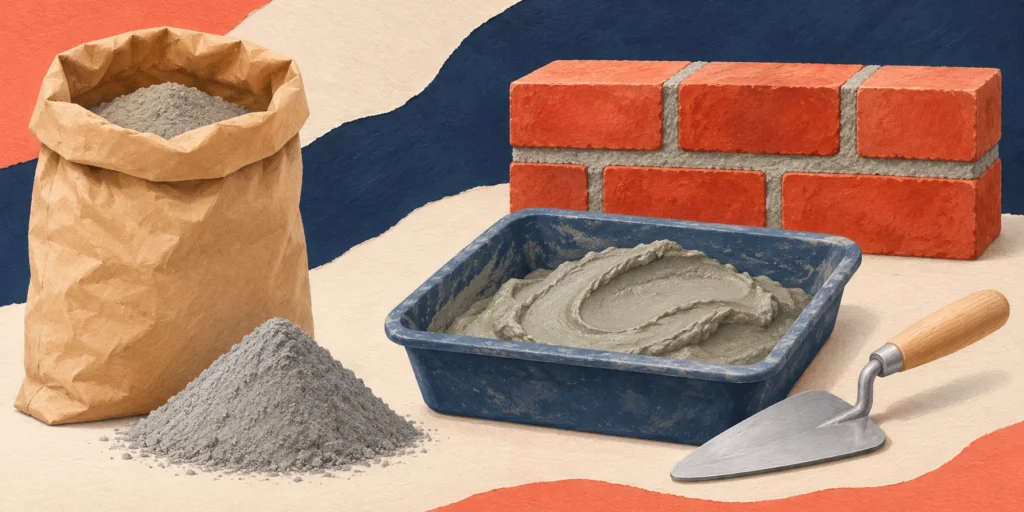
The featured image is an AI-generated editorial illustration, not a photograph, measurement or record of a study.