Home & GardenCeramic vs induction hob: what’s the difference?
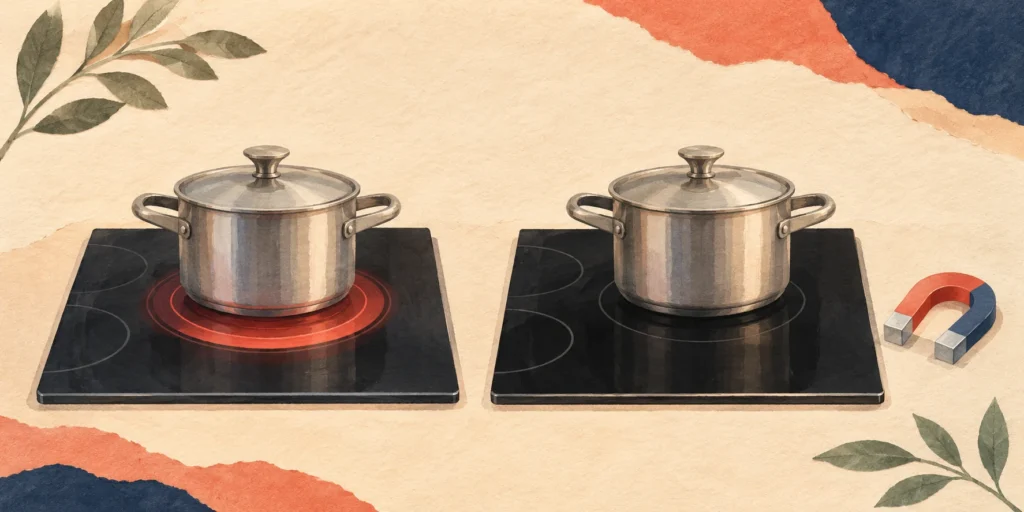
A conventional radiant ceramic hob heats an element beneath the glass, which transfers heat to the pan. Induction uses an electromagnetic field to generate heat in compatible cookware. Both use electricity and can have a glass-ceramic surface, so appearance alone is not the distinction.
The difference at a glance
A conventional radiant ceramic hob heats an element beneath the glass, which transfers heat to the pan. Induction uses an electromagnetic field to generate heat in compatible cookware. Both use electricity and can have a glass-ceramic surface, so appearance alone is not the distinction. [1][2]
The main differences
Ceramic and induction hob compared
| Feature |
Ceramic |
induction hob |
| Heating method |
Element heats through the surface |
Magnetic field heats compatible cookware |
| Power source |
Electricity |
Electricity |
| Cookware |
Follow surface and pan guidance for the model |
Induction-compatible cookware required |
| Surface description |
Often glass-ceramic |
Can also be glass-ceramic |
| Useful identification |
Model and manual, not just a smooth top |
Model, manual and compatible-pan requirements |
What ceramic means in this comparison
Retail comparisons commonly shorten conventional radiant electric glass-ceramic hobs to ceramic hobs. Here that is the meaning in the left column. Ceramic can also describe a surface material, so it is not a complete description of the heating technology. Calling induction the opposite of electric is equally misleading: induction is itself electric. [1][2]
Follow the route by which heat reaches the food
On a radiant model, an element under the glass provides heat to the pan above. Induction creates a field that heats suitable cookware. This explains why the two appliances can look much alike when switched off yet need different cookware checks. The mechanism matters more than whether the top is glossy, black or controlled by touch buttons. [1][2]
Pan compatibility is the first practical check
Induction requires compatible cookware; do not assume that every metal pan qualifies. For a particular pan and hob, use the cookware marking and both manufacturers’ guidance, including any base-size requirements. A purchase checklist should identify the pans you actually want to keep. Ordinary radiant ceramic cooking does not impose that same induction-compatibility condition, though the model still has cookware instructions. [2]
A worked specification-reading example
Imagine two fictional listings. Listing A says glass-ceramic radiant hob. Listing B says glass-ceramic induction hob and requires induction-compatible pans. The shared surface word does not make them the same type. Circle radiant or induction, then record the pans you own and check their documentation. Only after this step compare the dimensions and controls of those actual models. This is a paper exercise, not a test of a real appliance.
Do not read “induction” as “cold surface”
The pan and its contents become hot. Treat the cooking area according to the model’s residual-heat indications and instructions; do not touch it to identify the technology or test a marketing claim. This comparison does not offer a surface-temperature guarantee. When cleaning, follow the relevant manual rather than assuming that two similar-looking tops share every instruction.
Compare whole installations, not only the headline
Before replacement, obtain the actual model’s cut-out dimensions, electrical requirements and installation instructions. Have suitability checked by a competent installer rather than copying a connection arrangement from another model. This article provides no wiring instructions or universal power rating. For implanted medical devices, use the hob and medical-device guidance and the relevant professional advice; a general comparison cannot establish individual suitability. [1]
Keep performance claims tied to actual evidence
Induction is often marketed for efficiency and responsiveness, but this article does not supply measured boiling times or a bill-saving forecast. Your comparison should separate the heating method from any model-specific features. A flexible zone, timer or safety lock must be verified for the exact model; none is established just by the word induction.
Try the distinction
Both listings say glass-ceramic. Are they necessarily the same technology?
No. Read the heating-method description. Surface material and heat generation answer different questions.
A pan is metallic. Is that enough to prove induction compatibility?
No. Check its induction marking and the pan and hob instructions rather than assuming every metal base works.
Can you identify induction by touching the surface after cooking?
No. Do not use touch as a test: the pan and cooking area can be hot. Use the model information and manual.
Frequently asked questions
Is induction electric?
Yes. The field is generated electrically. [2]
Does a ceramic-looking top rule out induction?
No. The surface description does not by itself establish the heating method. [1]
Will every existing pan need replacement?
Not necessarily. Check each pan’s compatibility with the actual induction model.
Sources
Source pages checked on 23 November 2026. Fictional examples and self-checks were written with AI assistance and checked against the listed material.
- Induction and ceramic hobs: heating mechanisms — Beko UK.
- Electric and induction hobs: cookware and technology — Bosch UK.
The featured image is an AI-generated editorial illustration, not a photograph, measurement or record of a study.