Body wash vs shower gel: what’s the difference?
Both body wash and shower gel are liquid body cleansers. Body wash is often described as creamier, while shower gel commonly has a thicker gel texture. The names overlap, so read the individual product description.
In this comparison
The main differences
| Feature | Body wash | shower gel |
|---|---|---|
| Shared job | Cleansing the body [1] | Cleansing the body [1] |
| Common texture description | Creamier; a wider range of textures [1] | Thicker gel [1] |
| Typical emphasis | Cleansing with moisturising ingredients [1] | A refreshing cleansing feel [1] |
| Naming boundary | Useful product description, not a complete formula | Shower-care ranges also include creams [2] |
A useful distinction with an important limit
The texture distinction is a common product convention. It does not establish how every bottle will behave. A UK shower-care catalogue groups gels and creams in the same wider range, including cream-labelled products within shower-gel listings. That overlap makes the product’s own description more informative than a rigid two-box rule. [2]
A practical label-reading example
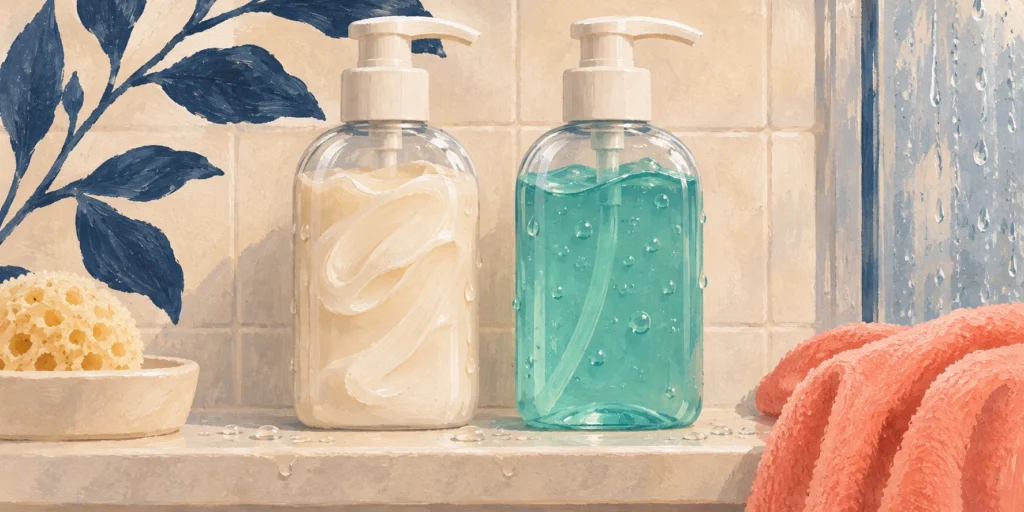
Imagine two fictional bottles. One says “body wash, creamy texture”; the other says “shower gel, cream formula”. If you prefer a creamy texture, both descriptions deserve a closer look. Rejecting the second solely because it says “gel” would ignore the extra information on its own label. This is a naming exercise, not a comparison of tested formulas.
Compare the same information on both bottles
Make a short comparison using the full product name, stated texture, ingredients and directions. Leave a blank where the packaging gives no answer. For example, do not turn “refreshing” into a measured cleansing score or “creamy” into a promise of suitability. A useful comparison distinguishes what the label actually says from what you inferred.
Try the distinction
A shower gel is described as a cream. Is that necessarily a contradiction?
No. Shower-care naming overlaps; the catalogue example includes creams as well as gels. Read the complete description. [2]
Does a creamy appearance reveal every ingredient?
No. Texture is one observation, not an ingredient list. In the fictional comparison, ingredient information needs its own row.
Can “body wash” alone settle which bottle suits you?
No. A category name is not a test of an individual formula. Compare the specific product information rather than assigning a winner from the front label.
Frequently asked questions
Are these two different ways to wash the body?
They are both body-cleansing products. The common distinction concerns formulation and texture descriptions rather than a different body area. [1]
Does this guide rank either as gentler?
No. It explains names and textures, and does not assess individual products, allergies or skin conditions.
Sources
Source pages checked on 25 November 2026. Fictional examples and self-checks were written with AI assistance and checked against the listed material.
- Body Wash vs. Shower Gel: What’s the Difference? — Dove Men+Care.
- Shower Gel — NIVEA UK.
The featured image is an AI-generated editorial illustration, not a photograph, measurement or record of a study.