Golden Retriever vs Labrador: what’s the difference?
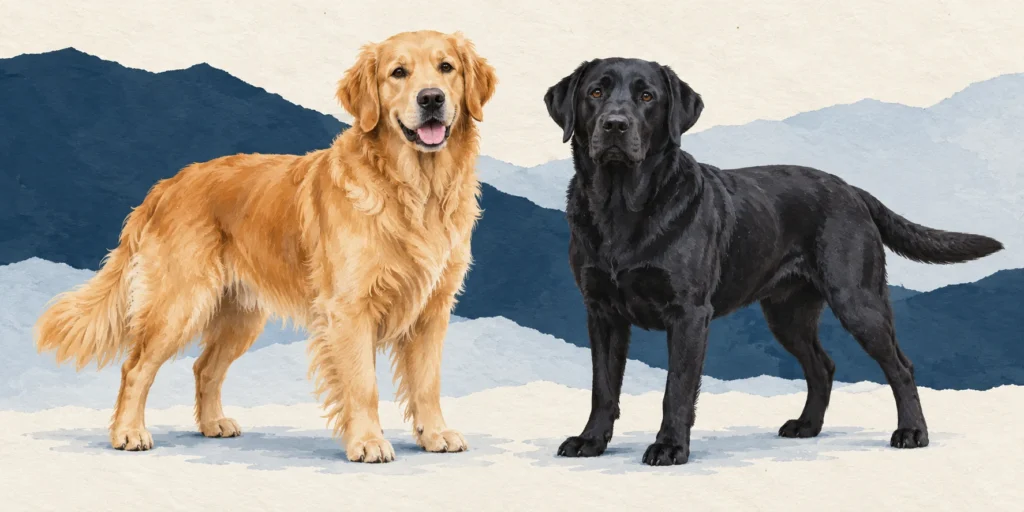
A Golden Retriever has a feathered, flat or wavy coat; a Labrador has a short dense coat and thick unfeathered tail. Both are active retrievers, with overlapping sizes and individual needs.
A Golden Retriever has a flat or wavy coat with feathering; a Labrador Retriever has a short, dense coat and a thick, unfeathered “otter” tail. Their recognised colours and coat-care routines differ, but size overlaps. Both are active retrievers: choosing the shorter coat does not remove the need for exercise, training and attention. [1][2][3][4]
The height figures describe UK breed-standard ideals, measured at the withers—the top of the shoulders. They are not a promise about an individual puppy’s eventual size, and a dog outside a quoted range is not automatically a different breed. [1][2]
Why a yellow Labrador is not a Golden Retriever
A pale yellow Labrador can be close to a cream Golden Retriever in colour. Look at the coat’s structure and tail instead: a Labrador’s short coat lacks the Golden’s feathering. Black and chocolate are also recognised Labrador colours. These are descriptions of breed traits, not a substitute for reliable information about a dog’s parentage. [1][2]
A worked size check
Suppose a hypothetical adult male measures 57 cm at the withers. That lies within both male ranges in the table. Height alone therefore cannot answer Golden Retriever or Labrador.
If that same dog has a short, dense coat and a thick tail without feathering, those observations fit the Labrador description. A longer feathered coat would point towards the Golden description. The exercise shows how to combine clues; it does not certify a real dog’s breed from a photograph. [1][2]
Compare the routine you can actually provide
Longer feathering brings more coat work. A Labrador’s simpler brushing routine still involves shedding and regular attention. Both dogs also need an active life and opportunities to learn; grooming is only one part of the commitment. [3][4]
Suppose you enjoy long walks but can only make time for brushing on Sundays. Mark those as two separate rows in your plan. The walking row does not fill the Golden’s additional coat-care row. Choosing a Labrador may reduce that particular task, but it does not turn an active dog into a low-attention companion.
Three questions before choosing
Coat work: can you keep up with the actual dog’s brushing needs?
Daily routine: where will exercise, training and company fit?
Individual dog: what do you know about its history, behaviour and needs?
A breed description is a starting point for those questions, not a guarantee of personality. [3][4]
Check the common shortcuts
A male dog is 57 cm tall. Does that make it a Labrador rather than a Golden?
No. 57 cm sits in both quoted male standard ranges. Check coat, tail and reliable background information. [1][2]
The dog is pale cream. Must it be a Golden Retriever?
No. Yellow Labradors can be light cream. Colour alone is insufficient. [1][2]
A Labrador needs less brushing. Does that mean it needs little exercise or training?
No. Shorter coat care does not remove its need for activity, mental engagement and training. Plan for the individual dog. [4]
Frequently asked questions
Is either breed automatically the better family dog?
No comparison can guarantee that for a particular household. Socialisation, training, supervision and the individual dog matter alongside breed tendencies. [3][4]
Sources
Source pages checked on 26 October 2026. The examples and self-checks were written for this article with AI assistance and checked against the listed material.
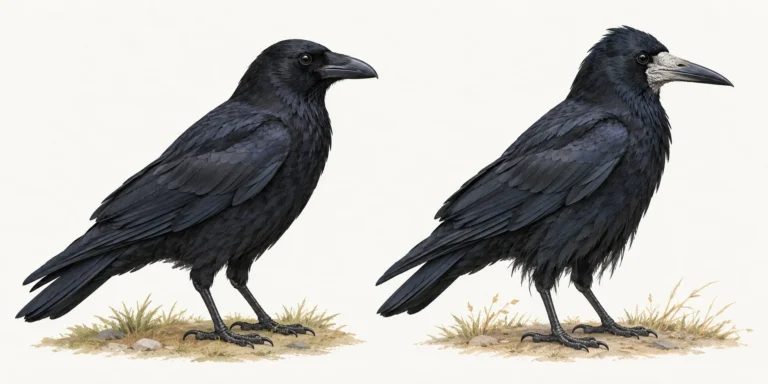
An adult rook has a pale bare patch around the base of its slimmer bill; a carrion crow has an all-black face and a heavier black bill. Young rooks and…
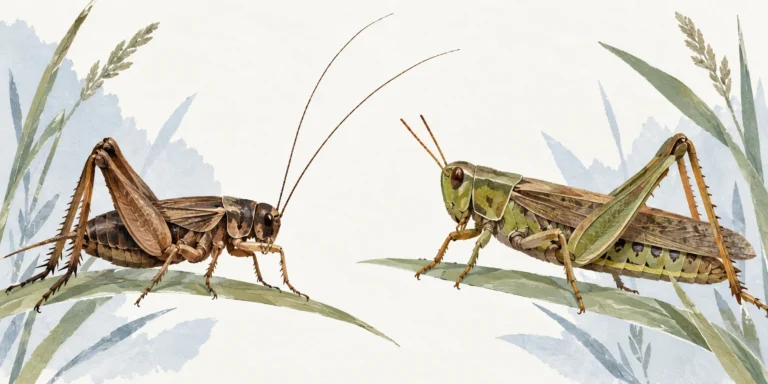
Crickets, including British bush-crickets, tend to have long antennae; grasshoppers have shorter antennae. Both jump, and colour alone is an unreliable guide.
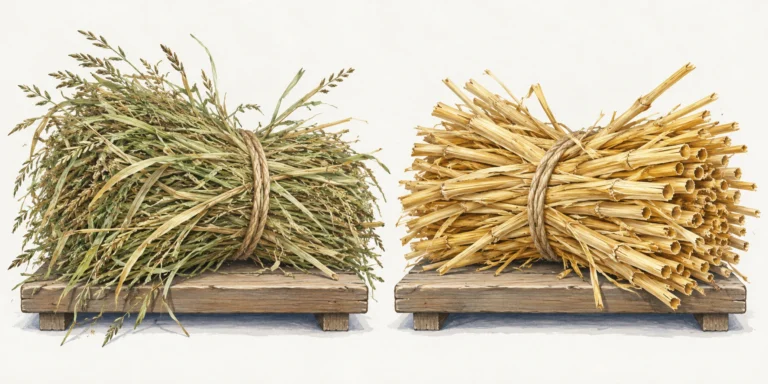
Hay is dried grass or other forage plants kept mainly as animal feed. Straw is the stalk material left from harvested cereals, often used for bedding, although it can also…