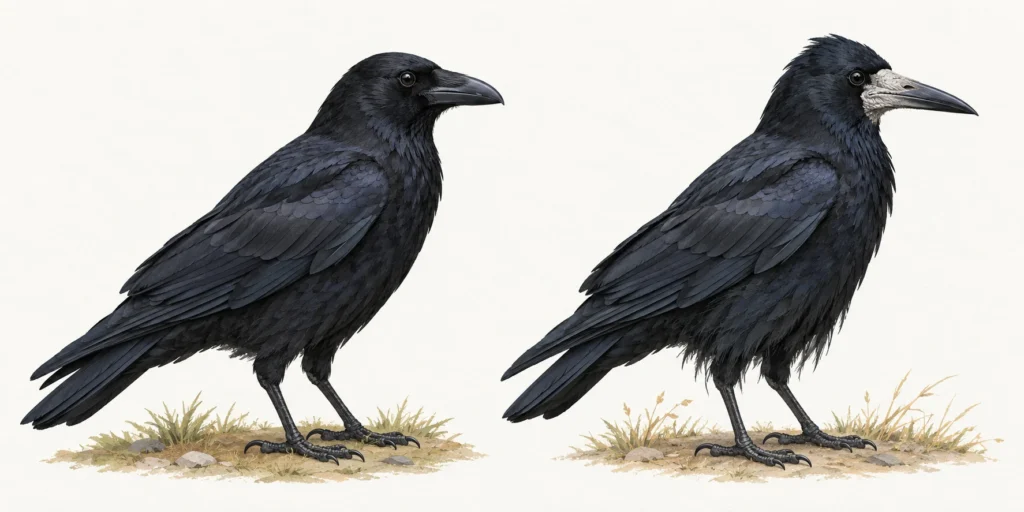
An adult rook has a pale bare patch around the base of its slimmer bill; a carrion crow has an all-black face and a heavier black bill. Young rooks and flocking behaviour need more care.
For the common British comparison, crow means carrion crow. An adult rook has a distinctive pale bare patch around the base of a slimmer, pointed bill; a carrion crow has a black feathered face and a heavier black bill. Young rooks can look more crow-like, and being alone or in a flock is only a supporting clue. [1][2][3]
Young birds can have black bills and resemble crows. [1]
Start with the bill base, not the number of birds
Imagine a black bird feeding in a field. A clear side view shows a pale bare patch where its pointed bill meets the face. That combination supports adult rook. Counting the other birds nearby adds context, but it is not the main evidence. [1][3]
Now imagine a distant photograph of a large black flock. If the faces and bills are only silhouettes, the photograph has not supplied the same clue. It would be too confident to label every bird a rook simply because there are many of them. A closer view may reveal different birds within the group.
The young-rook problem
The pale adult face is a very useful clue, but it is an age-dependent one. Juvenile rooks can have black bills and look much more like carrion crows. A black face is therefore not, by itself, enough to rule out rook. [1]
For an uncertain young bird, keep the full head and bill visible and consider their shape together with the rest of the bird. If the photograph cannot resolve those features, “crow or young rook” is a more useful record than a certain species name unsupported by the image.
An observation route for a black corvid
Clear adult face? Look for the rook’s bare pale bill-base patch.
Black-faced bird? Consider bill shape and the possibility of a young rook.
Only a silhouette or flock? Keep the identification open until better features are visible.
Social behaviour helps, but it does not override the physical evidence. [1][2][3]
Try the identification checks
A black bird is feeding alone. Must it be a carrion crow?
No. Crows are often alone or paired and rooks are usually sociable, but that is a tendency, not a conclusive rule. Look at the face and bill. [2][3]
A young bird has no pale bare face. Can I rule out rook?
No. Young rooks can have black bills and resemble crows. The adult face clue does not work equally well at every age. [1]
One bird in a group is clearly a rook. Are all the others rooks too?
Not necessarily. Identify the birds you can actually see clearly, rather than transferring one individual’s features to the whole group.
Frequently asked questions
Is a rook part of the crow family?
Yes. Rook and carrion crow are both members of that family, but they are different species. The broad family name crow is not the same as the specific name carrion crow. [1][2]
Sources
Source pages checked on 25 October 2026. The examples and self-checks were written for this article with AI assistance and checked against the listed material.
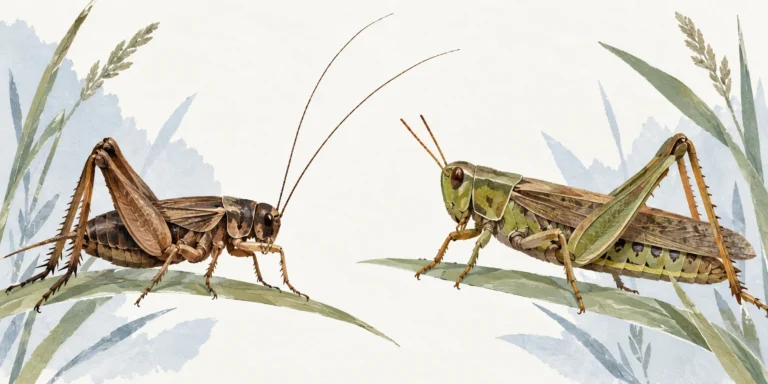
Crickets, including British bush-crickets, tend to have long antennae; grasshoppers have shorter antennae. Both jump, and colour alone is an unreliable guide.
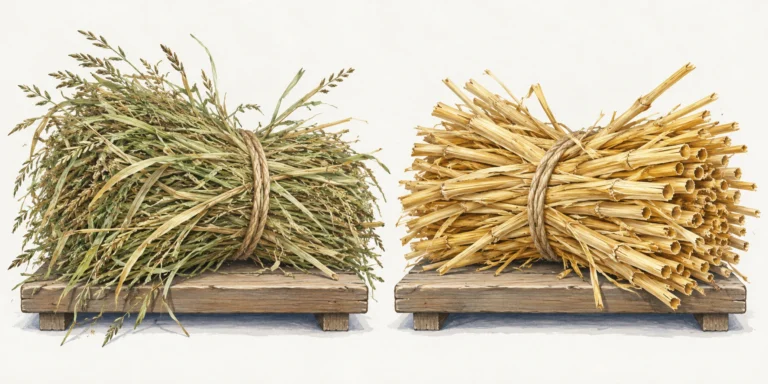
Hay is dried grass or other forage plants kept mainly as animal feed. Straw is the stalk material left from harvested cereals, often used for bedding, although it can also…
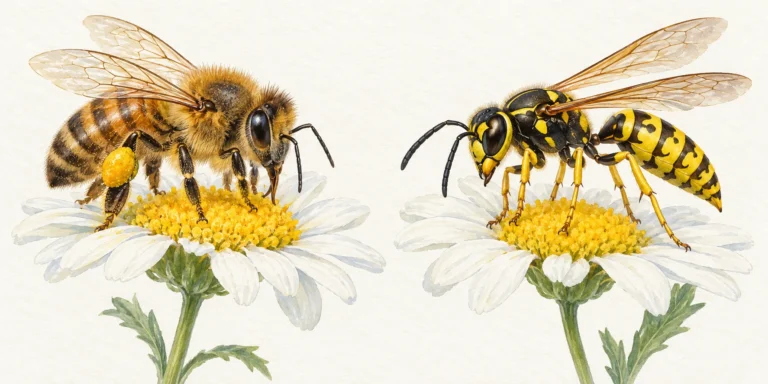
Familiar bees are usually hairier and collect pollen for their young; common social wasps are sleeker and feed their larvae mainly on other insects. Colour alone is not enough.