Mass is measured in kilograms; weight is a gravitational force measured in newtons. A 10 kg object keeps its mass on the Moon but has a much smaller weight.
Mass tells you how much material an object contains and is measured in kilograms (kg). Weight, in the scientific sense, is the gravitational force acting on that mass and is measured in newtons (N). Move an unchanged object to a place with different gravity: its mass stays the same, but its weight changes. [1][2][3]
Smaller on the Moon because surface gravity is weaker. [4]
In the equation W = mg
m is the mass, in kg.
W is weight, in N; g is gravitational field strength, in N/kg. [2]
Everyday shopping language
A quantity of goods may be described in kg.
“Weight” in trade often means mass, rather than a force stated in N. [1]
How to use W = mg
Multiply mass by the gravitational field strength for the location. The units do the checking: kg × N/kg gives N. You may also see g expressed in m/s²; a newton is equivalent to kg m/s². [2]
For a classroom example on Earth, take g = 9.8 N/kg. This is a rounded assumption for the calculation, not an exact value for every location. For the Moon, use the average surface value 1.62 m/s², equivalent to 1.62 N/kg. [2][4]
Worked example: one 10 kg object, two places
Imagine carrying an unchanged 10 kg metal block from Earth to the Moon. These are calculated values for the stated assumptions, not measurements of a real block.
Weight calculation: the mass stays at 10 kg
Earth: 10 kg × 9.8 N/kg = 98 N.
Moon: 10 kg × 1.62 N/kg = 16.2 N.
Compare: 16.2 ÷ 98 ≈ 0.165, so lunar weight is about one-sixth of the Earth example.
The object is still 10 kg in both rows. Only the gravitational force has changed. [1][2][4]
Working backwards is equally useful. If the weight is 98 N where g = 9.8 N/kg, mass = 98 N ÷ 9.8 N/kg = 10 kg. Dividing by gravity reverses the multiplication; it does not convert every number labelled “weight” into kilograms automatically.
Why does a scale display kg?
Ordinary language and physics use “weight” differently. A bag labelled 1 kg is giving a mass quantity, even when someone calls it a kilogram in weight. That wording does not turn the kilogram into a unit of force. For a physics answer, write the quantity and unit explicitly. [1][3]
Nor is the kilogram defined as “whatever has a particular weight on Earth”. Its modern definition uses a fixed value of the Planck constant. Local gravity and the definition of the mass unit are separate ideas. [3]
Check the quantity before calculating
A question gives 10 kg: is that already a force?
No. Kilograms identify mass. To calculate gravitational weight you still need g. With the example value 9.8 N/kg, the answer is 98 N. [2][3]
The block is on the Moon: should its mass become 1.65 kg?
No. That mixes up the roughly one-sixth weight ratio with mass. The unchanged block remains 10 kg; its calculated lunar weight is 16.2 N. [1][4]
The answer is 98 N: how do I recover mass?
State the gravity first. At 9.8 N/kg, divide 98 N by 9.8 N/kg to get 10 kg. At another g, the same force would correspond to a different mass. [2]
Frequently asked questions
Is there gravity on the Moon?
Yes. Its average surface gravitational acceleration is about 1.62 m/s², so objects there have gravitational weight. [4]
Does changing an object’s shape change its mass?
Not merely by reshaping it, provided material is not added or removed. [1]
Sources
Source pages checked on 20 October 2026. The examples and self-checks were written for this article with AI assistance and checked against the listed material.
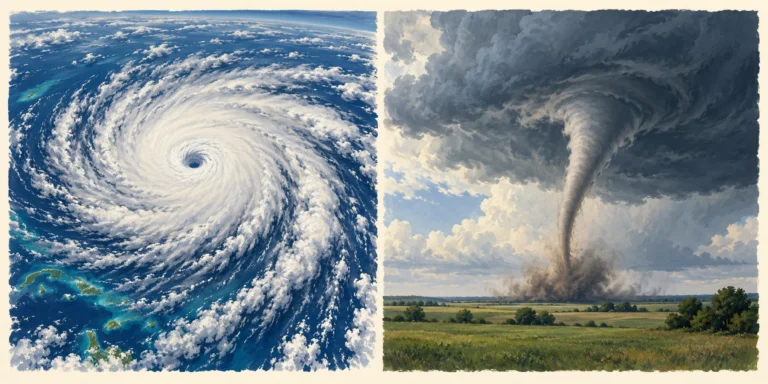
A hurricane is a large tropical cyclone that develops over warm seas; a tornado is a much smaller rotating column of air connecting a storm cloud to the ground.
Fog and mist both contain tiny water droplets suspended near the ground. In the general meteorological distinction, fog reduces visibility below 1,000 metres; mist is less obscuring.
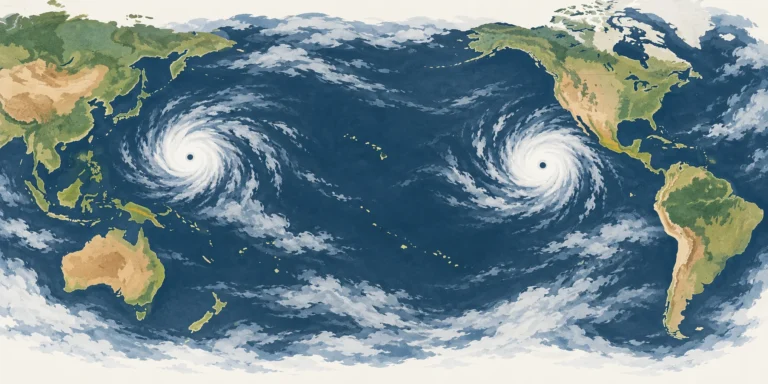
Hurricanes and typhoons are the same kind of tropical cyclone. The regional name changes: hurricane in the Atlantic and central/eastern North Pacific, typhoon in the north-west Pacific.