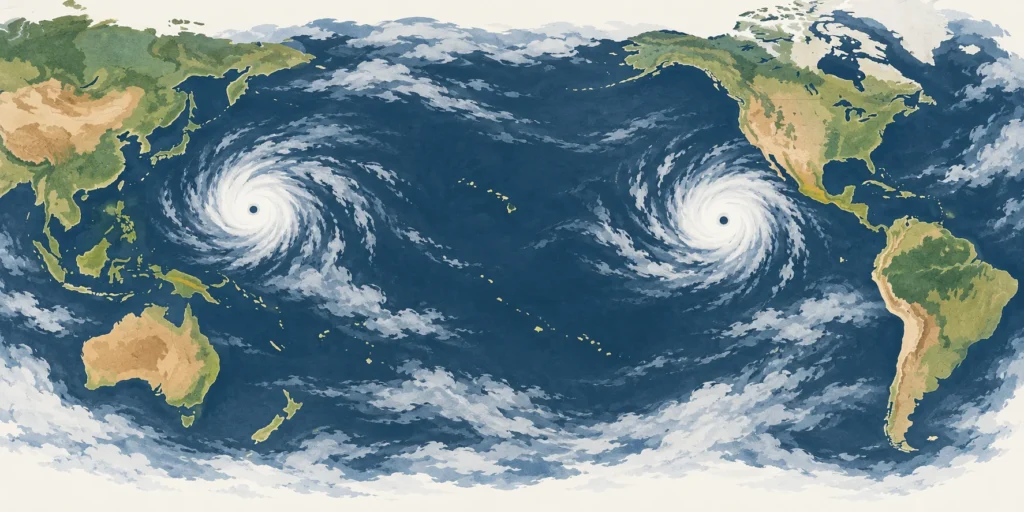
Hurricanes and typhoons are the same kind of tropical cyclone. The regional name changes: hurricane in the Atlantic and central/eastern North Pacific, typhoon in the north-west Pacific.
A hurricane and a typhoon are the same type of weather system: a strong tropical cyclone. The regional name differs. “Hurricane” is used in the North Atlantic and the central and eastern North Pacific; “typhoon” is used in the north-west Pacific. [1]
These systems develop over tropical or subtropical waters. Warm, moist air and organised thunderstorms feed a rotating low-pressure circulation. A mature cyclone can have an eye, an eyewall of intense thunderstorms and surrounding rainbands. The name on a news map does not imply a different engine inside the storm. [1][4]
In this terminology, tropical cyclone is the broad physical description. Weaker systems can be tropical depressions or tropical storms; “hurricane” and “typhoon” refer to stronger systems in their respective regions. In the Indian Ocean and South Pacific, tropical cyclone is also used in regional naming. [1][2]
One physical phenomenon, two regional labels
Tropical cyclone: identify the organised tropical weather system.
Atlantic or central/eastern North Pacific: a sufficiently strong system is called a hurricane.
North-west Pacific: a sufficiently strong system is called a typhoon.
This naming path does not estimate rainfall, storm surge or damage. [1][4]
Read sustained wind, not just the biggest gust
The familiar introductory threshold is 74 mph (about 119 km/h) in maximum sustained wind. A report of a brief gust reaching that speed does not establish that a system meets the sustained-wind threshold. It also does not establish that the storm is tropical. [1][2]
For a numerical comparison, keep the units and the reported measurement type alongside each value. If two reports use different averaging periods, do not silently treat them as identical measurements. The regional label is a naming clue; it is not a substitute for the full report.
A worked report-reading example
Take two invented reports, each explicitly describing a tropical cyclone with maximum sustained winds of 80 mph. Put the first in the Atlantic and the second in the north-west Pacific. The first fits the regional name hurricane; the second fits typhoon. Changing the name has not made the second wind figure larger. [1]
Now change the report to “a UK storm produced an 80 mph gust”. That sentence supplies neither the same measurement nor the same physical classification. You cannot turn it into “a hurricane hit the UK” simply by comparing 80 with 74. These are examples written to test the labels, not observations of actual storms.
What UK readers should make of ex-hurricanes
A cyclone moving into higher latitudes can change into an extratropical or post-tropical storm. The UK can be affected by such remnants. Separately, “hurricane force” is a wind-strength expression used in marine forecasts; it does not, by itself, identify a true tropical hurricane in British waters. [2][3]
Neither hurricane nor typhoon is a complete account of consequences. Rainfall, coastal storm surge and high waves can be important alongside wind. Compare those impacts directly rather than deciding that one regional word sounds more serious. [4]
Check the wording of three reports
Atlantic tropical cyclone, 80 mph sustained wind: which regional name?
Hurricane. The system, region and stated sustained wind fit the introductory classification. The example does not predict its damage. [1]
North-west Pacific tropical cyclone, 80 mph sustained wind: which name?
Typhoon. The same wind figure receives the other regional name; the word does not automatically mean a stronger storm. [1]
UK storm, 80 mph gust: does that prove it is a hurricane?
No. A gust is not a maximum sustained wind measurement, and hurricane-force winds do not by themselves establish a tropical cyclone. [2][3]
Frequently asked questions
Is a cyclone a third, completely different storm?
Not in this comparison. Tropical cyclone is the broad weather-system term, and is also used in regional storm naming elsewhere. [1]
Does every tropical storm have a clear eye?
Do not use a visible eye as the sole test. The eye described here is a feature of a mature system; classification also concerns the circulation and sustained winds. [1][4]
Sources
Source pages checked on 18 October 2026. The worked examples and self-checks were written for this article with AI assistance and checked against the listed material.
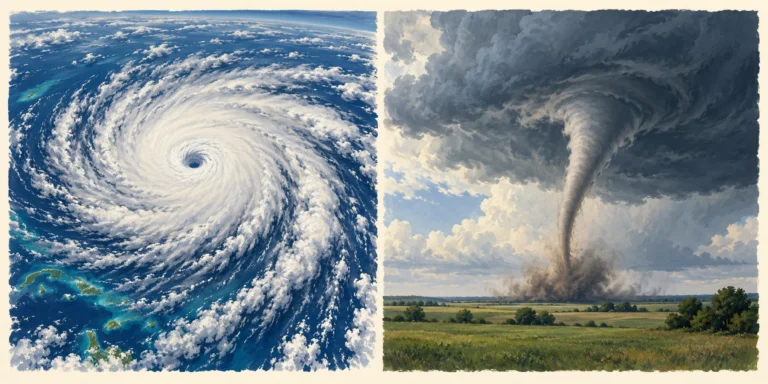
A hurricane is a large tropical cyclone that develops over warm seas; a tornado is a much smaller rotating column of air connecting a storm cloud to the ground.
Mass is measured in kilograms; weight is a gravitational force measured in newtons. A 10 kg object keeps its mass on the Moon but has a much smaller weight.
Fog and mist both contain tiny water droplets suspended near the ground. In the general meteorological distinction, fog reduces visibility below 1,000 metres; mist is less obscuring.