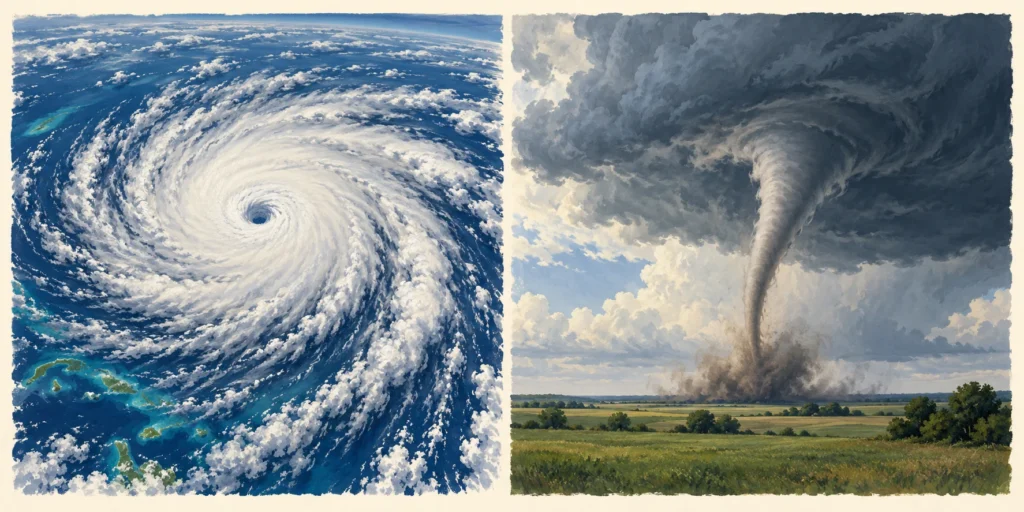
A hurricane is a large tropical cyclone that develops over warm seas; a tornado is a much smaller rotating column of air connecting a storm cloud to the ground.
A hurricane is a large, organised tropical cyclone that develops over warm seas. A tornado is a much smaller rotating column of air extending from a storm cloud to the ground. They differ in how they form, their scale and their lifespan; a tornado can even occur within a tropical cyclone. [1][2][3][4]
Often minutes; unusually long-lived examples exist. [2]
Wind terminology
At least 74 mph sustained winds for hurricane strength. [1][4]
That hurricane threshold does not define a tornado. [1][2]
Main comparison of hazards
A broad system involving wind, heavy rain and possible flooding and storm surge. [3]
Concentrated rotating winds along a much narrower track. [2]
A whole storm versus a feature within a storm
The hurricane label describes an organised tropical weather system. The tornado label describes a ground-contact circulation that develops from a storm cloud. Calling a tornado a “small hurricane” misses that distinction: reducing a hurricane’s size does not turn it into a tornado. [1][2][4]
The distinction also explains how the two can coexist. Thunderstorms associated with a tropical cyclone can produce tornadoes. The broad storm and the local rotating column are then different parts of the same weather situation, rather than competing descriptions of one object. Not every tropical cyclone produces a tornado. [3]
How a tornado can occur within a tropical cyclone
Broad system: a tropical cyclone contains extensive cloud and rain.
Storm within the system: some associated thunderstorms can develop rotation.
Possible local event: a rotating column reaches the ground as a tornado.
This is a possible relationship, not a claim that every hurricane contains a tornado. The illustration shows different viewpoints, not both phenomena drawn to the same scale. [3]
A practical example: reading a wind report
Suppose a news report mentions an 80 mph gust. That number alone does not make the event a hurricane. The hurricane threshold concerns sustained winds in a tropical cyclone, so you still need the type of weather system and the kind of wind measurement. A short peak gust and a sustained wind figure do not answer the same question. [1][4]
Now suppose another report describes a narrow rotating column beneath a thunderstorm, in contact with the ground for a few minutes. That description points towards a tornado, even if the report never uses a hurricane category. Identify the phenomenon first; do not try to classify both from one wind-speed headline. [1][2]
What the distinction means in the UK
Tornadoes do occur in the UK. Typical UK examples are relatively narrow and brief, although some have much longer tracks or cause substantial damage. Their rarity in an individual person’s experience does not make them exclusively an American phenomenon. [2]
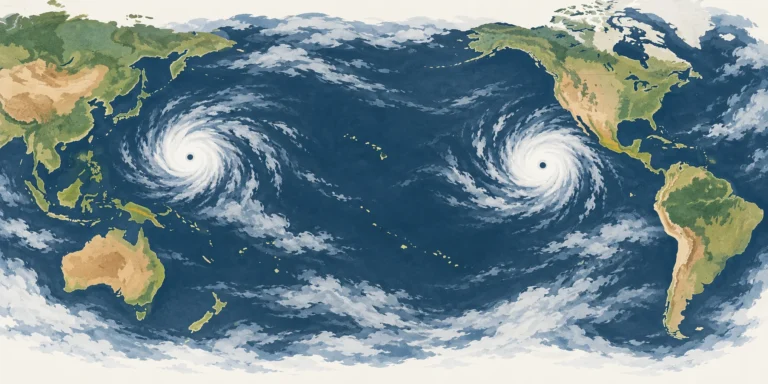
Hurricane and typhoon, by contrast, are regional names within tropical-cyclone terminology. For that naming question, see our hurricane versus typhoon comparison. It covers a different distinction from hurricane versus tornado. [4]
Check the description
Does an 80 mph gust prove a storm is a hurricane?
No. You need an organised tropical cyclone and the relevant sustained-wind figure. A gust value on its own does not supply either fact. [1][4]
Can a hurricane and a tornado occur in the same weather situation?
Yes. Thunderstorms associated with a tropical cyclone can produce tornadoes. The large cyclone and the local column remain distinct phenomena. [3]
Does being in the UK rule out a tornado?
No. UK tornadoes occur; typical examples are around 20–100 metres wide and last a few minutes, with exceptions to those usual dimensions and durations. [2]
Frequently asked questions
Which is stronger?
There is no useful universal ranking from the names alone. A hurricane describes a broad tropical system, while a tornado describes a local circulation. Compare the particular event and the hazard being discussed, rather than treating the labels as two positions on one size or severity scale. [1][2][3]
Sources
Source pages checked on 21 October 2026. The examples and self-checks were written for this article with AI assistance and checked against the listed material.
Mass is measured in kilograms; weight is a gravitational force measured in newtons. A 10 kg object keeps its mass on the Moon but has a much smaller weight.
Fog and mist both contain tiny water droplets suspended near the ground. In the general meteorological distinction, fog reduces visibility below 1,000 metres; mist is less obscuring.
Hurricanes and typhoons are the same kind of tropical cyclone. The regional name changes: hurricane in the Atlantic and central/eastern North Pacific, typhoon in the north-west Pacific.