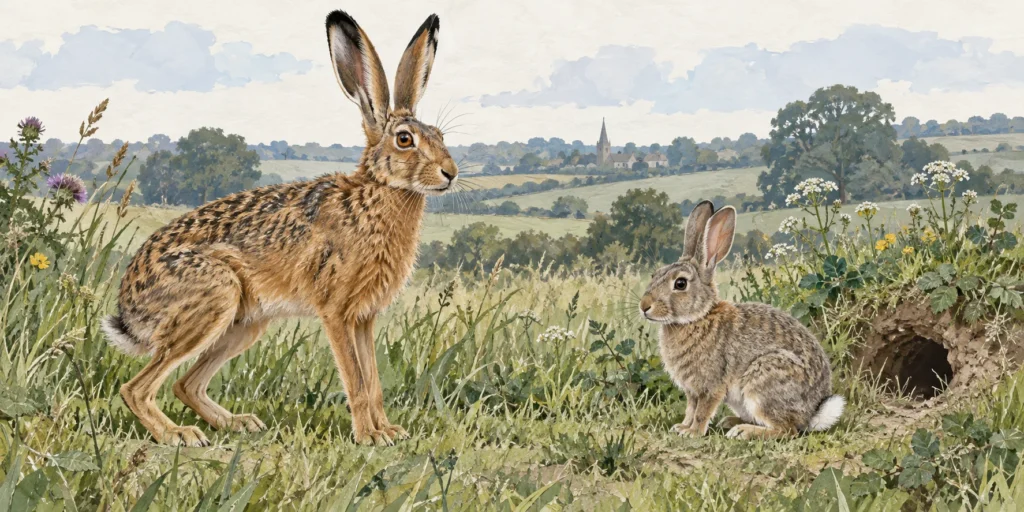
In Britain, a brown hare is usually larger and longer-legged than a European rabbit, with much longer ears ending in black tips. The rabbit has a more compact build and shorter ears. Brown hares rest above ground in shallow forms; rabbits live in underground warrens. These are different species, not adult and baby versions of the same animal. [1][2][3][4]
Here, hare means the brown hare (Lepus europaeus) and rabbit means the European wild rabbit (Oryctolagus cuniculus). Both are lagomorphs. Britain also has other hare populations, and domestic rabbit breeds can look very different, so the comparison has a defined scope. [3][4]
Brown hare and wild rabbit compared
Adult clues and contrasting ways of life
Feature
Brown hare
European rabbit
Adult outline
Usually larger, with a taller, longer-limbed frame
The useful visual contrast is the combination of ears, limbs and body shape. A brown hare’s hind legs give it a longer, more elevated outline than a typical wild rabbit. Its ear tips provide another conspicuous clue. A rabbit’s compact posture, shorter ears and white tail are useful together, rather than as a single test. [1][2]
Colour is less decisive than that combination. Both animals can look brownish in a distant photograph, and shadow can hide an ear tip. Scale is also hard to judge when an animal stands alone: a small-looking hare farther away may seem similar in size to a nearby rabbit. A closer crop cannot recover detail that the photograph never captured.
Three checks before recording a sighting
Scope: are you comparing the brown hare with a wild European rabbit?
Structure: can you see ear length and tips, limbs and body outline?
Context: does the visible behaviour support the structural clues, or are important details still hidden?
Why the shelter matters
A warren is more than a hole: it is a network of underground tunnels and chambers used by rabbits. Brown hares instead use shallow resting places at the surface. That difference helps explain why a hare may remain still in long grass and then run across open ground, while rabbits have burrows available as shelter. [1][3][4]
Social behaviour adds context but does not decide identity. Several feeding animals can be hares; a rabbit can be visible on its own. The underground-versus-surface contrast is a fact about their way of life, not an invitation to approach, flush out or investigate an animal’s shelter. [3][4]
A worked field observation
Imagine an animal at the edge of an arable field. Your photograph shows an elevated body, long hind limbs and very long ears with clear black tips. Those observations together support brown hare in this comparison. The field setting agrees with the identification, but it is the visible anatomy that makes the answer persuasive. [1][3]
A second photograph shows only a grey-brown head in grass. “It was alone” adds little: both animals may be seen alone. Record the uncertainty and look for a better view of the ears and complete outline. That is a more useful outcome than assigning a species from one weak clue.
Test three identification shortcuts
1. Several animals are feeding together: must they be rabbits?
No. Brown hares can feed in loose groups. Social behaviour supports identification but is not a universal dividing line. [3][4]
2. A furred, open-eyed newborn is a rabbit kit: does that fit?
No. That description fits a newborn leveret better. Rabbit kits are born blind and almost hairless in their burrow nest. This comparison concerns the newborn stage. [3][4]
3. A distant brown animal is visible alone: enough to decide?
No. Both colour and being alone are weak clues. Seek ear-tip, limb and body-outline detail before recording hare or rabbit. [1][2][3][4]
Frequently asked questions
Is a hare just a large rabbit?
No. The brown hare and European rabbit are different species with contrasting shelter and newborn-development patterns. Size is one clue, not their entire distinction. [3][4]
Does this ear rule identify every hare?
No. Mountain hares are a separate comparison, with different ear proportions and coat patterns. Keep the species scope when using the table. [3]
Sources
Sources checked on 14 October 2026. Worked examples and exercises were written for this article.
AI tools assisted with drafting and the featured editorial illustration. The illustration is not a photograph, a measured technical diagram or evidence of an actual test.
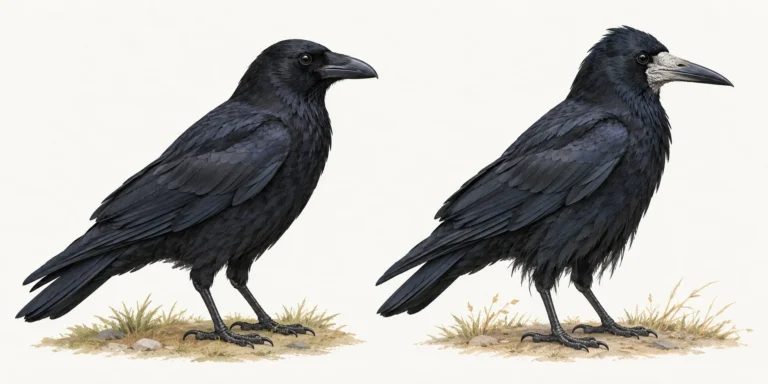
An adult rook has a pale bare patch around the base of its slimmer bill; a carrion crow has an all-black face and a heavier black bill. Young rooks and…
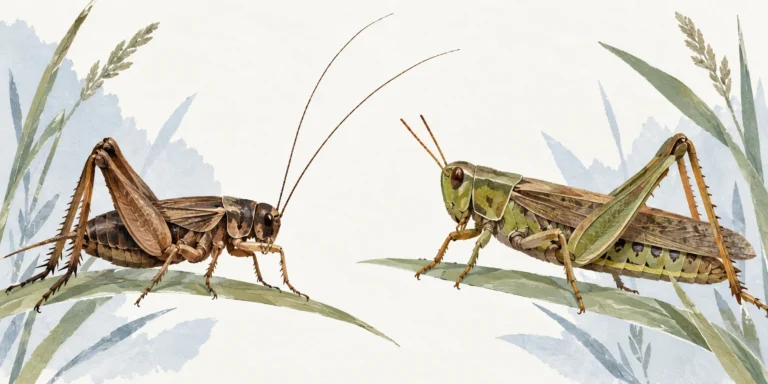
Crickets, including British bush-crickets, tend to have long antennae; grasshoppers have shorter antennae. Both jump, and colour alone is an unreliable guide.
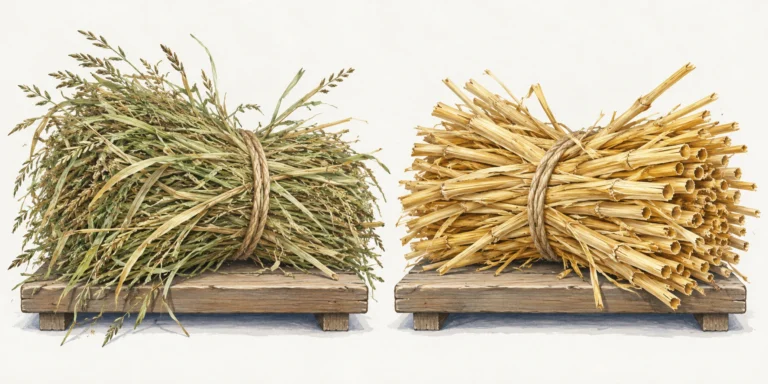
Hay is dried grass or other forage plants kept mainly as animal feed. Straw is the stalk material left from harvested cereals, often used for bedding, although it can also…