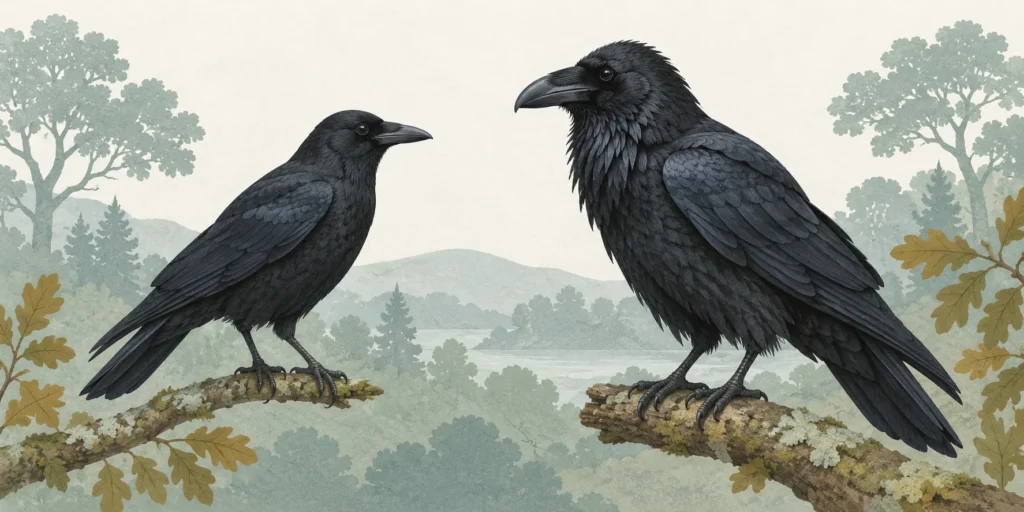
A common raven is larger and more heavily built than a carrion crow, with a thicker bill, shaggy throat feathers and a wedge-shaped tail in flight. Its voice is typically deeper. In the UK, use a combination of these clues rather than judging a distant bird by size alone.
“Crow” is an everyday name that can refer to several related birds. This guide compares the all-black carrion crow (Corvus corone) with the common raven (Corvus corax). Both belong to the crow family. A raven is therefore a member of that family, but it is a different species from a carrion crow. [3][4][5]
Crow and raven compared
Typical UK identification clues — check several together
Feature
Carrion crow
Common raven
Body length
45–47 cm
60–68 cm
Wingspan
93–104 cm
120–150 cm
Bill and head
Substantial black bill, relatively less massive
Very heavy bill and more imposing head profile
Throat
Relatively smooth-looking
Noticeably shaggy feathers, called hackles
Voice
Harsh, repeated cawing
Deep, throaty croaking
Flight clue
Often flies directly with steady wingbeats
Can soar; a wedge or diamond-shaped tail is useful
Social clue
May be alone, in pairs or in groups
May be alone, in pairs or in groups
The size ranges and call descriptions are typical identification clues, not a scale you can apply to an uncalibrated photograph. A nearer crow can appear bigger than a more distant raven. [1]
How to tell them apart in the field
Start with the bill and throat
A close side view is more useful than a brief impression of “a big black bird”. On a raven, look for a particularly heavy bill and loose-looking throat feathers. A carrion crow has a black bill too, so the colour of the bill does not decide the answer. Compare its overall proportions and throat outline. [2][3]
Try this observation routine: note what you can actually see, then separate it from what you assume. “Heavy bill and visibly shaggy throat” records two observations. “It looked fierce” records an impression and is much less useful for identification.
Wait for a view in flight
A raven’s tail can form a clear wedge or diamond when seen well. A closed, partly hidden or sharply angled tail is harder to interpret. Watch for a second pass rather than forcing a conclusion from one blurred frame. A raven often has a heavy, soaring flight, whereas a carrion crow’s flight is typically more direct and level. [2][3]
Listen before moving closer
A deep croak supports a raven identification; a familiar harsh caw points towards a carrion crow. Listening is particularly useful when the bird is backlit. Compare real call recordings as well as written descriptions: words are a memory aid, not a complete account of every sound either bird makes. [1]
Where the UK context changes the answer
In much of England and Wales, an all-black crow in a park, garden or field may be a carrion crow. In the north and west of Scotland and in much of Ireland, the grey-and-black hooded crow becomes important. Hybrids can occur where their ranges meet. Treat a grey-bodied crow as a different identification question rather than squeezing it into an all-black crow-versus-raven comparison. [4]
Habitat can support your judgement, but it cannot replace the bird’s features. Ravens occur beyond remote cliffs and uplands; they also use farmland and sometimes cities. “I saw it in a town” is not enough to rule a raven out. [3]
Other black birds to rule out
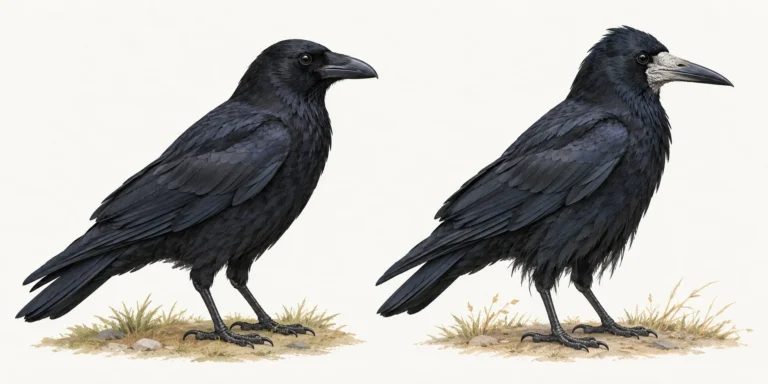
An adult rook has a pale, bare area at the base of its bill. A young rook does not show that adult feature so clearly. A jackdaw is smaller, with a greyish nape and pale eyes. If the bird does not fit either column in the table, broaden the comparison. [1]
A frequently repeated shortcut says that a single bird is a crow and a group contains rooks. That is too rigid: carrion crows can form groups, and ravens occur in pairs or larger gatherings. Social behaviour is supporting evidence, not a species label. [1][2][3]
Test your identification reasoning
The useful skill is deciding which clues deserve confidence. The exercise below includes one sighting where the right answer is to leave the bird unidentified.
Practise reading the clues
These are hypothetical sightings. Pick the best interpretation, then check the explanation. One clue alone cannot confirm a real bird.
A practical checklist for your next sighting
Record the place and view. Was the bird perched, flying, close or distant?
Check at least two clear features. Bill, throat, tail and voice usually tell you more than colour alone.
Consider the alternatives. A rook, jackdaw or hooded crow may explain a feature that does not fit.
Keep uncertainty in the record. “Unidentified corvid” is more accurate than a confident guess from a poor view.
For example, a hypothetical bird on a nearby fence with a smooth throat and familiar caw could reasonably suggest a carrion crow. A distant black dot above a hill offers far less evidence, even if the setting feels like raven country. You do not need to approach a bird or its nest to collect a better observation.
Common questions
Is a raven a type of crow?
It belongs to the crow family, but the common raven and carrion crow are separate species. Using their scientific names removes the ambiguity in the everyday word “crow”.
Are ravens always larger?
The typical species size ranges are clearly different. The difficulty is judging the size of a live bird at an unknown distance. Compare proportions and other features rather than relying on apparent size.
Can I identify one from a photograph?
A sharp photograph with a clear bill, throat or open tail may be useful. A blurred silhouette or an image without a reliable sense of scale may not settle the question. The stylised image at the top of this article is illustrative; use detailed photographs when identifying a real bird.
Sources
The linked source pages were reviewed on 3 October 2026. The exercises and worked examples on this page were written for this article.
An adult rook has a pale bare patch around the base of its slimmer bill; a carrion crow has an all-black face and a heavier black bill. Young rooks and…
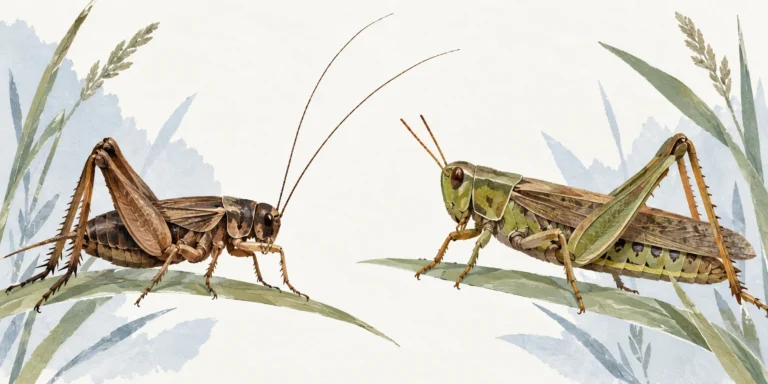
Crickets, including British bush-crickets, tend to have long antennae; grasshoppers have shorter antennae. Both jump, and colour alone is an unreliable guide.
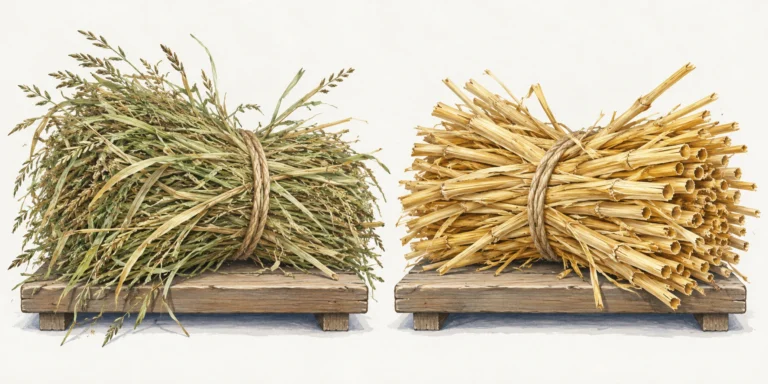
Hay is dried grass or other forage plants kept mainly as animal feed. Straw is the stalk material left from harvested cereals, often used for bedding, although it can also…