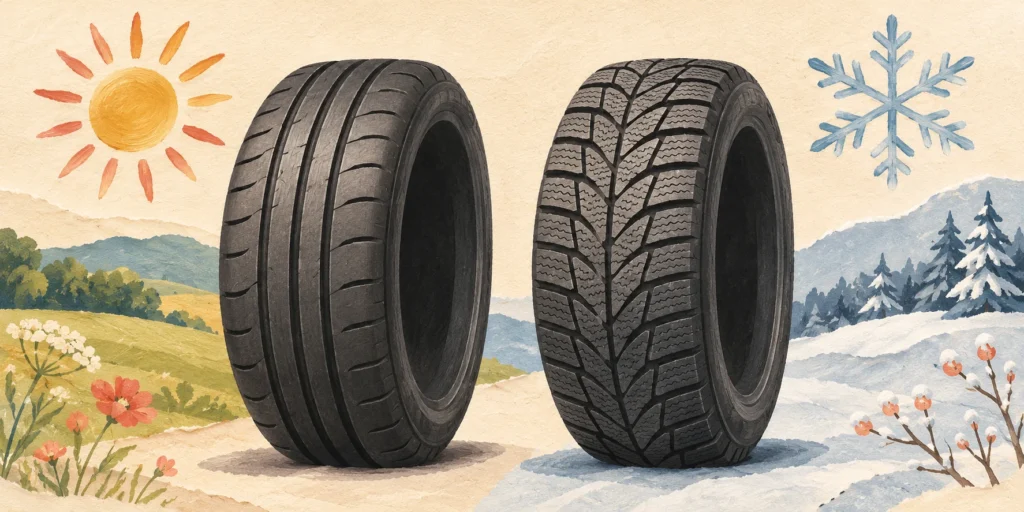
Motoring & TransportSummer tyres vs winter tyres: what’s the difference?
Summer tyres are designed for warmer conditions, including warm wet roads. Winter tyres use compounds and tread designs intended for cold conditions, including snow and ice. The distinction is about operating conditions, not simply whether it is raining or which month it is.
The difference at a glance
Summer tyres are designed for warmer conditions, including warm wet roads. Winter tyres use compounds and tread designs intended for cold conditions, including snow and ice. The distinction is about operating conditions, not simply whether it is raining or which month it is. [1][2]
The main differences
Summer tyres and winter tyres compared
| Feature |
Summer tyres |
winter tyres |
| Design emphasis |
Warm dry and wet roads |
Cold conditions, including snow and ice |
| Rubber compound |
Chosen for warmer operating conditions |
Formulated to retain useful flexibility in the cold |
| Tread design |
Typically larger blocks and fewer fine cuts |
Typically more fine cuts, called sipes |
| Wet weather |
Summer does not mean dry-only |
Winter does not mean snow-only |
| Other requirements |
Correct vehicle specification, pressure and condition still matter |
Correct vehicle specification, pressure and condition still matter |
The compound matters as well as the tread
The tyre’s rubber formulation and tread pattern work together. Winter tyres typically have more fine cuts in the tread blocks and compounds that remain suitable for cold conditions. Summer designs favour warmer-road use. You cannot establish a particular tyre’s suitability from a stylised picture of its grooves alone. Read the manufacturer’s actual tyre description and the requirements for the vehicle. [1]
Winter tyres are not only for visible snow
Cold wet roads and cold dry roads are part of the seasonal comparison, alongside snow and ice. Conversely, summer tyres are designed to handle wet roads in warm conditions as well as dry ones. “It rains here” therefore does not by itself identify the correct seasonal category. The practical question combines temperature, likely surface conditions and the type of journeys involved. [1][2]
How to understand the 7°C rule of thumb
A temperature around 7°C commonly appears in seasonal tyre guidance as an orientation point for considering winter versus summer use. It is not a universal laboratory crossover for every tyre, surface and manoeuvre. Treat it as a prompt to review the expected conditions, not as proof that one type always outperforms another at one exact temperature. This article provides no invented stopping-distance percentages or comparative test results. [2]
A worked comparison of two journeys
Consider two fictional drivers preparing a tyre discussion. One expects repeated early starts on cold upland roads; the other mainly expects milder urban trips. The first driver’s notes should emphasise persistent cold and possible snow or ice. The second driver’s notes should describe the actual local conditions rather than assuming that winter automatically means snow every day. Neither example supplies a fitment decision: both still need the tyre specification and vehicle requirements checked.
Where all-season tyres fit
All-season tyres combine characteristics from summer and winter designs. They form a third category, not simply another name for a winter tyre. Their role depends on conditions and the particular product. A decision about switching sets should therefore compare the relevant options rather than treating the choice as only two names. No single category cancels the need to maintain pressure, inspect condition and check tread. [1][2]
Prepare a useful specification checklist
Before discussing a change with a competent tyre fitter, bring the vehicle model, the tyre information specified for it, your usual journey conditions and any planned travel. Ask the fitter to confirm compatibility and suitable fitment for the vehicle. This general comparison does not specify a tyre size, pressure, speed rating or fitting arrangement for your car. It also does not cover the changing legal requirements of countries you may travel through.
Separate design intent from a safety guarantee
A seasonal tyre is designed for a range of conditions; it does not make every road safe. Its condition and correct use remain material. Avoid judging a tyre only from the season printed in a catalogue or a temperature seen once on a dashboard. Record the conditions you actually expect and use current vehicle and tyre instructions for the final choice. [2]
Try the distinction
It is raining on a warm day. Does that automatically mean winter tyres?
No. Summer tyres are designed for wet as well as dry roads in warmer conditions. Rain alone does not answer the seasonal question.
The forecast reads exactly 7°C. Is that a precise performance switch?
No. It is an orientation point in seasonal guidance, not a universal result for every product and surface.
Does choosing winter tyres remove maintenance checks?
No. Pressure, condition and tread still need attention. Use the vehicle’s instructions and suitable tyre advice for the actual fitment.
Frequently asked questions
Are winter tyres the same as all-season tyres?
No. All-season tyres combine characteristics of summer and winter designs. [1]
Can I choose purely by looking at tread?
No. Compound and vehicle compatibility also matter. A picture is not a product specification. [1]
Does this comparison recommend a tyre for my car?
No. It explains categories. The vehicle specification, actual product and expected conditions must be checked for a fitting decision.
Sources
Source pages checked on 22 November 2026. Fictional examples and self-checks were written with AI assistance and checked against the listed material.
- Tyre types: summer, winter and all-season designs — Continental.
- Winter motoring: seasonal types and maintenance — TyreSafe.
The featured image is an AI-generated editorial illustration, not a photograph, measurement or record of a study.