Automatic vs manual: what’s the difference?
In a conventional manual car, the driver selects gears and operates a clutch pedal. An automatic manages transmission changes without a driver-operated clutch pedal. Some automatics also offer manual gear selection.
In this comparison
The main differences
| Feature | Automatic | manual |
|---|---|---|
| Gear selection | Managed automatically in normal automatic operation [1] | Selected by the driver [1] |
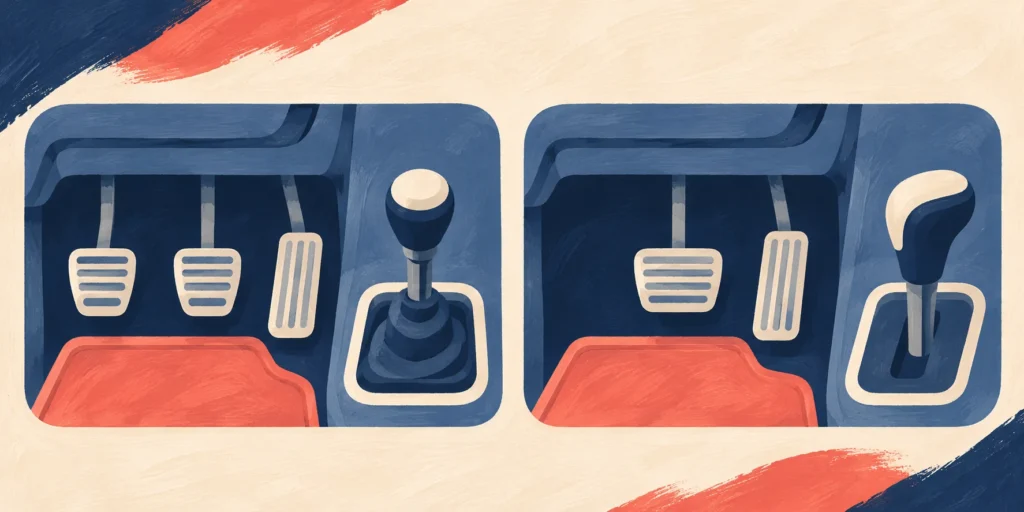
| Usual pedals | Brake and accelerator; no clutch pedal [2] | Clutch, brake and accelerator [2] |
| Main selector | Commonly P, R, N and D [2] | Gear positions selected with a gearstick [1] |
| Driver-selectable gears | May be available without a clutch pedal [1] | Part of the conventional control arrangement [1] |
Compare the controls before the mechanism
This guide concerns ordinary passenger-car transmission controls. Automatic is an umbrella description: torque-converter, dual-clutch and automated-manual designs do not all work identically. A continuously variable transmission varies its ratio rather than shifting through a conventional set of fixed gears. [1]
Why a manual mode does not make a car a conventional manual
Consider an invented car listing: “automatic, with paddles for gear selection”. The paddles describe an additional driver input. They do not, by themselves, imply a foot-operated clutch. In this comparison, the key question is whether the driver must coordinate the clutch pedal with gear selection. [1]
Read a listing without filling in the gaps
For a fictional comparison sheet, use separate rows for transmission type, clutch pedal and optional manual mode. If a listing only says “automatic”, you have not yet identified its exact mechanism. If it says “manual mode”, you have not established that it is a conventional manual. Ask for the precise specification before making either assumption.
Try the distinction
Three usual pedals: clutch, brake and accelerator. Which layout is illustrated?
A conventional manual. The featured illustration places that arrangement on the left; the automatic’s two-pedal arrangement is on the right. [2]
Two pedals plus gear-selection paddles: must that be a manual?
No. Driver-selectable gears can coexist with automated clutch operation. The absence of a clutch pedal matters to this controls comparison. [1]
Does every automatic change between fixed gears?
No. A continuously variable transmission changes its ratio without the conventional fixed-gear steps. “Automatic” does not identify a single internal design. [1]
Frequently asked questions
Does no clutch pedal mean no clutch anywhere inside?
No. Some automatic mechanisms contain clutches. Driver controls and internal components are different questions. [1]
Does the transmission name establish purchase or running costs?
No costs are calculated here. This article identifies control layouts; it does not price a particular car or predict its fuel use.
Sources
Source pages checked on 25 November 2026. Fictional examples and self-checks were written with AI assistance and checked against the listed material.
- Automatic, Semi-Automatic, and Manual Cars Compared — AA Cars.
- Automatic Driving Lessons: What’s the difference between a manual and an automatic? — AA Driving School.
The featured image is an AI-generated editorial illustration, not a photograph, measurement or record of a study.