Retinal and retinol are different retinoids: retinal is one conversion step closer to retinoic acid. Compare ingredient names, percentages and real UK formula examples.
Retinal and retinol are different members of the retinoid family. Retinal—also called retinaldehyde—is one conversion step from retinoic acid; retinol is two steps away. That explains the chemical distinction, but does not make the percentages on two finished products an automatic measure of equal results. [2][3][4]
Starting at retinal leaves one of these steps; starting at retinol leaves two. This is a pathway diagram, not a scale showing how quickly a finished skincare product works.
Laboratory work with removed human skin and cultured cells found retinoic acid after exposure to both retinol and retinal. It also found other metabolites, including conversion of retinal back to retinol. Real metabolism is more complex than a one-way arrow. [4]
Counting arrows does not establish “twice as effective” or “ten times faster”. To assess a claim about results, you would need evidence for the finished formula, the outcome measured and the comparison actually made. An ingredient pathway alone does not provide those details.
A concrete UK label comparison
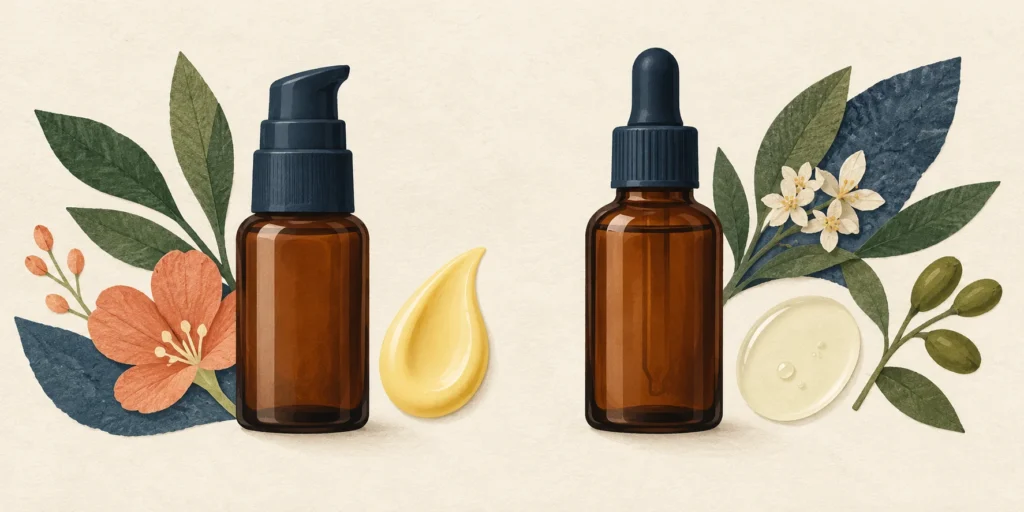
Consider Retinal 0.2% Emulsion and Retinol 0.2% in Squalane. The first lists retinal and water and is described as an emulsion. The second lists retinol and squalane and is water-free. Their shared number does not make them the same ingredient or the same formulation. [1][5]
This example is useful when reading a product label: record the ingredient, then the percentage, then the complete formula and its directions. It does not recommend either product for your skin or turn one brand’s formats into a rule for every retinoid.
What a percentage calculation can tell you
For a fictional label that explicitly states a percentage by mass, 0.1% means 0.1 g of the named ingredient per 100 g of product. A second formula labelled 0.3% by mass contains 0.3 g per 100 g. The arithmetic gives three times the named ingredient mass in an equal mass of product; it does not give three times the effect, especially when the ingredients differ.
Check your label-reading logic
1. The ingredient list says retinaldehyde. Is that a third ingredient?
No. Retinaldehyde is another name for retinal. Retinol is the different name in this comparison. [2][3]
2. Both real example products say 0.2%. Are they identical?
No. One names retinal in an emulsion; the other names retinol in a water-free squalane formula. The number does not erase those differences. [1][5]
3. Does one conversion step prove a product works twice as quickly?
No. A step count describes the simplified pathway. It supplies neither a time measurement nor a finished-product outcome comparison.
Frequently asked questions
Does “retinoid” mean only retinol?
No. Retinoid is the wider family term; retinal and retinol are members of it. [2]
Can this comparison tell me which product suits a skin condition?
No. It explains ingredients and labels. Individual treatment and suitability require a separate assessment.
Sources
Sources checked on 9 October 2026. Worked examples and exercises were written for this article.
AI tools assisted with drafting and the featured editorial illustration. The illustration is not a photograph, measurement or test result. Claims were checked against the linked sources; no independent human expert review is claimed.
Eau de toilette is generally a lighter fragrance expression; parfum names a more concentrated one. Compare the actual version as well as the label: a shared line name does not…
BIAB is a branded builder-gel system used to add structure. An ordinary gel-polish manicure mainly adds colour. Builder gel and colour gel can be used together.
A jacket is usually a shorter upper-body garment; coat is a broader outerwear term that includes long and short styles. Length is a useful clue, but neither word guarantees warmth…