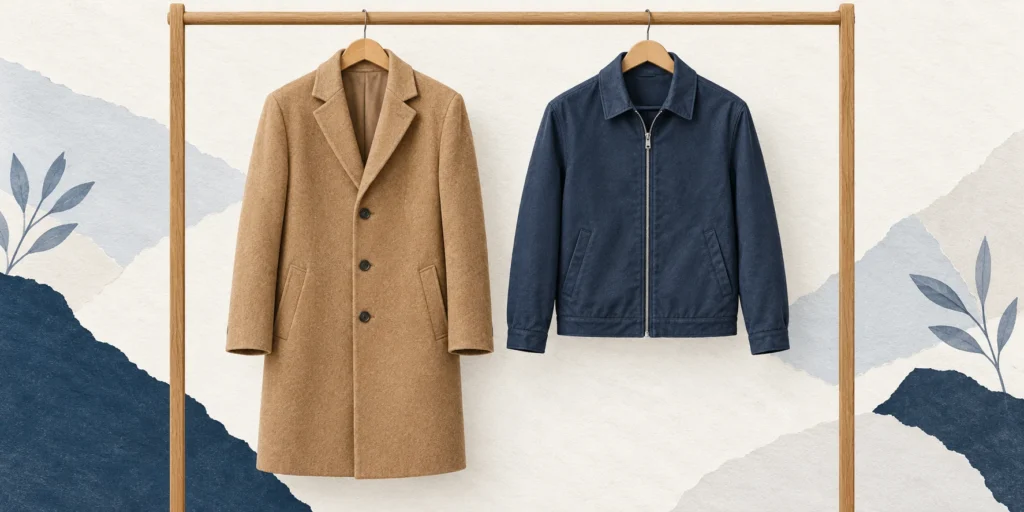
A jacket is usually a shorter upper-body garment; coat is a broader outerwear term that includes long and short styles. Length is a useful clue, but neither word guarantees warmth or weather protection.
In everyday British English, a jacket is usually a shorter garment covering the upper body, while coat is a broader outerwear term that can include both long and short styles. A long overcoat versus a short casual jacket is a clear contrast, but there is no universal hemline that separates every coat from every jacket. [1][2]
A word meaning does not supply a warmth or waterproof rating.
The same limit applies: inspect the actual garment’s specification.
Length is a clue, not a rule in centimetres
A knee-length overcoat beside a waist-to-hip-length casual jacket makes the distinction easy to see. The difficulty comes when you turn that example into “all coats are long”. Short coats are part of ordinary usage too. Treat length as a useful description of the garment in front of you, rather than a naming law. [1][2]
For example, you might describe an item as “a short wool coat” or “a denim jacket”. Those descriptions add information that coat or jacket alone leaves out. A request for a longer hem is more precise than assuming that every item in a coat category will provide the coverage you mean.
A jacket can be tailored as well as casual
A jacket can be worn over a shirt as part of a smart outfit. The word does not limit you to a zip-up casual outer layer. In British usage, a suit jacket is familiar; coat used for that part of a suit is associated with North American English or older British usage. [1][2]
So if someone says “bring a jacket”, the setting matters. They might mean a smart layer for an indoor event or an outdoor garment. Clarify the occasion or describe the item, instead of treating the noun as a complete dress instruction.
A worked length comparison
Suppose two hypothetical garments are measured from the same shoulder reference point to the hem. One is 85 cm long and the other 60 cm. The first extends 25 cm farther in that measurement:85−60=25.
That comparison tells you about length. It does not tell you which will fit your body, how either is insulated or whether the fabric is intended for rain. The numbers are invented to show the measurement, not taken from a product test. Compare the same measurement method before using two length figures side by side.
Describe the garment before relying on the label
Name: coat or jacket gives the broad clothing idea.
Coverage: add the actual length and where the hem sits on you.
Construction: check material, lining and stated features.
Context: explain whether you mean smart dress, everyday outerwear or a specific weather task.
Check the clothing shortcuts
Must every coat be longer than every jacket?
No. Coats may be long or short. The usual contrast is helpful, but there is no universal length boundary for all styles. [1][2]
Does jacket always mean a casual outdoor layer?
No. A jacket can be part of a smart outfit over a shirt. The occasion and garment description matter. [2]
Our 85 cm garment is 25 cm longer than our 60 cm garment. Does that prove it is warmer?
No. That subtraction compares length only. It supplies no information about insulation, fabric or a tested warmth rating.
Frequently asked questions
Is it wrong to say suit coat?
Not universally. That sense is used in North American English and is old-fashioned in British English. In a contemporary British conversation, suit jacket is the clearer everyday wording. [1][2]
Sources
Source pages checked on 23 October 2026. The examples and self-checks were written for this article with AI assistance and checked against the listed material.
Eau de toilette is generally a lighter fragrance expression; parfum names a more concentrated one. Compare the actual version as well as the label: a shared line name does not…
BIAB is a branded builder-gel system used to add structure. An ordinary gel-polish manicure mainly adds colour. Builder gel and colour gel can be used together.
A tuxedo is formal evening tailoring with contrasting lapel facings and matching dress trousers. In the UK it is the conventional choice for black tie.