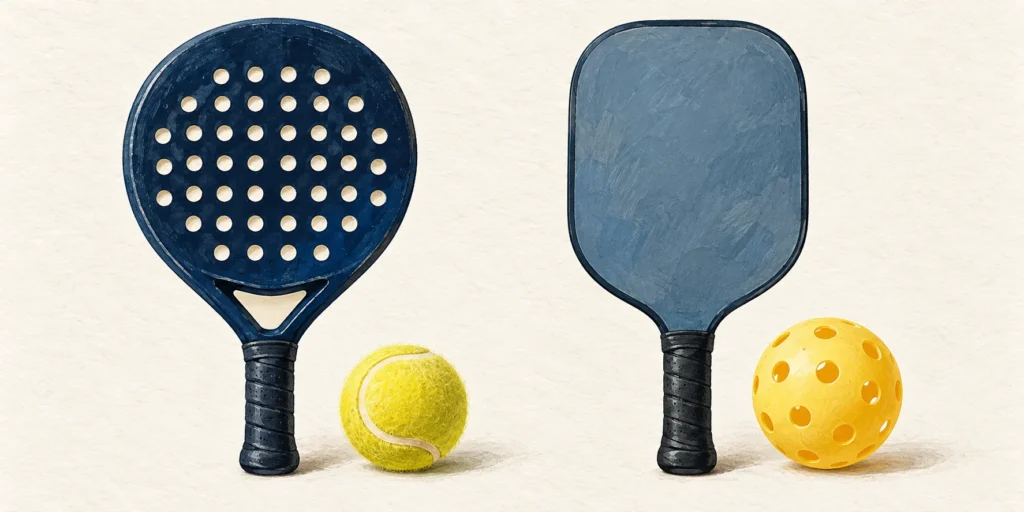
Padel uses an enclosed court with playable wall rebounds and a tennis-like ball. Pickleball uses an open court, a perforated plastic ball and a non-volley kitchen near the net.
Padel is played on an enclosed court where wall rebounds are part of rallies, using a thick perforated racket and a tennis-like ball. Pickleball uses an open court, a solid-faced paddle and a hollow perforated plastic ball. Its distinctive near-net area is the non-volley zone, often called the “kitchen”. [1][3]
In padel, a ball sent to the opponents must land in their court before touching the wall or cage. After that court bounce, a wall rebound can keep the rally alive, provided the ball is returned before its second ground bounce. Hitting the wall first is a different outcome: that shot is out. [2]
Pickleball has no such rebound-wall system. Its kitchen extends 7 ft, approximately 2.13 m, from the net on each side across the court’s width. This marked zone changes where a player can volley, rather than providing a surface for the ball to bounce off. [4]
The opening two bounces in pickleball
The serve must bounce before the receiver returns it. That return must also bounce before the serving side plays it. Only after those two required bounces may the players begin volleying, subject to the kitchen rule. A volley means hitting the ball before it bounces. [3]
The kitchen is a non-volley zone, not a blanket ban on entry. A player can enter to play a ball after it has bounced. Treating every shot from that area as forbidden would turn a specific restriction into a different rule. [3]
Two different rally-reading paths
Padel: court bounce → wall rebound → return before a second ground bounce.
Pickleball opening: serve bounces → return bounces → volleys become possible outside the kitchen.
These paths explain selected rules, not every possible fault. [2][3]
Two worked rally examples
Imagine a padel shot landing inside the opposite court, then rebounding from the back wall. A player reaches it before another ground bounce and returns it. The wall contact itself has not ended the point. Change the order to wall first, floor second, and the original shot is out. [2]
Now imagine the opening of a pickleball point. The receiver lets the serve bounce and sends it back. The serving player immediately volleys that return: this is too early, because the return needed its own bounce. Waiting for the bounce would satisfy that opening requirement. [3]
Serving and scoring are separate differences
A padel serve is underarm after a bounce and goes diagonally into the opposite service box. There are two attempts. Conventional scoring runs 15, 30, 40 and game; at deuce, a two-point advantage is needed in that format. Sets commonly run to six games with a two-game lead, with a tie-break usually at 6–6. [2]
In conventional side-out pickleball, only the serving side scores. Games commonly run to 11 with a two-point margin. At 10–10, 11–10 is not enough; 12–10 would win. These are the formats used for this comparison: check an organised session’s scoring format rather than assuming every competition uses identical arrangements. [3]
Check three first-session situations
A padel ball lands in court, then hits the back wall. Has the wall ended the rally?
No. It can still be returned before the second ground bounce. Reversing the order to wall before court would make the shot out. [2]
A pickleball receiver returns the serve. May the serving player volley immediately?
No. The return must bounce first; the serve and return each need their required bounce. [3]
May a pickleball player enter the kitchen to return a bounced ball?
Yes. It is a non-volley zone. Entering to play a ball after a bounce is different from volleying there. [3]
Frequently asked questions
Why do pickleball court widths sometimes say 6.09 m and sometimes 6.10 m?
The specified 20 ft equals 6.096 m. Different rounding produces those figures; it is not a different kind of court. This article rounds to 6.10 m. [4]
Which equipment holes belong to which sport?
For padel, look for holes through the racket face. For pickleball, look for holes in the plastic ball; the paddle face is solid. [1]
Sources
Source pages checked on 19 October 2026. The examples and self-checks were written for this article with AI assistance and checked against the listed material.
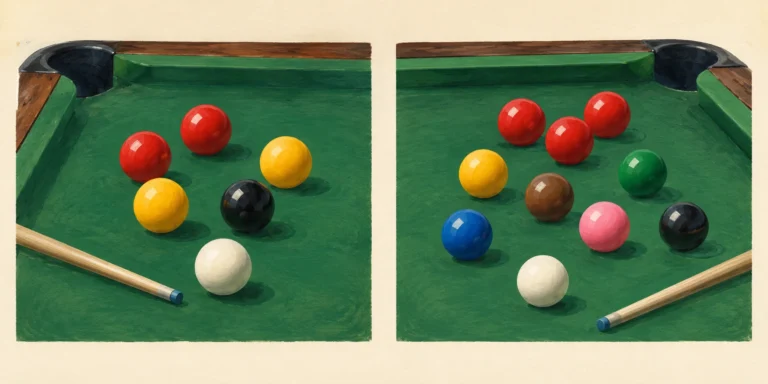
Blackball pool clears an assigned group and then the black; snooker builds a points score through reds and colours. Pool has several rule sets, so agree the version first.
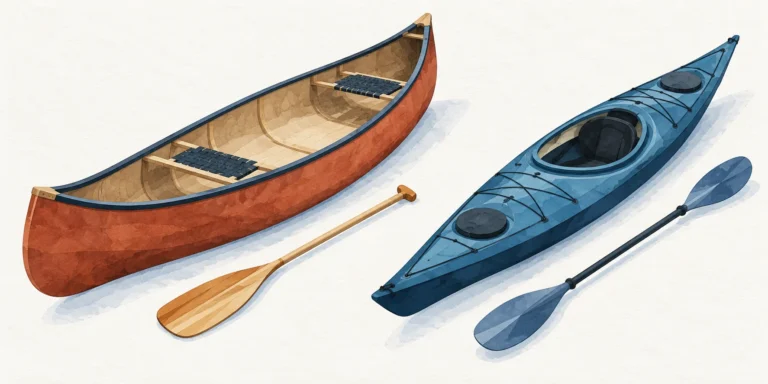
A canoe usually uses a single-bladed paddle and a kayak a double-bladed one. Sitting position and discipline help too: open tops and numbers of seats are unreliable shortcuts.