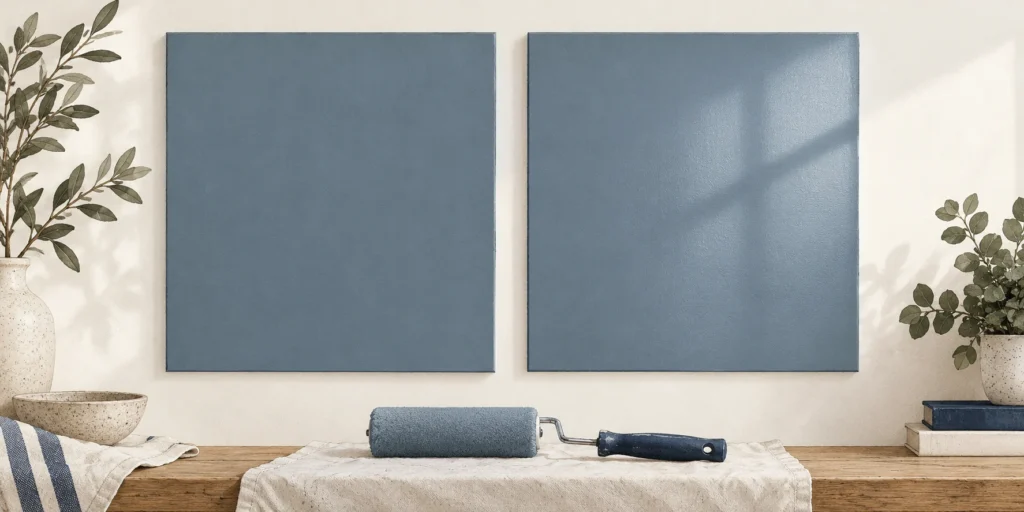
Matt emulsion gives a low-sheen finish that is more forgiving of uneven walls. Silk reflects more light. Washability depends on the product, not sheen alone.
Matt paint gives a low-sheen finish that is generally more forgiving of uneven walls. Silk paint reflects more light and has a gently polished appearance. Silk is often easy to wipe, but washable matt products also exist: sheen alone does not tell you how well a paint will clean. [1][2]
This comparison concerns water-based interior wall emulsion in the UK. “Silk” describes a finish, not fabric in the paint. It is different from choosing a gloss or satin coating for woodwork. [1]
Choose appearance and cleaning performance separately
Light reflecting from a silk wall can make an uneven patch more noticeable. Matt reduces the visual emphasis, but does not fill holes or flatten a poor repair. Inspect a sample under the room’s daylight and artificial lighting before committing to the finish. [1]
Two decisions before you choose a tin
Appearance: low sheen → matt; a gentle shine → silk.
Use: occasional marks → check the exact product’s washability and room suitability.
Surface: resolve preparation requirements before calculating paint quantity.
A washable matt can meet both a low-sheen preference and a cleaning requirement. [1][2]
For example, Dulux Easycare Washable & Tough Matt is a named UK matt product designed for washing marks away. Dulux Silk is a separate interior emulsion with a delicate shine. These are concrete product examples, not a recommendation that one brand or finish is always best. [2][3]
A worked hallway example
Suppose a hallway has 26 m² of paintable wall area after openings have been excluded. The walls have some visible repairs and occasionally need marks cleaned off. A washable matt is a sensible specification to investigate: it combines the desired low sheen with a stated cleaning function. Silk remains an option if the gentle shine is wanted. [1][2]
The named washable matt lists up to 13 m² per litre and two coats. At that maximum coverage, the calculation is: 26 m² × 2 ÷ 13 m²/litre = 4 litres. This is an ideal calculation before allowing for absorption, application losses or extra coats—not a promise that four litres will finish that actual hallway. [2]
The named silk lists up to 14 m² per litre and two coats. That different figure belongs to that product; it does not establish that every silk paint covers more area than every matt. Compare the exact tins using the same wall area and coat count. [3]
Preparation still matters
Both example products require a clean, dry surface and removal of loose or flaking material. Their application directions also allow for extra coats when the colour change is strong. Read the instructions for your existing coating and substrate before starting; a finish name does not specify the entire preparation system. [2][3]
Investigate a washable matt. It answers both requirements more directly than assuming cleaning always demands silk. Repairs still need appropriate preparation. [1][2]
2. Smooth wall and a softly reflective appearance wanted?
Silk fits the appearance brief. Check a sample in the actual light and choose a product suitable for the room. [1][3]
3. Is 26 m² ÷ 13 m²/litre = 2 litres enough for the two-coat example?
No: that is the ideal one-coat quantity. Two coats cover 52 m² in total, giving 4 litres at that maximum rate, before additional allowances. [2]
Frequently asked questions
Is silk the same as gloss?
No. Silk is a mid-sheen wall finish; gloss is substantially shinier and commonly associated with woodwork. [1]
Can I choose a bathroom paint from its finish name alone?
No. Match the exact product to the room and its conditions; matt or silk alone is not a moisture-resistance specification.
Sources
Sources checked on 10 October 2026. Worked examples and exercises were written for this article.
AI tools assisted with drafting and the featured editorial illustration. The illustration is not a photograph, measurement or test result. Claims were checked against the linked sources; no independent human expert review is claimed.
A traditional conservatory is mostly glazed; a traditional orangery has more solid roof and masonry around a glazed lantern. Modern designs can blur that distinction.
Bio detergent contains stain-targeting enzymes; non-bio does not. Compare what that means for food stains, low-temperature washing and wool-care labels.