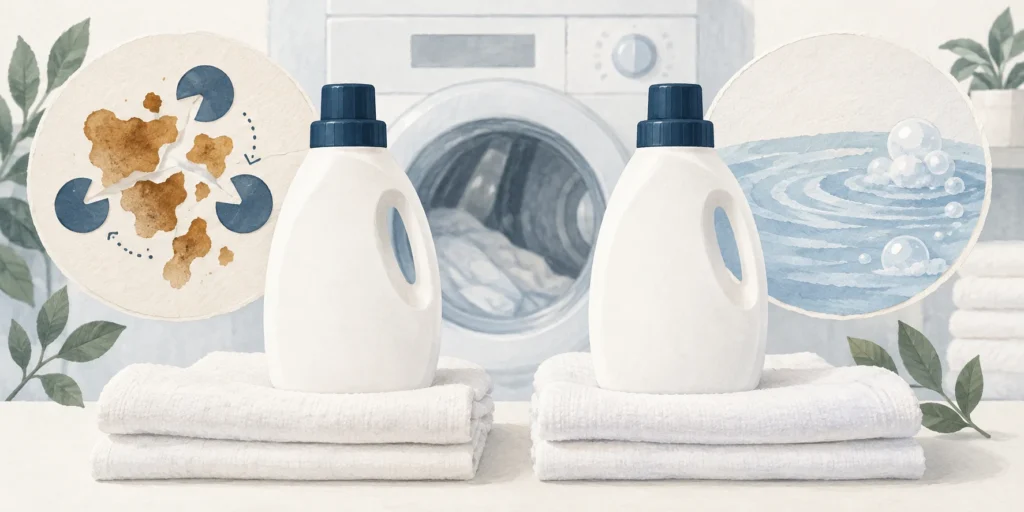
Bio detergent contains stain-targeting enzymes; non-bio does not. Compare what that means for food stains, low-temperature washing and wool-care labels.
In the UK, bio detergent contains enzymes that help break down particular stains; non-bio detergent does not contain those enzymes. Both are laundry detergents. The distinction is about the formula’s cleaning ingredients, rather than whether it is a liquid or powder, fragrance-free or suitable for every fabric.
The most useful comparison starts with two questions: what is the stain, and what is the fabric? A food stain on a cotton T-shirt and a stain on a wool jumper may need different choices even when both are going into a washing machine. [1][2][3]
Bio and non-bio compared
What the category tells you — and what needs a separate label check
Question
Bio detergent
Non-bio detergent
Contains enzymes?
Yes: this is the defining distinction
No: the formula cleans without added enzymes [1][2]
Particular stain targets
Enzymes can help break down protein, starch and fat
Does not use that enzyme action; still formulated to clean laundry [1][2]
Low-temperature washing
Enzymes can support cleaning at lower temperatures
Performance depends on the specific formula and directions [1][2]
Liquid, powder or capsule?
Bio is a formula category, separate from product format
Non-bio is also a formula category, separate from format [1][2]
Wool suitability?
Do not assume: wool-care guidance advises avoiding enzyme detergents
“Non-bio” alone does not confirm wool suitability; check both labels [3]
What the enzymes contribute
Different stain materials include protein, starch and fat. A bio formula uses enzymes to help break down these targets, which is one reason a bio product can be useful for everyday food stains and lower-temperature washing. That is a mechanism, not a guarantee that every mark disappears in every wash. [1][2]
The extra cleaning route in a bio formula
Target stain material → enzyme action → smaller breakdown products that can be removed in the wash.
This is a simplified explanation of stain breakdown. Other formula ingredients and the wash itself still matter; non-bio does not mean “no cleaning”. [1][2]
A wash result also depends on the actual product directions. Read its dosage, load and temperature guidance alongside the garment’s care label. The bio/non-bio name does not replace those instructions. [1][2]
Fabric comes before a stain-removal shortcut
Wool needs a different starting point. Wool-care guidance calls for a mild, neutral detergent and advises avoiding heavy-duty biological products, enzymes and bleach. Choosing a pack labelled non-bio answers the enzyme question, but does not by itself prove that the complete formula is appropriate for wool. [3]
A specific professional bio-liquid product examined for this comparison expressly says not to use it on wool or silk. That is a useful reminder to read an actual product’s restrictions. It does not make “non-bio” a universal permission to wash any delicate fabric. [4]
A worked laundry decision
Imagine a fictional cotton T-shirt with a food stain. Its care label allows the wash you intend, and the detergent label is suitable for the fabric. A bio formula can add enzyme action against relevant food-stain materials. Use the product’s actual dose and programme guidance; the word bio does not tell you an exact dose. [1][2]
Now change only the garment to a wool jumper. The stain still looks like food, but the fabric changes the decision: first identify a wool-suitable detergent and follow the jumper’s care label. Transferring the cotton decision merely because “food stains benefit from enzymes” would ignore the fibre restriction. [3][4]
Keep fragrance and format as separate questions
“Non-bio” describes the absence of enzymes. It does not, by itself, state that the product is fragrance-free. If fragrance absence is your requirement, check that separate wording and the product information rather than treating non-bio as an equivalent label. [1][2]
Likewise, a liquid bottle, powder box or capsule is a format. It is not the answer to the enzyme question. Compare the bio/non-bio wording and directions on the actual product before choosing the dispensing format you prefer. [1][2]
Follow the decision path
1. Cotton food stain, with compatible garment and detergent instructions?
Consider the stain target. A bio formula offers enzyme action against protein, starch and fat. Follow the stated dose and wash instructions; this does not promise complete removal. [1][2]
2. A wool jumper: does “non-bio” settle the choice?
No. Look for a wool-suitable mild detergent and follow the garment’s care label. Absence of enzymes is one relevant feature, not approval of the whole formula. [3]
3. I specifically want fragrance-free detergent. Is non-bio the same label?
No. Bio/non-bio tells you about enzymes. Fragrance-free is a separate requirement to check in the actual product information. [1][2]
Frequently asked questions
Does non-bio mean the detergent cannot remove stains?
No. It means it does not use added enzymes; it remains a laundry-cleaning formula. [1][2]
Does bio mean I must wash everything at 30°C?
No. Enzymes can help at lower temperatures, but the correct programme still depends on the garment and product directions. [1][2]
Does this article establish which detergent suits a skin condition?
No. These labels explain enzyme content and laundry use; they do not establish an individual medical recommendation.
Sources
Source pages checked on 8 October 2026. The worked examples and exercises were written for this article.
AI tools assisted with drafting and the featured editorial illustration. The illustration is not a photograph, measurement or test result. Claims were checked against the linked sources; no independent human expert review is claimed.
Matt emulsion gives a low-sheen finish that is more forgiving of uneven walls. Silk reflects more light. Washability depends on the product, not sheen alone.
A traditional conservatory is mostly glazed; a traditional orangery has more solid roof and masonry around a glazed lantern. Modern designs can blur that distinction.