The Netherlands is the country; Holland refers specifically to North Holland and South Holland, two of its twelve provinces. The wider Kingdom is another geographical distinction.
The Netherlands is the country. Holland refers specifically to North Holland and South Holland, two of its twelve provinces. People often use Holland informally for the whole country, but that is less geographically precise. The wider Kingdom of the Netherlands is a separate distinction: it contains four countries, including the Netherlands. [1][2]
No: the Netherlands is one of four constituent countries [2]
Why both names appear
The two Holland provinces have had considerable economic and cultural prominence. That helped the broader use of Holland persist, especially abroad. It explains the familiar wording without turning two provinces into the entire country. [1]
In a casual conversation, you may understand what someone means by “a holiday in Holland”. In a geographical comparison, ask which scope they intend. If they mean the country, “the Netherlands” avoids narrowing the description to only part of it.
Read the relationship as part within whole
Two provinces belong within a larger country
Holland: North Holland + South Holland.
Other provinces: ten more, including Utrecht, Groningen and Limburg.
The European Netherlands: all twelve provinces together.
The count is 2 + 10 = 12 provinces. It is not an area or population ratio. The paper illustration is an abstract part-and-whole metaphor, not a map of the actual province boundaries. [1]
This is a containment relationship, rather than two competing country names with identical boundaries. Something can belong to the Netherlands without belonging to either Holland province. Adding “North” or “South” also matters when the province itself is the information you need.
A worked country-and-province example
Imagine you are making a simple location table with separate country and province columns. For a record explicitly located in North Holland, put “the Netherlands” in the country column and “North Holland” in the province column. For a record explicitly located in Utrecht province, keep the same country but use “Utrecht” for the province. [1]
Writing Holland as the country in one row and the Netherlands in the other would obscure that shared country. Writing Holland as the province for the Utrecht record would introduce a geographical error. The example is about clear wording; it is not advice about the exact fields used by a particular booking service or official form.
The country and the Kingdom are also different scopes
The Kingdom of the Netherlands comprises the Netherlands, Aruba, Curaçao and St Maarten. The Netherlands is therefore one country within the Kingdom, rather than a synonym for all four. Bonaire, Saba and St Eustatius form part of the Netherlands itself, so the country is not confined entirely to Europe. [2]
For the original Holland comparison, keep the layers separate: two provinces, the country, and the wider Kingdom. That prevents a correction about Holland from creating a second mistake by treating every Caribbean part of the Kingdom as a Dutch province.
Choose the right geographical scope
1. Is Utrecht province outside the Netherlands because it is outside Holland?
No. It is one of the other Dutch provinces. Outside Holland does not mean outside the Netherlands. [1]
2. A table asks for the country: which of these two names is clearer?
The Netherlands. North Holland or South Holland may then be relevant if a separate province field is needed. Holland is often used broadly, but its precise geographical scope is narrower. [1]
3. Does the Netherlands mean all four countries of the Kingdom?
No. It is one constituent country. The Kingdom is the wider grouping that also includes Aruba, Curaçao and St Maarten. [2]
Frequently asked questions
Are North Holland and South Holland separate countries?
No. They are two provinces within the Netherlands. Their names distinguish parts of the country, not two independent countries. [1]
Should Holland always be treated as a misunderstanding?
No. Its broad informal use is established. The useful response is to clarify whether the conversation concerns the country or specifically the two provinces, rather than assuming the speaker means a different destination. [1]
Sources
Sources checked on 17 October 2026. The worked examples and self-checks were written for this article.
AI tools assisted with drafting and the featured editorial illustration. The illustration is not a photograph, a measured diagram or evidence of an actual test.
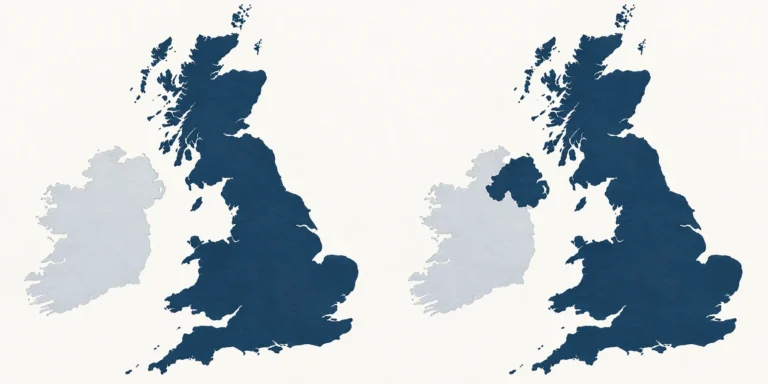
Great Britain means England, Scotland and Wales; the United Kingdom includes those three and Northern Ireland. The island of Ireland and the country Ireland are separate naming questions.
Empathy concerns understanding another person’s feelings or perspective. Sympathy expresses concern for their suffering. Both can be part of the same response.