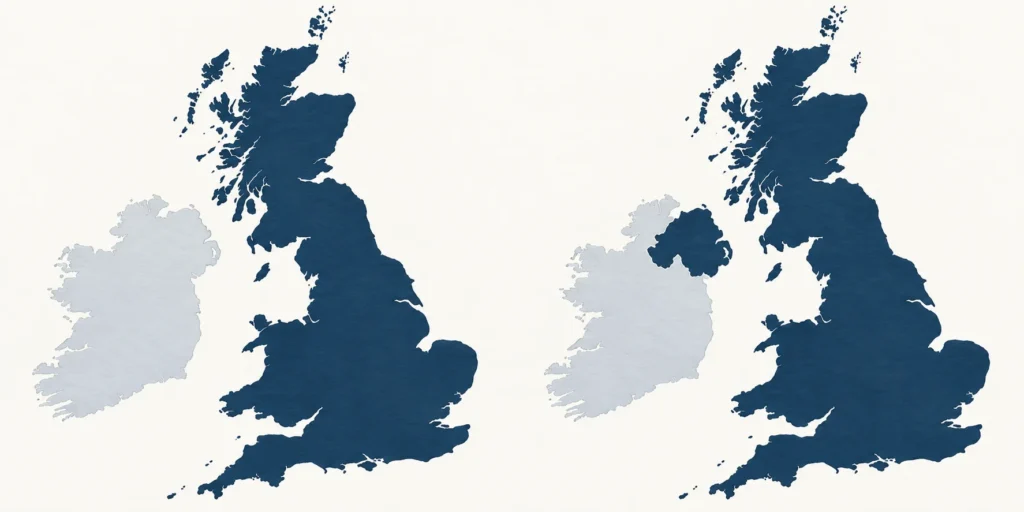
Great Britain vs United Kingdom: what’s the difference?
Great Britain means England, Scotland and Wales; the United Kingdom includes those three and Northern Ireland. The island of Ireland and the country Ireland are separate naming questions.
Great Britain refers to England, Scotland and Wales, while the United Kingdom includes those three and Northern Ireland. Great Britain is a geographical name; the UK is the sovereign state. The full state name is the United Kingdom of Great Britain and Northern Ireland. [1][2]
Great Britain is the large island containing the mainlands of England, Scotland and Wales. In collective usage, the name also covers those countries and their associated islands. That is why “Great Britain” need not mean only a single continuous piece of land in every geographical description. Northern Ireland is excluded from this grouping. [1]
The United Kingdom is a political union of four constituent parts. Calling the whole UK “England” leaves out three of them; calling it “Great Britain” leaves out Northern Ireland. Choose the scope your sentence actually needs. [1][2]
The inclusion test
England + Scotland + Wales: Great Britain, in the collective sense.
Great Britain + Northern Ireland: United Kingdom.
Ireland, the country: outside the United Kingdom.
This shows membership, not land area, population or personal identity. [1][2]
A worked example: naming the coverage of a guide
Imagine you edit a fictional guide with chapters on England, Scotland and Wales. “A guide to Great Britain” is an accurate description of that three-country coverage. Now add a fourth chapter covering Northern Ireland. “A guide to the United Kingdom” describes the expanded scope more precisely. [1][2]
If you then add a chapter on Ireland, the country, the UK heading alone is no longer enough. “A guide to the UK and Ireland” makes the additional coverage explicit. This is an editorial naming example: it does not assume that routes, administrative rules or services operate identically in every chapter.
Ireland is both an island name and a country name
The island of Ireland contains Northern Ireland and the country Ireland, often described as the Republic of Ireland when a distinction is needed. Northern Ireland belongs to the UK; the country Ireland does not. Saying only “Ireland” can therefore leave a reader unsure whether the island or the state is intended. [1][2]
For precise writing, add the words that settle the question: “the island of Ireland”, “Northern Ireland” or “Ireland, the country”. Do not replace one with another merely to shorten a caption.
Nearby islands do not all belong to the UK
Jersey, Guernsey and the Isle of Man are Crown Dependencies and are not part of the United Kingdom. A geographical grouping of islands and a state boundary are different things. [3]
“British Isles” is a wider geographical term covering Great Britain, Ireland and smaller islands. It does not make the country Ireland part of the UK, and it should not be used as a substitute for someone’s nationality or preferred identity. For this comparison, the explicit place lists above are clearer than treating a wider island-group label as a political definition. [1]
Choose the right heading
Your table covers England, Scotland and Wales only. Which heading fits?
Great Britain fits the three-country coverage. A UK heading would imply Northern Ireland is included as well. [1][2]
The same table now includes Northern Ireland. What changes?
Use United Kingdom or UK. You have added the fourth constituent part, not added the whole island of Ireland. [1][2]
A location is in Jersey. Does that make it a UK location?
No. Jersey is a Crown Dependency outside the UK. Its proximity to other islands does not change that boundary. [3]
Frequently asked questions
Does “Great Britain” mean only England?
No. Scotland and Wales are included too. The England-only shorthand changes the meaning. [1]
Can a map label tell me someone’s nationality?
A geographical label alone cannot settle an individual’s identity or status. This guide explains place names; it is not a nationality or eligibility assessment.
Sources
Source pages checked on 18 October 2026. The worked examples and self-checks were written for this article with AI assistance and checked against the listed material.
The Netherlands is the country; Holland refers specifically to North Holland and South Holland, two of its twelve provinces. The wider Kingdom is another geographical distinction.
Empathy concerns understanding another person’s feelings or perspective. Sympathy expresses concern for their suffering. Both can be part of the same response.