The difference at a glance
Antiperspirant reduces the amount of sweat reaching the skin. Deodorant controls body odour without providing that sweat-reduction function. A product labelled “antiperspirant deodorant” combines both jobs.
Antiperspirant reduces sweat reaching the skin; deodorant controls odour. Learn how combined products and packaging claims affect the choice.
The difference at a glance
Antiperspirant reduces the amount of sweat reaching the skin. Deodorant controls body odour without providing that sweat-reduction function. A product labelled “antiperspirant deodorant” combines both jobs.
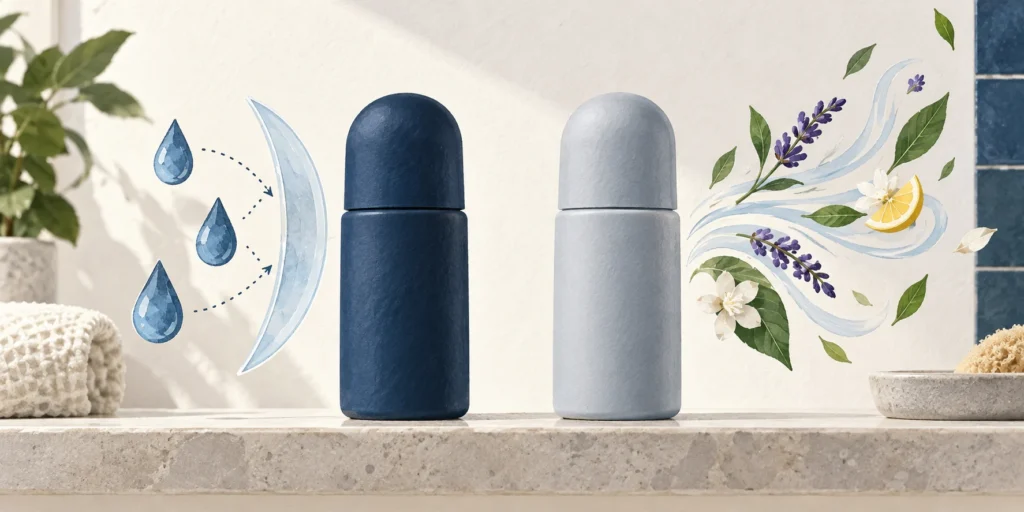
The distinction matters when the complaint is “my underarms still feel wet” rather than “I notice an odour”. A deodorant can perform its stated odour-control job while leaving perspiration unchanged. A familiar scent, spray can or roll-on ball does not tell you which function is inside. [1] [2] [3]
| Question | Antiperspirant | Deodorant without antiperspirant |
|---|---|---|
| Main target | Reduces underarm perspiration reaching the skin | Controls underarm odour [1] [3] |
| How it works | Usually aluminium salts form temporary gel plugs in sweat pores | Odour-control ingredients act on odour-causing bacteria; formulas may also use fragrance [2] [3] |
| Wetness | Has a sweat-reduction function | Does not provide sweat reduction [1] |
| Odour | Can reduce odour too; combined products explicitly offer both | This is the defining purpose [2] [3] |
| What to look for | “Antiperspirant” and sweat-protection wording | “Deodorant” and odour-control wording; read the full claim [1] [3] |
Body odour develops when skin bacteria break down substances in sweat. Sweat and an unpleasant smell are therefore connected, but they are not the same thing. Deodorant acts on the odour side of the problem; antiperspirant acts on how much sweat reaches the surface. [1] [2]
Most antiperspirants use aluminium salts. These form temporary gel plugs near the top of sweat pores, limiting the sweat released there. The effect is temporary: friction and normal skin renewal remove the plugs over time. That is different from permanently stopping the body from sweating. [2]
Deodorant formulas can control odour through ingredients that limit odour-causing bacteria, and may use fragrance to mask or change the smell. A pleasant fragrance is one part of a possible formula, rather than proof of sweat reduction. [2] [3]
Start with the full product name and function on the pack. “Antiperspirant deodorant” is not a contradiction: it describes combined sweat and odour control. For a product called simply “deodorant”, check whether additional wording also identifies an antiperspirant function.
Then separate three questions: what does it do, what form is it in, and how does its label say to use it? A spray, roll-on or stick is an application format. Sweat reduction and odour control are functions. Two products with similar-looking packaging can therefore serve different purposes.
An hour count belongs to a specific product claim. Do not assume every antiperspirant lasts the same number of hours, or that an odour-protection claim guarantees the same duration of dryness. This guide has not carried out a wear test. [3]
In this fictional example, Sam buys a roll-on whose pack says “deodorant — 48-hour odour control”. After a warm commute, Sam notices dampness and concludes the product has failed.
The missing step is checking the target: the quoted claim concerns odour, not sweat reduction. If Sam’s intended result is less underarm wetness, the relevant function to look for is antiperspirant. If the intended result is only odour control, a deodorant matches that question. The example does not predict how any real product will perform.
Open the statement that matches what you want to understand. This is a guide to cosmetic functions, rather than a diagnosis or a recommendation of a particular brand.
Look for an antiperspirant function and the product’s sweat-protection claim. Odour-control wording by itself does not answer the wetness question. [1] [3]
A deodorant addresses that function. Read the full label so you know whether it also contains an antiperspirant component. [1] [2]
That can be a combined antiperspirant deodorant. The words identify two functions in one formula, not two separate products you must automatically buy. [1] [3]
Follow the product’s directions for where, how and when to apply it. For example, some antiperspirant sprays need shaking to distribute a powder component, while some alcohol-based deodorant sprays do not. A universal instruction based only on the word “spray” would miss that difference. [2]
No. An aluminium-free claim describes an ingredient choice; it does not itself establish an antiperspirant function. Look for the stated function rather than inferring it from one front-of-pack phrase. [1] [2]
“Better” needs a target. Sweat reduction and odour control answer different questions; product preference also depends on the individual formula and its instructions.
No. Scent is not a measure of sweat reduction. Compare the product’s function and claims instead. [2] [3]
Source pages checked on 7 October 2026. The practical examples and exercises were written for this article.
AI tools assisted with drafting and the featured editorial illustration. The illustration is not a photograph, measurement or test result. Claims were checked against the linked sources; no independent human expert review is claimed.

Eau de toilette is generally a lighter fragrance expression; parfum names a more concentrated one. Compare the actual version as well as the label: a shared line name does not…
BIAB is a branded builder-gel system used to add structure. An ordinary gel-polish manicure mainly adds colour. Builder gel and colour gel can be used together.

A jacket is usually a shorter upper-body garment; coat is a broader outerwear term that includes long and short styles. Length is a useful clue, but neither word guarantees warmth…