Food & DrinkPorter vs stout: what’s the difference?
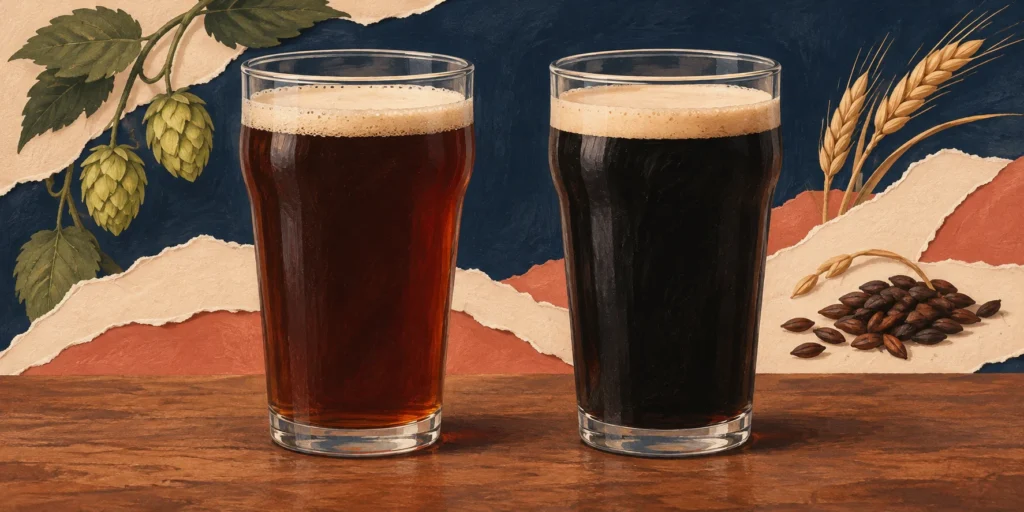
Porter and stout are related dark-beer families, rather than opposites with one universal dividing line. In the English Porter and Irish Stout styles compared here, porter is usually browner with gentler roast; stout is darker with a more pronounced coffee-like roast.
The difference at a glance
Porter and stout are related dark-beer families, rather than opposites with one universal dividing line. In the English Porter and Irish Stout styles compared here, porter is usually browner with gentler roast; stout is darker with a more pronounced coffee-like roast. [1] [2]
The main differences
English Porter and Irish Stout compared
| Feature |
English Porter |
Irish Stout |
| Colour |
Brown to dark brown, often ruby highlights [1] |
Black to deep brown, typically opaque [2] |
| Roast character |
Restrained; chocolate, caramel and toast notes [1] |
More pronounced, often coffee-like [2] |
| Guideline ABV |
4.0–5.4% [1] |
3.8–5.0% [2] |
| Texture |
Medium-light to medium body [1] |
Medium-light to medium-full; nitro service affects creaminess [2] |
Why the style names need a scope
The comparison uses modern English Porter, style 13C, and Irish Stout, style 15B. It does not turn those descriptions into rules for every beer carrying porter or stout on its label. The historical relationship is close: stout was originally used in the expression “stout porter”. [1]
Stout does not automatically mean stronger
The two alcohol ranges in the table overlap. A fictional English Porter labelled 5.2% ABV could therefore be stronger than a fictional Irish Stout labelled 4.2% ABV. Both figures sit inside the respective guideline ranges. Read the actual ABV rather than predicting strength from the darker name. [1] [2]
Foam does not identify the whole family
A creamy, persistent head is associated with nitro-served Irish Stout. A bottled example need not reproduce that dispense-related texture. Comparing a nitro pour with a bottled beer mixes a style question with a serving-method question. [2]
Try the distinction
Porter 5.2% ABV, stout 4.2% ABV: which fictional beer is stronger?
The porter. Its labelled ABV is higher; stout is not a guarantee of higher alcohol. The example values fall within the two cited style ranges. [1] [2]
A dark beer has chocolate notes. Does that prove it is porter?
No. The porter description includes chocolate, but the stout description can include it too. One flavour note is insufficient to identify a beer. [1] [2]
A bottled stout lacks a nitro-style head. Is that automatically wrong?
No. The service method contributes to the familiar creamy texture; the guidance explicitly distinguishes bottled and nitro-served versions. [2]
Frequently asked questions
Is every stout made only with unmalted roasted barley?
No. The cited Irish Stout guidance permits dark roasted malts or grains. A single ingredient rule does not define every stout. [2]
Can these ranges identify the style of an unknown beer?
Not on their own. The overlap is a reason to consider the named style and its fuller description, rather than ABV alone.
Sources
Source pages checked on 26 November 2026. Fictional examples and self-checks were written with AI assistance and checked against the listed material.
- 2021 Beer Style Guidelines: 13C English Porter — Beer Judge Certification Program.
- 2021 Beer Style Guidelines: 15B Irish Stout — Beer Judge Certification Program.
The featured image is an AI-generated editorial illustration, not a photograph, measurement or record of a study.