The difference at a glance
Caster sugar has smaller crystals than granulated sugar and dissolves more easily. Granulated sugar is coarser; caster is useful when a smooth mixture matters. This comparison is about ordinary white sugars. [1]
Caster sugar has smaller crystals than granulated sugar and dissolves more easily. Granulated sugar is coarser; caster is useful when a smooth mixture matters. This comparison is about ordinary white sugars.
The difference at a glance
Caster sugar has smaller crystals than granulated sugar and dissolves more easily. Granulated sugar is coarser; caster is useful when a smooth mixture matters. This comparison is about ordinary white sugars. [1]
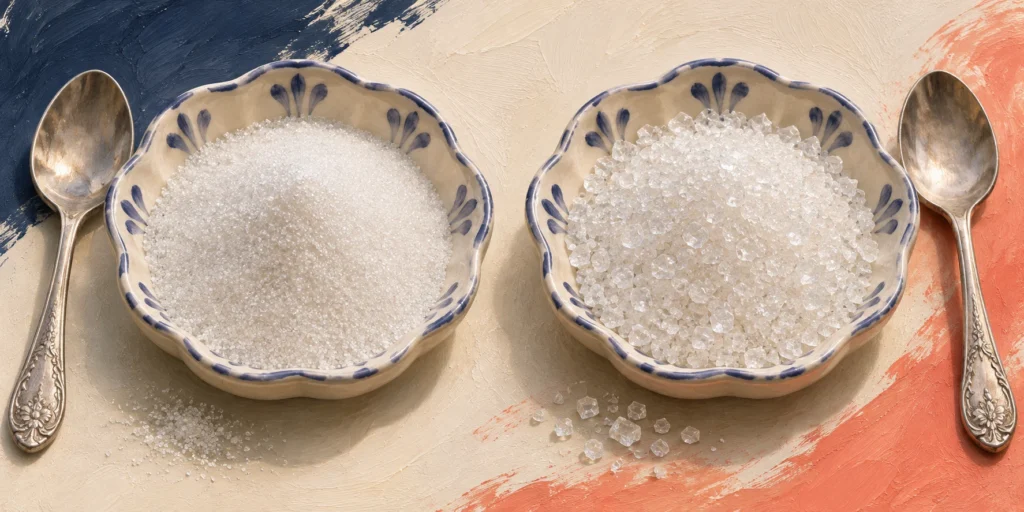
| Feature | Caster sugar | granulated sugar |
|---|---|---|
| Crystal texture | Finer crystals [1] | Coarser than caster [1] |
| Dissolving | Dissolves more easily [1] | Larger crystals take more dissolving [1] |
| Typical baking role | Cakes, custards, mousses and meringues [1] | General-purpose cooking [1] |
| Everyday example | Fine crystals for cakes and sponges [2] | Sweetening a cup of tea [2] |
The distinction is the grain you are working into a mixture. A recipe asking for caster sugar is specifying a fine crystalline ingredient; a bag of granulated sugar supplies a visibly coarser one. Caster sugar is still crystals, unlike powdered icing sugar. [1]
Suppose a fictional sponge recipe asks for 150 g of caster sugar, but your cupboard contains granulated sugar. First identify the mismatch: crystal size. Do not quietly change the recipe to “150 g of any sugar” and assume the same result. The most dependable way to follow that recipe is to obtain the specified ingredient or choose a recipe written for the sugar you have. This example illustrates a decision, not a tested substitution.
When writing a shopping list, record the type as well as the amount: “white caster sugar” is more useful than “sugar”. Golden caster, ordinary white granulated and icing sugar are different descriptions. Checking both the recipe wording and the packet prevents buying a powder when fine crystals were intended. [1]
No. Granulated crystals are larger. That difference is why a recipe may specify caster. [1]
Not by that description. Icing sugar is powdered; caster remains crystalline. Read the packet name. [1]
No. It is one familiar use, alongside general cooking. A typical use is not an exclusive rule. [1] [2]
There is no universal result promised here. Follow a substitution specifically tested for your recipe rather than treating the names as interchangeable.
No. “Golden” identifies another variety. The size comparison in this guide concerns white caster and white granulated sugar. [1]
Source pages checked on 25 November 2026. Fictional examples and self-checks were written with AI assistance and checked against the listed material.
The featured image is an AI-generated editorial illustration, not a photograph, measurement or record of a study.
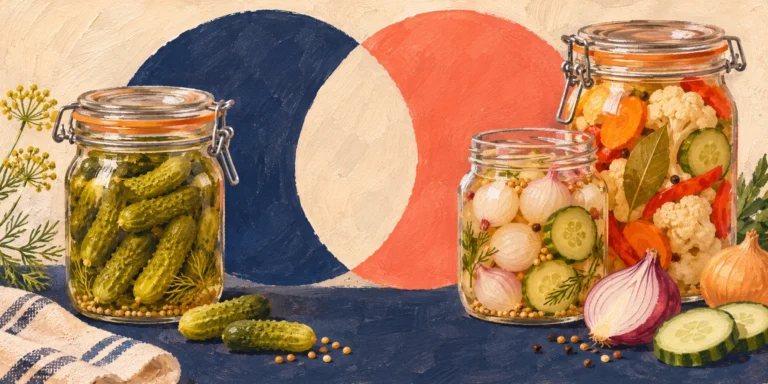
A gherkin is a small type of cucumber that is often pickled. Pickle is a broader word: it can mean food preserved in vinegar or salty water, a pickled cucumber,…
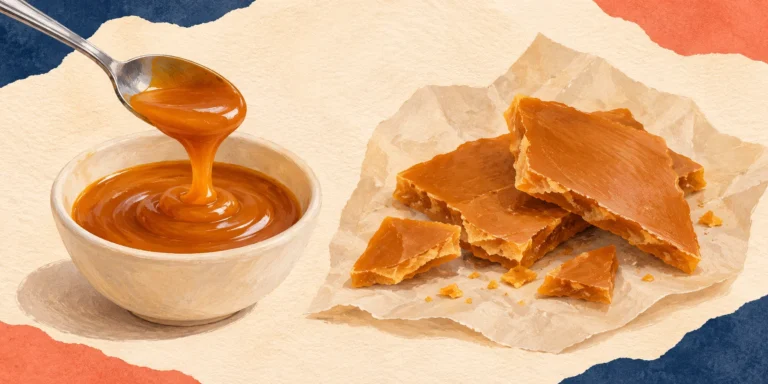
Caramel begins with sugar heated until it browns; cream or butter can then turn it into a sauce. Toffee commonly cooks sugar with butter, cream or milk and sets into…
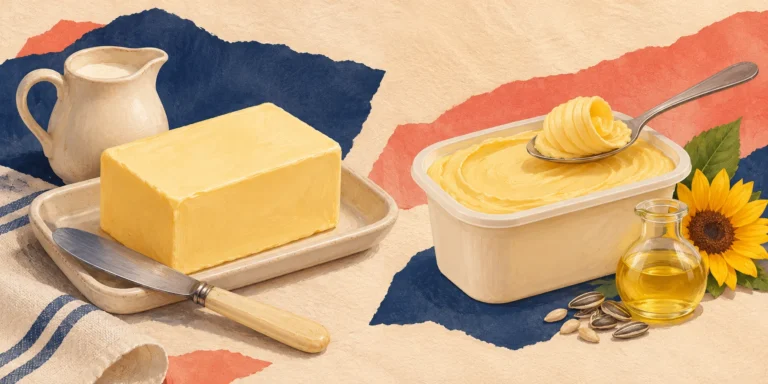
Butter is a dairy fat product. Margarine and margarine-style spreads use a formulated fat-and-water mixture, commonly based on plant oils. A soft tub may instead contain butter blended with oil:…