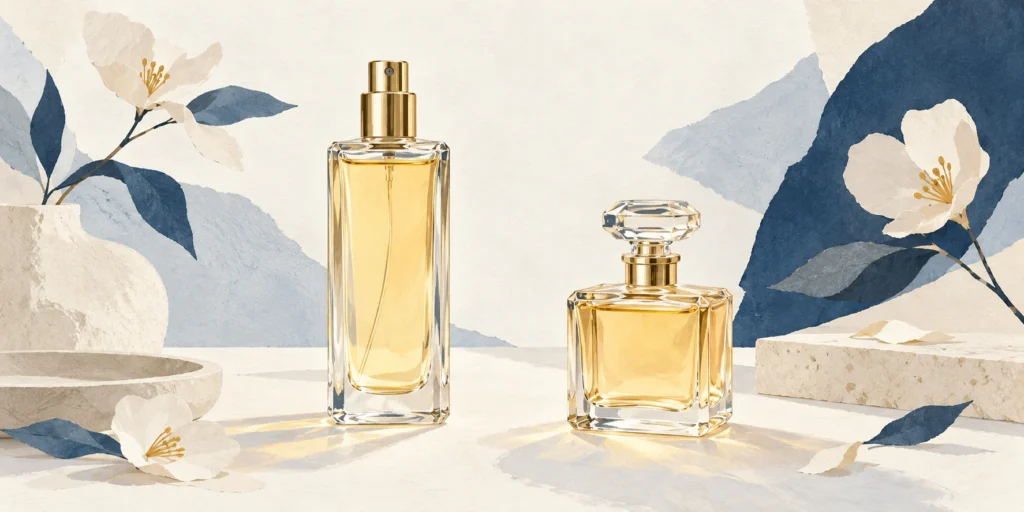
Eau de toilette is generally a lighter fragrance expression; parfum names a more concentrated one. Compare the actual version as well as the label: a shared line name does not promise an identical scent.
Eau de toilette, often shortened to EDT, is generally a lighter fragrance expression, while parfum names a more concentrated format. Here parfum means that named concentrated version, not every product casually called perfume. Eau de parfum is another label again. The exact version matters as well as the fragrance line’s name. [1]
The most concentrated interpretation in that family. [1]
Scent example: N°5
Current EDT description highlights floral aldehydes with sandalwood and vetiver. [2]
Parfum description highlights rose, jasmine, ylang-ylang and neroli. [2]
Shared point
A fragrance version whose actual description matters.
Also a fragrance version; the label is not a score for personal preference.
What to compare
Exact line, version and bottle volume.
The same details, rather than the shared line name alone.
Why “the same name, but stronger” is incomplete
For a concrete example available in UK product information, take CHANEL N°5 Eau de Toilette and N°5 Parfum. They share the N°5 identity, but their descriptions emphasise different facets: the EDT highlights sandalwood and vetiver alongside floral aldehydes, while the parfum description centres on a floral bouquet enhanced by neroli. [1][2]
Those descriptions help explain why concentration is only one part of the comparison. They do not amount to a blind test, a measured list of ingredient proportions or a promise that you will prefer one. The named example shows why reading only N°5 can leave out useful information.
A practical version-checking example
Imagine that you enjoyed a sample marked N°5 Eau de Toilette. Later, you see a listing marked N°5 Parfum. Before treating it as a replacement, write down the full name of the sample and compare it with the full name of the listing. The difference is in the version, even though the line name matches.
Then compare the actual descriptions and bottle volumes. If both hypothetical bottles contain 50 ml, they contain the same volume of liquid; that number does not establish an equal concentration or identical scent. You need the format information as well. This is an invented label-reading example, not a report of testing those bottles.
Three separate questions
Identity: is it the same fragrance line?
Version: EDT, eau de parfum or parfum?
Your preference: do you like that particular interpretation?
A more concentrated format does not answer all three questions for you.
Check what the label tells you
Does parfum here mean eau de parfum?
No. They are distinct format names. Keep the full wording when identifying a product or comparing versions. [1][2]
I liked an EDT sample. Is the parfum guaranteed to smell like a stronger copy?
That is not established by the shared name. The N°5 descriptions emphasise different facets, so compare the actual version. [2]
Do two 50 ml bottles necessarily have the same concentration?
No. 50 ml is the volume of liquid, not its fragrance concentration. EDT and parfum are distinct formats; equal bottle volumes do not make them the same version.
Frequently asked questions
Does EDT tell me an exact number of hours it will last?
The format name alone does not provide a measured wear time for a particular product. Read the actual product information; this comparison makes no fixed-hour performance claim.
Sources
Source pages checked on 25 October 2026. The examples and self-checks were written for this article with AI assistance and checked against the listed material.
BIAB is a branded builder-gel system used to add structure. An ordinary gel-polish manicure mainly adds colour. Builder gel and colour gel can be used together.
A jacket is usually a shorter upper-body garment; coat is a broader outerwear term that includes long and short styles. Length is a useful clue, but neither word guarantees warmth…
A tuxedo is formal evening tailoring with contrasting lapel facings and matching dress trousers. In the UK it is the conventional choice for black tie.