Bourbon vs whiskey: what’s the difference?
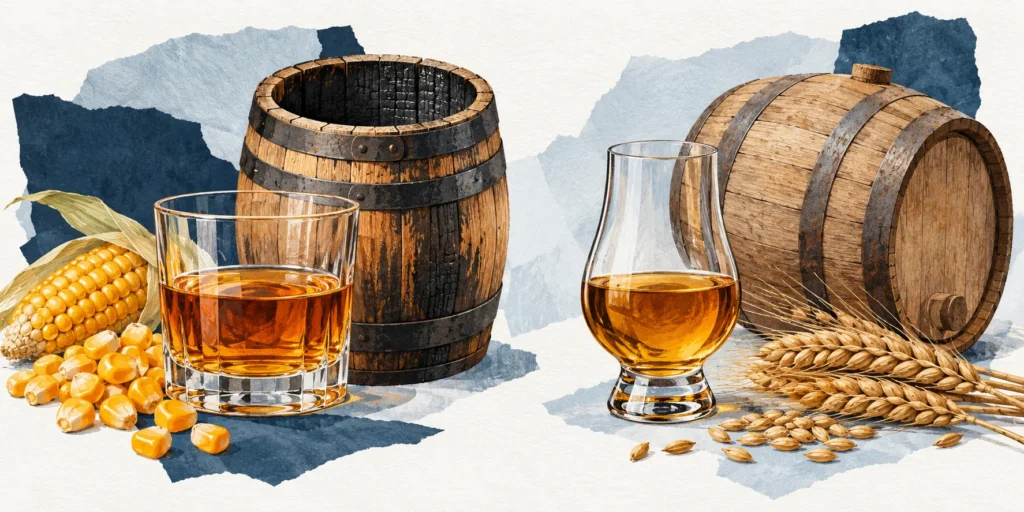
Bourbon is a type of American whiskey, made with at least 51% corn and stored in new charred oak. Whiskey is the wider family, whose named styles follow different rules.
In this comparison
Bourbon and the wider whiskey family
| Feature | Bourbon | Whiskey / whisky more broadly |
|---|---|---|
| Relationship | One defined American type. [2] | The family containing bourbon and other styles. [2] [3] |
| Origin | Distilled and aged in the United States. [1] [2] | Origin depends on the named style; Scotch is Scottish. [3] |
| Grain | At least 51% corn in the mash. [2] | No single corn recipe describes every type. [1] [3] |
| Oak | Requires new, charred oak storage. [2] | Cask rules depend on the type. [1] [3] |
| Age wording | “Straight bourbon” adds a minimum of 2 years under US rules. [1] | Scotch requires at least 3 years in Scotland. [3] |
| Shared point: strength | US bottling minimum 40%ABV. [2] | Scotch also has a 40%ABV minimum; strength alone does not identify the style. [3] |
Read the type before the extra words
On an imagined drinks menu, “Kentucky straight bourbon”, “American rye whiskey” and “single malt Scotch whisky” all belong to the whiskey family. Only the first is bourbon. “Kentucky” gives an origin within the United States; it is not the boundary of the whole bourbon category. [1] [2] [3]
The extra word straight matters: the US standard requires at least two years of qualifying storage. Plain bourbon’s US definition does not specify that minimum. That is a comparison of American production definitions, not a universal age rule for spirits marketed in Britain or elsewhere. Scotch has its own three-year minimum. [1] [3]
A grain calculation is only one check
Suppose an invented grain recipe contains 60 kg corn in 100 kg total grain. The corn share is 60%, so it exceeds the 51% threshold. A second recipe with 45 kg corn in 100 kg has 45% corn and falls short. [2]
Passing that arithmetic does not prove that the first recipe became bourbon. Its production location, distillation and storage must also qualify. Likewise, the colour of the finished drink cannot provide a grain recipe or a barrel history. The example explains a label condition; it is not a distilling recipe.
- Family: whiskey or whisky.
- Type: bourbon, rye, Scotch or another named style.
- Qualifier: words such as straight add information.
- Actual bottle: read its origin, age wording and ABV together.
A shared strength or amber colour does not collapse these categories. [1] [2] [3]
Check the label logic
A bottle is American whiskey. Must it be bourbon?
No. American whiskey includes other types. The specific grain and production conditions determine whether bourbon is the appropriate type. [1] [2]
Does 60% corn automatically make our imagined recipe bourbon?
No. It clears the corn-percentage condition only. The other production requirements still matter. [1] [2]
Is Scotch a kind of bourbon?
No. Both belong to the wider whisky family, but Scotch is distilled and matured in Scotland and follows its own requirements. [3]
Frequently asked questions
Does the extra e in whiskey identify bourbon?
No. US rules allow whiskey or whisky. Read the named type, rather than using spelling as a production test. [1]
Sources
Source pages checked on 25 October 2026. The examples and self-checks were written for this article with AI assistance and checked against the listed material.
- 27 CFR §5.143 — Whisky — Electronic Code of Federal Regulations.
- FAQ: General Bourbon Questions — Kentucky Distillers’ Association.
- Scotch Whisky Categories: from Single Malt to Blended Scotch Whisky — Scotch Whisky Association.
The featured image is an AI-generated editorial illustration, not a photograph, measurement or record of a test.