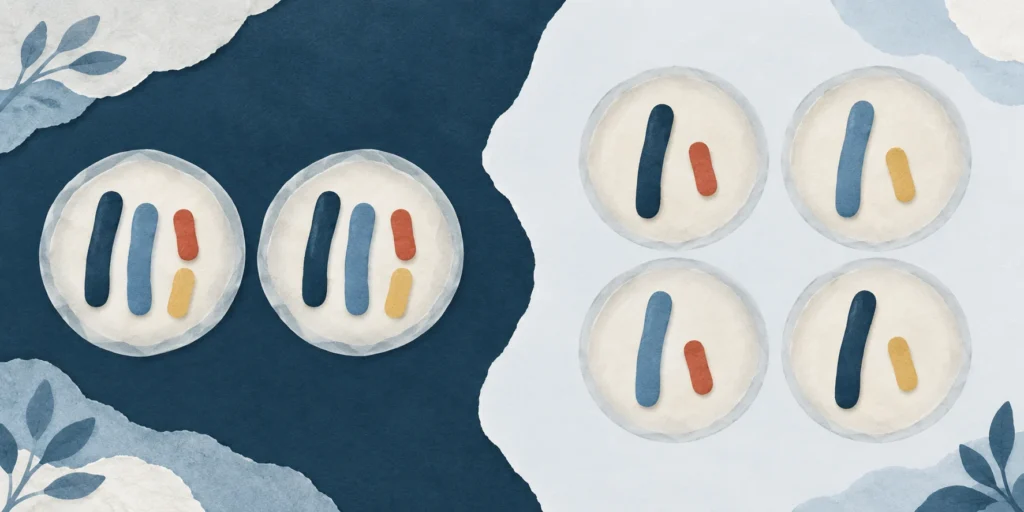
Mitosis normally preserves chromosome number through one division. Meiosis uses two divisions to halve it, producing genetically varied haploid products in a simplified model.
Mitosis normally keeps the chromosome number the same through one division. Meiosis uses two divisions to reduce it by half and produces genetically varied haploid products. For a typical human diploid starting cell, that means 46 chromosomes in each mitotic daughter cell, compared with 23 in a gamete formed through meiosis. [1][2][3][5]
The comparison below follows a simplified animal-cell model. It distinguishes a chromosome, a copied chromosome’s sister chromatids, and the number of resulting cells. Keeping those counts separate prevents several common diagram mistakes.
A typical human diploid cell has two chromosome sets, with 46 chromosomes in total. A sperm or egg has one set, with 23. Their combination at fertilisation restores the usual total: 23 + 23 = 46 chromosomes. Without reducing the gamete count, combining two diploid sets would not preserve that usual total. [1][3]
Mitosis serves a different purpose in this comparison: distributing the copied chromosome information into two nuclei. It is generally followed by division of the cell contents. “Two cells” describes the usual completed cell-division outcome, rather than saying that nuclear division and splitting the whole cell are the same physical event. [2]
Homologous chromosomes are not sister chromatids
Homologous chromosomes are the paired corresponding chromosomes inherited from the two parents. In meiosis, they pair and can exchange DNA through crossing over, creating new combinations. Sister chromatids are the two copies within a duplicated chromosome. Mixing up these relationships makes meiosis I look incorrectly like ordinary mitosis. [4][6]
In the first meiotic division, the homologous partners separate while sister chromatids remain together. In the second, the sister chromatids separate. Mitosis also separates sister chromatids. This is why “meiosis is simply mitosis twice” misses the distinctive first division. [5][6]
A worked four-chromosome model
For a manageable original counting exercise, imagine a diploid starting cell with four chromosomes: two homologous pairs. Call one pair long and the other short. Four is an invented model count, not the human count. Before division, copying the DNA makes each chromosome a two-chromatid structure. The model then has four duplicated chromosomes and eight chromatids, not eight homologous chromosomes. [6]
Follow one starting cell through two possible routes
Start: one diploid model cell, 4 chromosomes in 2 homologous pairs.
Meiosis route, division I: homologous partners separate; each of 2 cells has 2 duplicated chromosomes.
Meiosis route, division II: sisters separate; each of 4 final cells has 2 chromosomes.
Counts describe the stages stated, not every instant of division. The featured image illustrates only the final model outcomes; it is not a microscope image. [5][6]
The useful check is per cell. The mitosis route ends with two cells containing four chromosomes each. The meiosis route ends with four cells containing two each. Both routes distribute copied material, but only the meiotic route reduces the chromosome-set number in each final product.
Four products does not mean four human eggs
The neat four-equal-cell diagram is a teaching simplification. Human egg formation produces one egg and polar bodies, rather than four equally functioning eggs. Use the diagram to learn chromosome segregation; do not treat its equal circles as an exact account of every type of gamete formation. [6]
Check the model before revealing each answer
1. Copying four chromosomes makes eight chromatids: are there now eight chromosomes?
Not at that stated stage. The four duplicated chromosomes each have two sister chromatids. Count the duplicated units separately from their component copies. [6]
2. After meiosis I, does meiosis II halve the chromosome number again?
No. In this model each cell has two duplicated chromosomes after I. Separating the sisters in II leaves two chromosomes in each final product; it does not reduce that count to one. [6]
3. Can a four-cell model be labelled four functional human eggs?
No. It is a simplified segregation model. The egg/polar-body outcome means four equal final discs should not be read as four functional eggs. [6]
Frequently asked questions
Are mitotic daughter cells always error-free copies?
The normal outcome preserves matching genetic information, but copying or segregation errors can occur. The comparison describes the usual process rather than guaranteeing that every division is perfect. [2]
Is crossing over a third meiotic division?
No. It is an exchange of DNA between homologous chromosomes during the meiotic process. The two divisions are meiosis I and meiosis II; count those separately from the DNA exchange. [4][6]
Sources
Sources checked on 17 October 2026. The worked examples and self-checks were written for this article.
AI tools assisted with drafting and the featured editorial illustration. The illustration is not a photograph, a measured diagram or evidence of an actual test.
A hurricane is a large tropical cyclone that develops over warm seas; a tornado is a much smaller rotating column of air connecting a storm cloud to the ground.
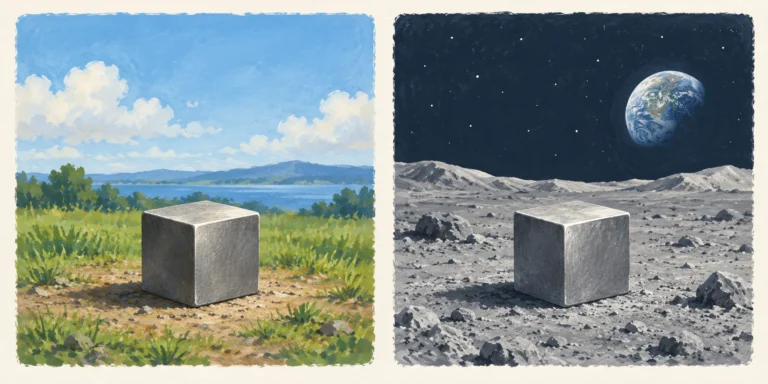
Mass is measured in kilograms; weight is a gravitational force measured in newtons. A 10 kg object keeps its mass on the Moon but has a much smaller weight.
Fog and mist both contain tiny water droplets suspended near the ground. In the general meteorological distinction, fog reduces visibility below 1,000 metres; mist is less obscuring.