Swallow vs swift: what’s the difference?
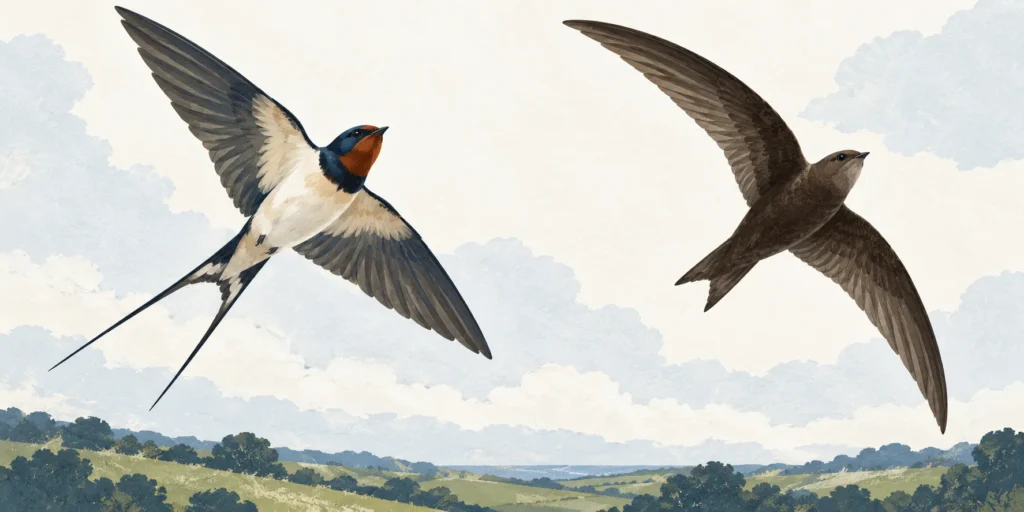
A swallow has a pale belly, red throat and a deeply forked tail. A swift looks darker, with long curved wings and a short forked tail. Learn the UK field clues.
In this comparison
In Britain, this comparison means the barn swallow (Hirundo rustica) and common swift (Apus apus). A fast-moving bird above a street is not automatically either: house martins and sand martins can also cause confusion. [1] [2] [3]
Swallow and swift compared
| Clue | Swallow | Swift |
|---|---|---|
| Underside | Pale belly with a dark breast band and red throat | Mostly sooty brown; small pale throat patch [1] [2] |
| Tail | Deep fork; adults have two long outer streamers | Short fork, sometimes folded to a point [1] |
| Wings | Pointed, broader-looking wings | Long, narrow, curved wings [1] [3] |
| Resting | Can perch on overhead wires | Does not normally perch on wires [1] |
| Nest | Open mud cup, often inside an outbuilding | Hidden cavity under tiles or in building walls/eaves [1] |
| Shared trait | Catches insects in flight | Also catches airborne insect prey [1] [2] [3] |
Use a sequence, rather than one glimpse
- Underside: genuinely pale, or dark against the sky?
- Shape: long tail streamers, or long curved wings with a short tail?
- Cross-check: does another clear feature support the same identification?
If you cannot see the first two reliably, leave the identification open. [1]
A dark silhouette against a bright sky does not prove swift: shadow can hide a swallow’s pale underside. Wait for a turn that shows the belly. Likewise, the absence of long streamers does not rule out a young swallow. [1]
An original worked observation
Imagine a bird circling a village pond in July. One turn reveals a cream belly and reddish throat; another shows two long, thin outer tail feathers. Those independent features support swallow. Low flight over the pond fits, but it is the visible plumage and tail that make the answer persuasive. [1] [2]
Now remove those details: you see only a small dark shape for a second. “It was fast” adds little. Keep the record uncertain rather than building a confident answer from speed or location alone.
Season and buildings provide context
Swallows can arrive from March and remain into October. Swifts usually appear later, mainly from May, with departures beginning in August. These are broad patterns: migration varies, and occasional swallows have overwintered in Britain. An October sighting therefore needs careful features rather than a calendar shortcut. [1] [2] [3]
A bird disappearing into a roof gap supports swift; an open mud cup inside a barn supports swallow. Neither the presence of a building nor a nest seen from a poor angle settles the question by itself. [1] [3]
Try three sightings
1. Pale belly, red throat and long streamers?
Swallow is the supported answer. The combination is stronger than any single feature. [1] [2]
2. Dark underside, long curved wings and a short fork?
Swift is the better match. A small pale throat patch is compatible with that answer. [1] [3]
3. Pale underside but no streamers: definitely swift?
No. Young swallows lack the adult streamers. A clear white rump suggests house martin; brown upperparts and a brown chest band suggest sand martin. Get a better view before choosing. [1]
Frequently asked questions
Are swifts simply large swallows?
No. They are different birds. Use the named species and the combination of tail, wings and underside, rather than apparent size in a distant view. [2] [3]
Can a call help?
Yes: swift groups make high-pitched screams, while swallows give twittering or trilling calls. A clearly heard call can support visible clues. [1]
Sources
Sources checked on 10 October 2026. Worked examples and exercises were written for this article.
- House Martin, Swift or Swallow? How to Tell the Difference — RSPB.
- Swallow — British Trust for Ornithology.
- Swift — British Trust for Ornithology.
AI tools assisted with drafting and the featured editorial illustration. The illustration is not a photograph, measurement or test result. Claims were checked against the linked sources; no independent human expert review is claimed.