Cheetah vs leopard: what’s the difference?
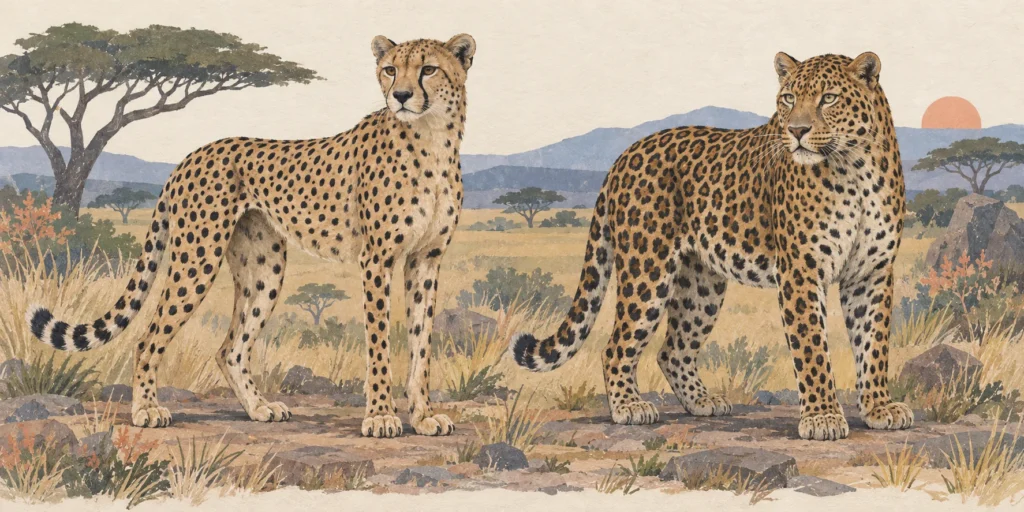
Cheetahs have solid spots, black facial tear marks and a lean, long-legged build. Leopards have rosettes and a more muscular body. Learn the useful clues.
In this comparison
The animals compared here are the cheetah (Acinonyx jubatus) and the leopard (Panthera pardus). Look for several matching features in a clear view of a typical adult. [1] [2]
Cheetah and leopard compared
| Feature | Cheetah | Leopard |
|---|---|---|
| Main coat pattern | Solid round or oval black spots | Rosettes: irregular, flower-like dark rings [1] [2] |
| Face | Black lines from inner eye towards mouth | No characteristic cheetah tear lines [1] |
| Body proportions | Lean torso, long slender legs, small head | More substantial, muscular build [1] [2] [3] |
| Claws | Partly retractable; most remain exposed | Retractable claws used when grasping prey [2] [3] |
| Hunting adaptation | Short, fast pursuit after approaching prey | Stealthy approach followed by a pounce [2] [3] |
Start with the pattern, then check the face
On a cheetah’s main body, the markings are filled-in spots. A leopard’s rosettes have a darker outline surrounding a lighter centre. Do not judge from one tiny patch: take a clear view of the flank, then check the face and proportions. [1] [2]
- Flank: filled-in spots or rosettes?
- Face: are cheetah-like tear lines visible?
- Build: long and lean, or more muscular?
A combination of clues is stronger than one unclear marking. [1] [2]
A worked photograph example
Imagine a photograph of a tan cat on open ground. The flank shows separate solid spots. A closer view reveals black lines running down from the eyes, along with long slender legs. Together, those details support cheetah. The open landscape helped you notice the animal, but it did not identify it. [1]
Now imagine a second photograph taken from much farther away. All you can see is “spotted cat”. The useful answer is not enough detail. Enlarging a blurred patch does not create reliable evidence of spots or rosettes.
Why their builds differ
A cheetah’s flexible spine, long limbs and tail help with short bursts of pursuit and turning. Its partly exposed claws contribute traction. A leopard uses retractable claws in grasping prey and is an accomplished climber; it may take a kill into a tree. [2] [3]
These are adaptations, not an instruction to reduce every hunt to one rule. Cheetahs also approach prey before a chase. You can identify useful anatomical differences without waiting to watch either animal hunting. [3]
Try three sightings
1. Solid flank spots, facial tear lines and long lean legs?
Cheetah is the better match. All three visible clues point in the same direction. [1]
2. Flower-like flank markings on a muscular cat?
Leopard is the better match. The rosettes matter more than the shared tan-and-black colouring. [1] [2]
3. A very dark cat with markings only visible in good light?
Colour alone cannot settle it. Leopards can have very dark coats with the pattern still visible under suitable light. Look for the pattern and other features. [2]
Frequently asked questions
Is a leopard just a bigger cheetah?
No. They are different species, with different coat patterns, body proportions and claw adaptations. [1] [2] [3]
Does a tail with black rings prove it is a cheetah?
No. Tail detail can support a comparison, but a clearer view of the flank, face and overall build is a better starting point.
Sources
Sources checked on 9 October 2026. Worked examples and exercises were written for this article.
- Cheetah — Smithsonian’s National Zoo and Conservation Biology Institute.
- Leopard — San Diego Zoo Wildlife Alliance.
- Cheetah — San Diego Zoo Wildlife Alliance.
AI tools assisted with drafting and the featured editorial illustration. The illustration is not a photograph, measurement or test result. Claims were checked against the linked sources; no independent human expert review is claimed.