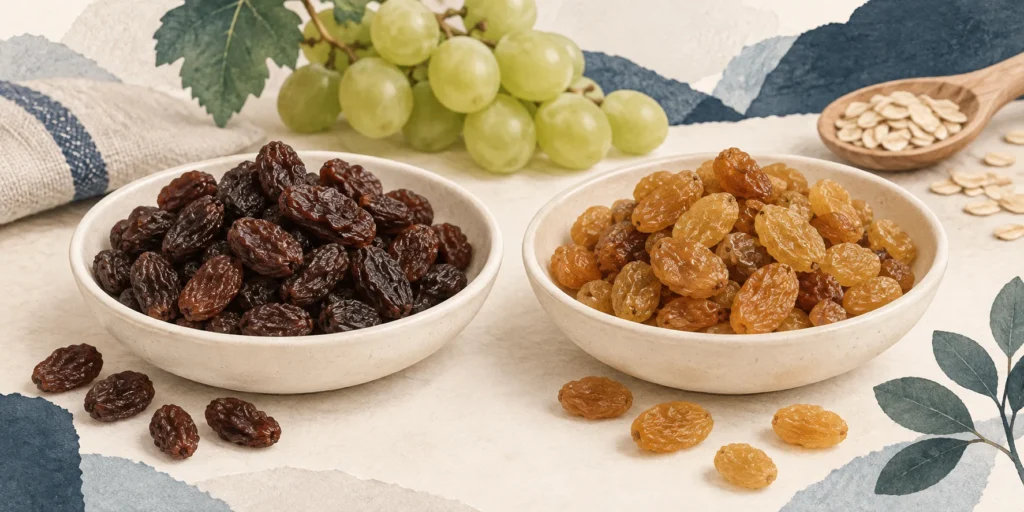
Raisins and sultanas are both dried grapes. In British shops, raisins are usually darker and sultanas lighter and milder; recipe substitutions need context.
Raisins and sultanas are both dried grapes. In British ingredient lists, raisins are usually the darker dried fruit, while sultanas are generally lighter, with a milder flavour. The names do not establish a universal black-grape-versus-white-grape rule. Whether you can swap them depends on the recipe.
For a British shopper, the practical difference is the fruit’s appearance and flavour in the finished dish. For a grower or importer, grape variety and drying method also matter. Keeping those two contexts separate avoids making a simple packet comparison into an inaccurate botanical rule. [1][2][3]
Raisins and sultanas compared
How the names are commonly used in British recipes
A commercial name is not a promise that every producer uses one grape variety. One regional industry guide lists several sultana varieties, including Thompson Seedless and Merbein Seedless, while its raisin entry describes Muscat Gordo Blanco. That is a concrete production example, rather than a rule for every British packet. [3]
Processing helps explain appearance too. In that sultana-production example, drying oil is used to speed drying and preserve a lighter base colour. The finished colour therefore cannot be read as a simple photograph of the fresh grape’s skin colour. [3]
From grape to the ingredient in the bowl
Grape variety + drying process → dried-fruit colour and character → the product name used in its market.
The shared starting point is grapes; the variety, treatment and local naming do not have to be identical. [1][2][3]
Can you replace one with the other?
Sometimes the recipe explicitly allows it. A UK orange-and-sultana milk-pudding recipe specifies 60 g sultanas or raisins for four servings. In that case, changing the fruit name does not require inventing a conversion factor: the stated mass remains 60 g. [4]
That example supports a swap in that recipe, not identical results in every cake or bread. If another recipe calls for a particular fruit, or gives soaking or preparation instructions, keep those instructions in view. A change in flavour or visible colour may be acceptable to you, but it is still a change.
A worked cupboard example
You plan to use the pudding recipe that accepts either fruit, but have 25 g raisins and 35 g sultanas. Together they supply 25 g + 35 g = 60 g dried grapes. That keeps the stated fruit quantity while combining the two flavours. The arithmetic is exact; this article has not cooked or tasted the mixture.
For a doubled, eight-serving version of that ingredient list, the fruit quantity is 2 × 60 g = 120 g. The allocation remains 60 g ÷ 4 = 120 g ÷ 8 = 15 g fruit per serving. Scale the rest of that recipe consistently too; these calculations are not a nutrition recommendation or a new universal pudding formula. [4]
Choose the relevant situation
1. My recipe says “60 g sultanas or raisins”. What mass should I use?
60 g of the permitted fruit. If you combine the two, keep their total at 60 g. The recipe already provides the choice; there is no basis for a special raisin-to-sultana factor. [4]
2. I want a lighter-looking fruit in a scone. Which name should I look for?
Sultanas are the usual lighter option in this British comparison. Check the actual fruit rather than treating the name as a guarantee of one precise shade. [1]
3. An American recipe calls for golden raisins. Is that a different fruit species?
Not necessarily. “Golden raisins” can be an American name for sultanas. The fruit is still dried grapes; use the recipe and packet description to interpret the term. [1]
No. The production guide examined lists several varieties for sultanas. That also cautions against treating one region’s naming as a universal rule. [3]
Does a lighter colour mean a healthier choice?
Colour alone does not establish that comparison. This guide explains ingredient names and recipe use, rather than ranking their health effects.
Sources
Source pages checked on 8 October 2026. The worked examples and exercises were written for this article.
AI tools assisted with drafting and the featured editorial illustration. The illustration is not a photograph, measurement or test result. Claims were checked against the linked sources; no independent human expert review is claimed.
Lamb and mutton are sheep meat from different age groups. Mutton comes from older sheep and has a fuller flavour; the cut, provenance and cooking method matter alongside age.
Cognac is a specific member of the broader brandy family, defined by its French origin and production requirements. The word brandy alone does not establish Cognac origin or age.
Cacao and cocoa come from the same plant, and the names overlap. For cooking, the useful distinction is the actual product: nibs or powder, and natural or alkalised cocoa.