Dash vs hyphen: what’s the difference?
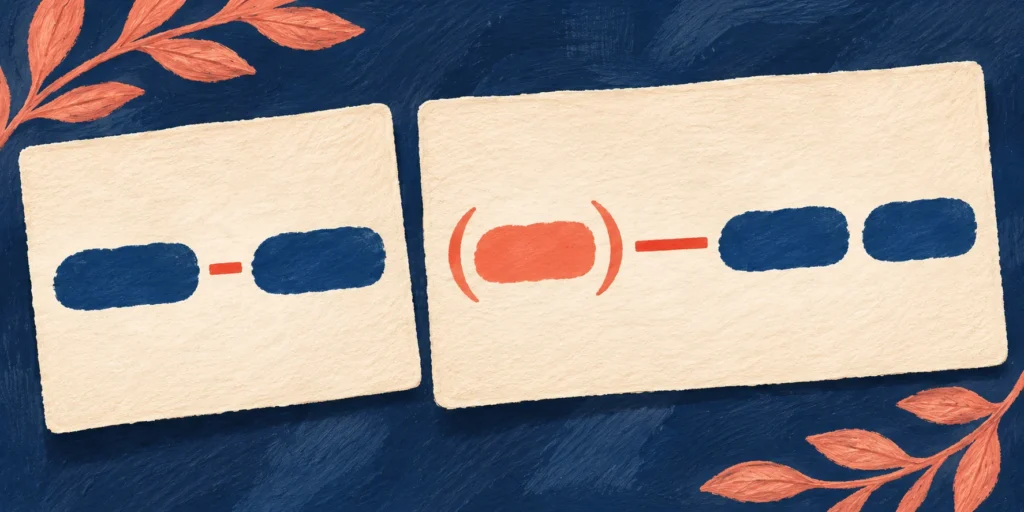
A hyphen (-) joins parts of a word or compound expression. A dash (—) separates an interruption from the surrounding sentence. Their different lengths help show their different jobs.
In this comparison
The main differences
| Feature | Dash | hyphen |
|---|---|---|
| Main function | Separates a sentence interruption | Joins word parts or a compound modifier |
| Symbol shown here | Em dash: — | Hyphen: – |
| Original example | The parcel — the blue one — is yours. | A three-day workshop |
| Spacing in these examples | Spaces around the dash | No spaces inside the compound |
Start with the job, then choose the mark
Ask whether the material belongs inside a word group or interrupts the sentence. In “a three-day workshop”, the words describe the workshop together, so hyphens connect the modifier. In “The workshop — postponed yesterday — starts on Friday”, the extra information interrupts a sentence that still works without it. The marks are not interchangeable decoration. [1] [2]
A practical edit
Imagine a notice reading “Bring a water resistant jacket – the forecast has changed.” One useful edit is “Bring a water-resistant jacket — the forecast has changed.” The first mark groups the description of the jacket; the second introduces an additional thought. This is an invented teaching example, not a quotation or a claim that every compound adjective must always be hyphenated.
Keep style decisions consistent
Dash spacing varies between editorial styles. This article uses spaced em dashes; follow the style required by your publisher or course. For a compound word whose established spelling is uncertain, consult a current dictionary. A punctuation guide explains the function of a mark, but does not settle the spelling of every word. [1] [2]
Try the distinction
Which mark belongs in “a five minute break”?
Write “a five-minute break”: the modifier belongs together before the noun.
Which mark encloses “the smaller one” in a sentence?
“The box — the smaller one — is empty.” The insertion can be removed while leaving a complete sentence.
Should every keyboard hyphen become a dash?
No. Check its job. Replacing the hyphens in five-minute with dashes breaks the compound rather than improving it.
Frequently asked questions
Is an en dash the same as a hyphen?
No. An en dash (–) is a separate, longer mark often used for ranges. That use differs from the sentence interruption illustrated here. [1]
Can I omit the interruption?
In the box example, yes: “The box is empty” retains the sentence structure. That removal test helps identify the extra material.
Sources
Source pages checked on 24 November 2026. Fictional examples and self-checks were written with AI assistance and checked against the listed material.
- The Hyphen — University of Sussex.
- The Dash — University of Sussex.
The featured image is an AI-generated editorial illustration, not a photograph, measurement or record of a study.