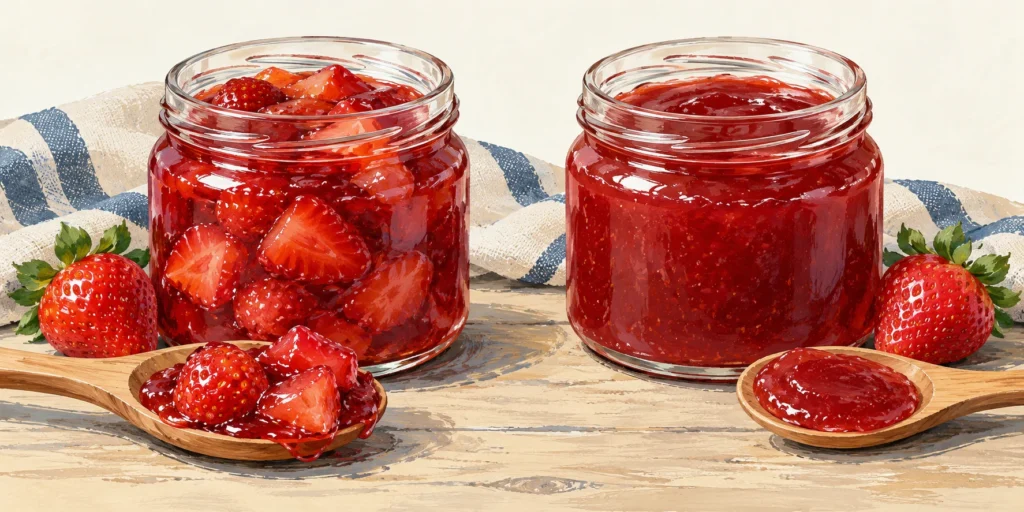
Conserve often suggests larger fruit pieces, but the names overlap. Compare actual recipes, fruit quantities and texture rather than assuming every conserve is chunky.
Conserve often suggests a fruit-rich spread with larger pieces, while jam is the broader familiar name for a cooked fruit spread. In British shops the terms overlap: a conserve can be sieved, and a jam can contain whole fruit. The recipe tells you more than the name alone. [1][3][4]
This comparison concerns the words on ordinary shop-bought fruit spreads. It does not set legal minimum fruit contents or compare home-preserving methods. “More fruit”, “smoother” and “less sugar” are separate questions.
Conserve and jam: names versus the actual recipe
Feature
Conserve
Jam
Usual implication
Often suggests larger pieces or a substantial fruit texture. [1]
A broader name that covers different fruit textures. [1][3]
Important texture exception
Sweet Tip Raspberry Conserve uses sieved raspberries. [4]
Hartley’s Strawberry Jam is in a whole-fruit range. [3]
One strawberry recipe
Bonne Maman Strawberry Conserve: 50 g prepared fruit per 100 g. [2]
Hartley’s Strawberry Jam: 45 g prepared fruit per 100 g. [3]
Check the particular texture and whether it contains seeds. [1][4]
Check the particular texture; the word jam does not promise smoothness. [3]
Why texture needs its own check
Imagine you want an even layer in a sponge cake. Buying a conserve because it sounds more luxurious does not tell you whether large berries will interrupt that layer. Equally, choosing jam does not guarantee a smooth filling. Look for an explicit description such as sieved, smooth or whole fruit. [1][3][4]
Then check seeds separately. Sweet Tip Raspberry Conserve is made with sieved raspberries, yet its product information says it contains raspberry pips. Sieving and a seedless result are not interchangeable promises. This matters when the texture of the filling is your main reason for choosing it. [4]
A worked strawberry-label comparison
Take Bonne Maman Strawberry Conserve and Hartley’s Strawberry Jam as two specific examples. Their current recipes state 50 g and 45 g of prepared fruit per 100 g of finished product. Subtracting gives 50 − 45 = 5 g more prepared fruit per 100 g in the first recipe. That describes these two products, not a rule that every conserve contains more fruit than every jam. [2][3]
The nutrition tables nevertheless both list 59 g sugars per 100 g. For an illustrative 15 g serving, the calculation is 15 × 59 ÷ 100 = 8.85 g sugars, or about 8.9 g. More prepared fruit has not produced a lower listed sugar figure in this pair. Read the same nutrition row and the same 100 g basis on both labels; do not substitute a different preparation statement for that row. [2][3]
Choose by texture, then compare equivalent label figures
Choose the job: a chunky topping or an even spread?
Check texture and pips: neither name settles both.
Compare like with like: prepared fruit per 100 g with prepared fruit per 100 g; nutrition sugars with nutrition sugars.
Use the current pack for the jar you are buying: the numerical example concerns the linked recipes checked for this article. [2][3][4]
Try the label checks
Does “conserve” guarantee large fruit pieces?
No. Sweet Tip Raspberry Conserve is a sieved example. A name can suggest a style without guaranteeing that texture in every recipe. [1][4]
Does more prepared fruit automatically mean less listed sugar?
No. The two strawberry recipes above have different prepared-fruit quantities, but both nutrition tables list 59 g sugars per 100 g. [2][3]
Does “sieved raspberry” guarantee no pips?
No. The particular sieved conserve used here still contains raspberry pips. Look for an explicit seedless statement when that is the texture you need. [4]
Frequently asked questions
Are preserve and conserve used similarly?
They can be. Both may describe spreads with substantial fruit pieces, but the individual recipe remains the useful guide to texture. [1]
Sources
Source pages checked on 21 October 2026. The examples and self-checks were written for this article with AI assistance and checked against the listed material.
Baking soda and bicarbonate of soda are two names for the same cooking ingredient: sodium bicarbonate. Baking powder is a different mixture, so that is not the same name-only swap.
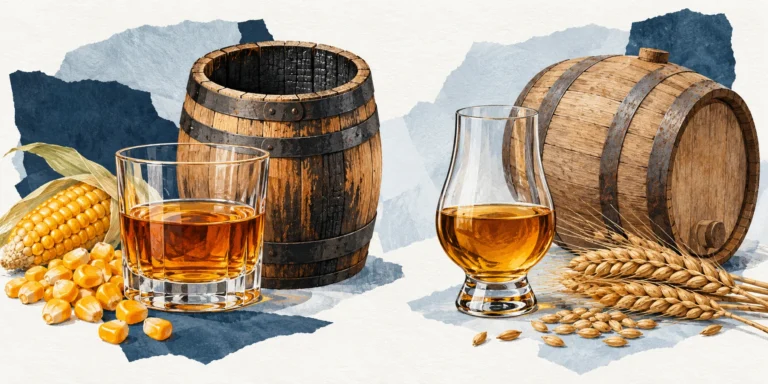
Bourbon is a type of American whiskey, made with at least 51% corn and stored in new charred oak. Whiskey is the wider family, whose named styles follow different rules.
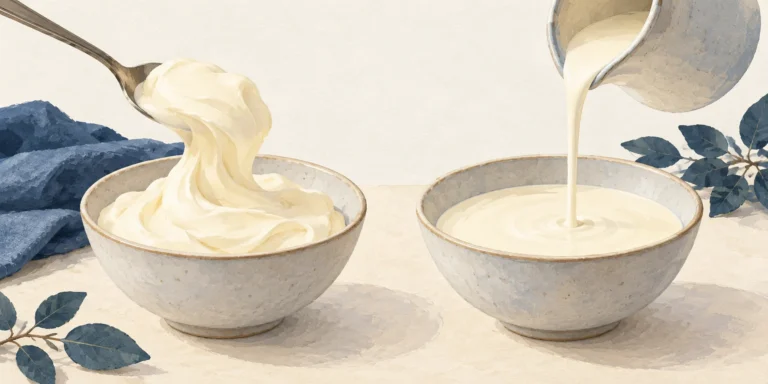
British double cream is typically around 48% fat and can be whipped; single cream is around 18% and is used for pouring or enriching dishes. They are not interchangeable in…