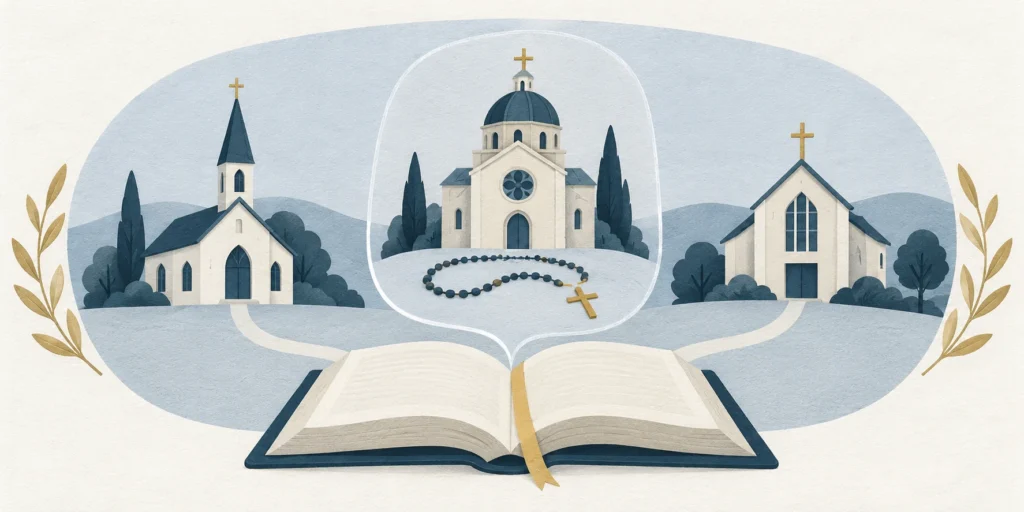
Catholics are Christians. Christian is the wider term; Catholic identifies a particular church tradition within Christianity, with distinctive authority and sacraments.
Catholics are Christians. “Christian” is the wider term; “Catholic” identifies a particular church tradition within Christianity. The useful question is how Catholic belief and practice compare with other Christian traditions, rather than whether someone must choose between being Catholic and Christian. [1][3]
In everyday British usage, “Catholic” often means Roman Catholic. This article uses it for the Catholic Church in communion with the Bishop of Rome, while using the Church of England as a concrete example of another Christian tradition. It is not a survey of every church. [1][3]
Catholic and Christian compared
A specific identity within a wider category
Question
Catholic
Christian
What does the word identify?
A particular church communion within Christianity
The wider religious identity, including Catholics and other Christians [1][3]
Belief in Jesus Christ?
Central to Catholic faith
Also central to the Anglican Christian example compared here [1][3]
Authority of the Pope?
The Bishop of Rome has a universal role in Catholic teaching
The broad word does not imply membership of the Catholic Church [1]
Number of sacraments?
Seven in Catholic teaching
The broader label alone does not specify a church’s teaching [2][4]
Can both labels describe one person?
Yes: a Catholic is Christian
Yes: Christian may be the broad description of a Catholic [1][3]
The relationship is inclusion, not two separate religions
Christianity
Catholic Christianity
Other Christian traditions also belong within the wider category, including Anglican Christianity.
The diagram shows a relationship between terms, not population sizes or a complete classification. [1][3]
Shared beliefs do not erase differences
Catholic and Anglican teaching both centre on Jesus Christ and describe God as Father, Son and Holy Spirit: the Trinity. That shared language helps explain why both belong within Christianity. It does not mean that every doctrine, service or church structure is identical. [1][3]
The distinction also prevents a misleading generalisation. “Christian teaching says…” may be too broad if the point belongs to one church. Name the tradition when discussing a specific authority, sacrament or practice.
Authority and sacraments: two concrete differences
In Catholic teaching, the Pope is the Bishop of Rome and has a universal role in the Church’s authority and unity. The wider category “Christian” includes people outside Catholic communion, so Christian identity does not automatically mean accepting that Catholic structure. [1]
Catholic teaching identifies seven sacraments: baptism, confirmation, Eucharist, penance, anointing of the sick, holy orders and matrimony. They are grouped around initiation, healing and service. That count belongs to Catholic teaching; the word “Christian” on its own does not give you a single sacrament count. [1][2]
For a British comparison, the Church of England describes baptism and Eucharist as two chief sacraments, alongside five other sacramental ministries: confirmation, reconciliation, anointing, marriage and ordination. Saying “Catholics have seven; Anglicans have only two rites” would lose that distinction. [4]
A worked wording example
Suppose a form asks for a broad religion and offers “Christian”. A Catholic person can accurately use that description. If a separate question asks for a denomination or tradition and offers “Catholic”, that gives a more specific answer. The form’s available options and the person’s own description still matter.
In conversation, replace “Are you Catholic or Christian?” with “Are you Catholic, or do you belong to another Christian tradition?” That wording keeps the meaningful distinction without excluding Catholics from Christianity. [1][3]
Try three descriptions
1. Someone says “I am a Catholic Christian”: is that contradictory?
No. The first word specifies a tradition within the broader identity given by the second. [1]
2. Someone is an Anglican Christian: must they also be Catholic?
No. Christian is the wider category; the Anglican example here is a different church tradition. [1][3]
3. Does “Christian” on a form prove a belief in exactly seven sacraments?
No. You need the specific church’s teaching. The Catholic count is seven; the Anglican example distinguishes two chief sacraments and five other sacramental ministries. [2][4]
Frequently asked questions
Why does a creed use the word “catholic”?
The word can mean “universal”. Its use in a creed does not, by itself, establish that the speaker belongs to the Roman Catholic Church. Context matters. [1][3]
Are all other Christians part of one church?
No. “Non-Catholic Christian” is a broad description, not the name of a single church with one uniform set of practices. The Anglican example above illustrates one tradition, rather than representing every other Christian. [1][3]
Sources
Sources checked on 11 October 2026. Worked examples and exercises were written for this article.
AI tools assisted with drafting and the featured editorial illustration. The illustration is not a photograph, measurement or test result. Claims were checked against the linked sources; no independent human expert review is claimed.
Islam names the religion; a Muslim is a person who follows it. Muslim can also be an adjective, while Islamic describes a connection with the religion.
In Church of England usage, a christening is a baptism, commonly the name for a child’s service. Baptism also includes adults; thanksgiving is a different service.
Shia and Sunni are traditions within Islam. Their central historical difference concerns succession and authority after Muhammad, with diversity within both.