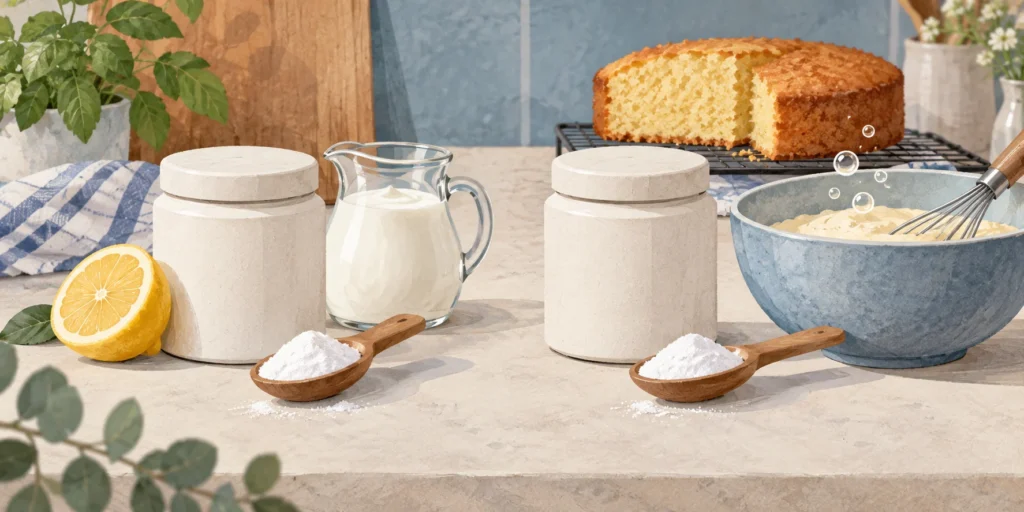
Baking soda is sodium bicarbonate, usually sold in the UK as bicarbonate of soda. Baking powder is a mixture containing bicarbonate and an acid, commonly with starch. Both can raise a bake, but they supply different ingredients to the reaction and are not equal-spoon substitutes.
When bicarbonate reacts with an acid in a moist mixture, it releases carbon dioxide. Those gas bubbles help a batter or dough expand. With baking soda, the recipe supplies the acidic partner; with baking powder, the powder already includes one. [1][4]
The raising agents compared
What you add to the mixing bowl
Feature
Baking powder
Baking soda / bicarbonate of soda
Basic composition
Bicarbonate mixed with an acid; commonly includes starch
Moisture starts the reaction; double-acting types also react during heating
Reacts with an acidic ingredient once the mixture is wet [4]
Equal quantity swap?
Does not contain the same amount of bicarbonate per spoon
An equal-spoon replacement changes the mixture’s balance [1][4]
Why the acid matters
Bicarbonate is alkaline. An acidic ingredient such as yoghurt, buttermilk or lemon juice can provide a reaction partner in a recipe that calls for it. Once mixed, the reaction begins, so follow the recipe’s mixing and baking sequence rather than leaving a finished batter waiting unnecessarily. [4]
Baking powder packages the alkaline and acidic components together. That is why a recipe can use it without adding lemon juice simply to activate the raising agent. The recipe may still contain acidic ingredients for flavour or other reasons; their presence does not automatically mean the powder is wrong. [1][4]
Baking powder route: bicarbonate and acid already in the blend + moisture → carbon dioxide bubbles.
This shows the acid–bicarbonate reaction used in baking, rather than every chemical change that heat can cause. [4]
Baking powder does not always mean cream of tartar
Cream of tartar is one acid used in a simple baking-powder mixture, but the exact commercial formula varies. A current UK baking-powder ingredient list gives raising agents E450 (diphosphates) and E500 (sodium carbonates), plus starch. A general definition that says every baking powder contains cream of tartar would therefore be too narrow. [2][3]
Starch helps keep a dry blend from reacting prematurely through unwanted moisture. Use a dry spoon and close the lid after use. The useful comparison is the ingredients and intended function, rather than the appearance of the white powder. [1][2][3]
What double-acting means
A powder labelled double-acting provides reaction stages when it becomes wet and when it is heated. That wording concerns when gas is released; it does not mean use twice the amount, nor does it justify treating every baking powder as identical. [4]
Why some recipes use both
A recipe may include an acid, bicarbonate to help balance it, and baking powder to provide additional lift. Seeing both on the list is not evidence of a duplication error. Removing one changes what the recipe developer intended the ingredients to do. [1][4]
A useful scaling example — without a substitution
Suppose a fictional recipe specifies 250 g plain flour and 2 level teaspoons of baking powder. You want to scale that ingredient list to 500 g flour. The scale factor is 500 ÷ 250 = 2, so the corresponding powder quantity is 2 × 2 = 4 level teaspoons of the same baking powder. This is an arithmetic example, not a recommended flour-to-powder ratio for every cake.
If the cupboard instead contains bicarbonate of soda, “4 teaspoons of white powder” is not the answer. The ingredient has changed, not merely the quantity. The replacement must account for the acidic partner and the rest of the recipe; use a recipe or substitution designed for those ingredients. [1][4]
Read your recipe: three situations
Open the situation closest to your ingredient list. These explanations help you understand the recipe rather than inventing a new one from a single ingredient.
1. The recipe asks for baking powder; I have only bicarb.
Do not use the same number of spoonfuls of bicarb. You would change both bicarbonate concentration and the supplied acid. Find a suitable recipe or a specific substitution that handles both changes. [1][4]
2. The recipe asks for bicarbonate of soda and yoghurt.
That is a plausible acid-and-bicarbonate pairing. Use the recipe’s stated amounts; the fact that yoghurt is present does not establish a universal bicarb dose. [4]
3. The recipe asks for both powders.
Both can have a role: bicarbonate balances an acidic ingredient, while baking powder supplies further raising power. Follow that recipe rather than deciding the second powder is redundant. [1][4]
Frequently asked questions
Is baking soda the same as baking powder?
No. Baking soda is bicarbonate of soda; baking powder includes bicarbonate and an acid in a blend. [1][4]
Does self-raising flour change the calculation?
Yes. It already contains a raising agent, so replacing plain flour with self-raising flour while retaining all the extra powder is a recipe change. Follow instructions written for that flour. [1][2]
Can I judge the ingredient by colour?
No useful distinction is established by the white powder alone. Keep the ingredient in its labelled container and use the name and ingredients list.
Sources
Source pages checked on 7 October 2026. The practical examples and exercises were written for this article.
AI tools assisted with drafting and the featured editorial illustration. The illustration is not a photograph, measurement or test result. Claims were checked against the linked sources; no independent human expert review is claimed.
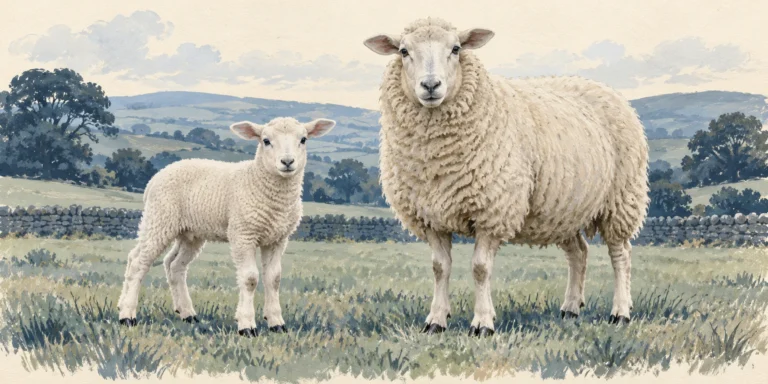
Lamb and mutton are sheep meat from different age groups. Mutton comes from older sheep and has a fuller flavour; the cut, provenance and cooking method matter alongside age.
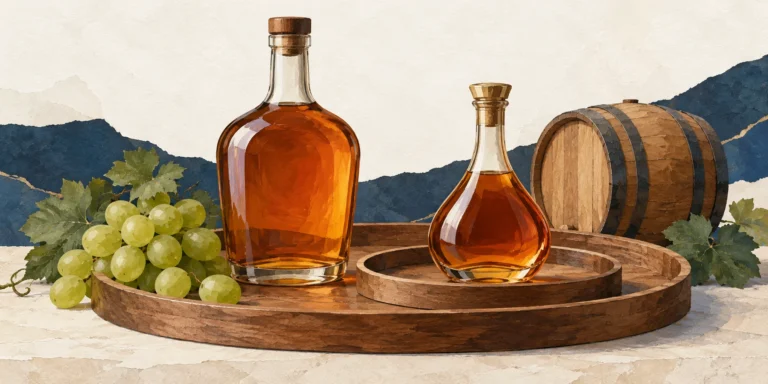
Cognac is a specific member of the broader brandy family, defined by its French origin and production requirements. The word brandy alone does not establish Cognac origin or age.
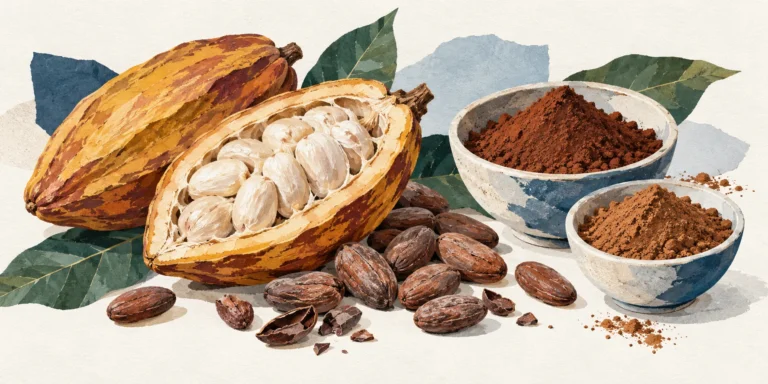
Cacao and cocoa come from the same plant, and the names overlap. For cooking, the useful distinction is the actual product: nibs or powder, and natural or alkalised cocoa.