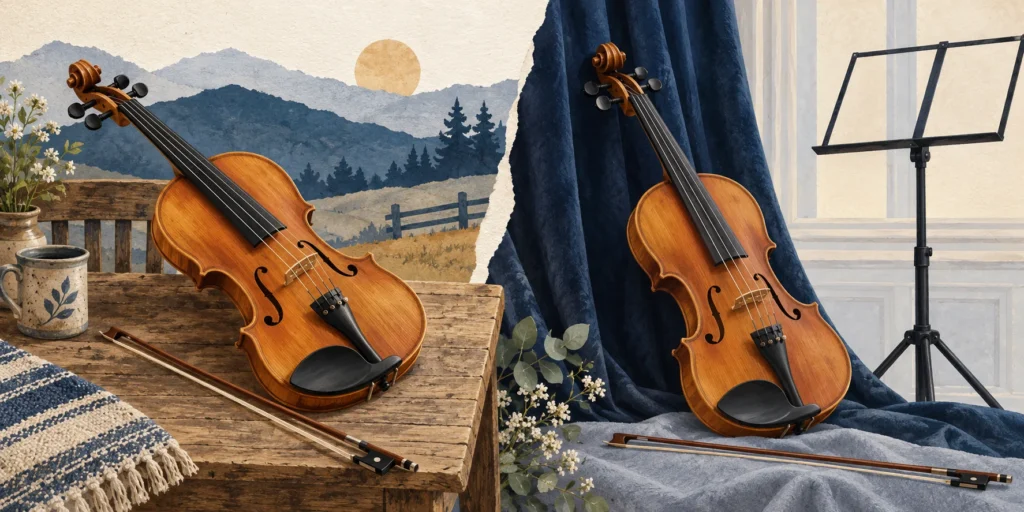
The difference at a glance
A fiddle is usually the same instrument as a violin. “Fiddle” commonly places it in folk or traditional music; “violin” is the standard instrument name and is commonly used in classical settings. The main difference is the music and playing approach, not a separate body design. [1] [4]
If you want to learn folk tunes but already own a violin, you do not normally need to buy another type of instrument. What you may need is a teacher who understands the tradition you want to play.
Fiddle and violin compared
Common usage and shared features of the ordinary acoustic instrument| Feature | Fiddle | Violin |
|---|
| Typical context for the word | Folk and traditional music, including English and Scottish traditions | Standard instrument name; often used for classical repertoire |
|---|
| Body design | Usually the same instrument as a violin | Same bowed, fretless string instrument |
|---|
| Standard strings and tuning | Usually four strings: G, D, A, E from low to high | Four strings: G, D, A, E from low to high |
|---|
| Learning emphasis | Learn the phrasing, rhythm and sound of a particular tradition | Learn the phrasing, technique and repertoire of the chosen classical course |
|---|
| Reading and listening | Learning by ear can be central; notation can also help | Notation is often used in classical study; listening remains useful |
|---|
| Set-up (shared, optional variation) | Some players choose changes for their playing needs; no single required fiddle set-up | Set-up also varies by player and instrument |
|---|
| What a beginner buys | A suitable, playable violin can serve as a fiddle | A suitable, playable violin for the player’s size and needs |
|---|
The shared design and tuning are the key factual similarities. Tradition-specific learning and optional set-up explain why the words can suggest different experiences. [1] [2] [3] [4]
Different names, shared anatomy
The ordinary instrument has four strings over a bridge, a fingerboard without frets and tuning pegs at the scroll end. Standard tuning runs G–D–A–E from low to high. Calling it a fiddle does not add frets, change the standard string count or require a different wooden body. [2] [4]
The name can also be affectionate or informal. A player may call the same instrument a violin in one conversation and a fiddle in another. Here the comparison concerns the familiar modern violin used in British folk and classical music, rather than every historical bowed instrument.
What actually changes when you play folk music?
The music gives the instrument its role. A folk tune’s rhythm, phrasing and ornaments are learned within a particular tradition, rather than from a universal “fiddle technique”. English and Scottish traditions provide concrete examples of fiddle use; they should not be treated as one interchangeable style. [1] [3]
For a beginner, a useful lesson question is “How should this phrase sound in this tune?” Playable notes are only the starting point. You also need to hear where phrases breathe and what gives the tune its movement. A recording and a teacher can give the same notes a musical context that a shopping label cannot.
Learning by ear is a skill, not a lower grade
Traditional learning can place substantial weight on listening and playing back what you hear. For example, Scottish traditional music graded exams offer a choice between reading music and playing back by ear. That is a specific assessment route, not proof that all fiddlers avoid notation. [3]
It is therefore unhelpful to separate players into “fiddlers cannot read” and “violinists cannot improvise”. Ask how your teacher will combine listening, technique and any written music for your goals. Neither name alone describes everything a player can do.
Set-up changes are optional, not a new species of instrument
Some fiddle players choose a flatter bridge curve or particular strings. Such choices can support their preferences, but they are not required by the word fiddle. A five-string version also does not create a reliable naming boundary: five-string electric instruments can be called violins or fiddles. [4]
If you are starting, describe the music you want to play and ask a teacher or instrument specialist whether any change is useful. Do not alter a bridge merely because an online comparison says every fiddle needs one; the ordinary instrument already serves both contexts.
A beginner’s decision path
Imagine you own a playable four-string student violin and want to learn English folk tunes. The practical next step is a suitable lesson or beginner folk resource, rather than a second purchase. These scenarios are examples written for this guide.
I own a violin but want to join a folk session. Do I need a fiddle?
Your violin can normally be your fiddle. Focus on learning relevant tunes, listening to their style and finding an appropriate teacher. Check that the instrument fits you and is playable before considering changes. [1]
I want orchestral playing and folk tunes. Must I choose one instrument?
The same ordinary violin can serve both. You can learn different repertoires and approaches on it. Tell your teacher about both goals so that advice about technique or set-up considers the full use.
A listing says “fiddle”. Does that guarantee a folk-ready set-up?
No. Ask about the actual condition, size, strings and set-up. The name alone does not specify a flatter bridge or a particular string material. [4]
Common questions
Is fiddle tuning always different?
No. G–D–A–E is usual. Some folk players use alternative tunings such as G–D–A–D or A–D–A–E for particular music; these are choices, not a universal definition. [1]
Is a fiddle easier to play?
The name does not make the instrument easier. Different pieces and traditions ask for different skills; choose a learning path that matches the music you want to make.
Does “fiddle” mean a cheap violin?
No. In this context it describes usage and approach, not a price or quality category. [1] [4]
Sources
- Beginners’ guide to English folk music: Instruments — English Folk Dance and Song Society
- The Structure of the Violin: The structure of the strings — Yamaha Corporation
- Traditional Music Graded Exams — Royal Conservatoire of Scotland
- What’s the Difference Between Fiddle and Violin? — Yamaha, Jake Uitti
Sources reviewed on 4 October 2026. This article was prepared with AI assistance and checked against the linked sources. The featured image is an AI-generated editorial illustration. The worked examples and decision paths were written for this guide; they are not reports of tests or expert review.