Beer vs lager: what’s the difference?
Lager is a type of beer. The useful comparison is usually lager versus ale: different fermentation traditions, rather than beer versus a separate drink.
In this comparison
Beer and lager compared
| Question | Beer | Lager |
|---|---|---|
| What does the word cover? | The wider drink category | One family of beer [1] |
| What fermentation does it use? | Includes ale, lager and mixed methods | Conventionally cool, bottom fermentation [2] |
| Must it be pale? | No: beer covers many colours | No: dark lagers can be brown to black [4] |
| Does it mean real ale? | Some beers are live or cask-conditioned | Lager describes a different characteristic [3] |
| Examples of narrower labels | Ale, lager and mixed-fermentation beer | Pilsner, Helles and dark lager [1] [2] [4] |
The useful comparison is ale versus lager
In conventional brewing terminology, ales use warm or “top” fermentation, whereas lagers use cool or “bottom” fermentation. The familiar yeast names are Saccharomyces cerevisiae for ale and Saccharomyces pastorianus for lager. These describe brewing traditions and yeast behaviour; modern methods include crossovers, so a single temperature reading is not a universal test. [2]
Mixed fermentation adds another reason not to draw a perfect two-box system. A brewer may use more than one yeast strain, or yeasts and bacteria, to develop a beer. The broad word beer remains useful even when a more specific style takes explanation. [2]
- Beer: the broad heading.
- Lager: one fermentation family beneath it.
- Pilsner or dark lager: more specific labels within that family.
This is an inclusion diagram, not a complete family tree of every beer style. [1] [4]
Why colour and fizz can mislead
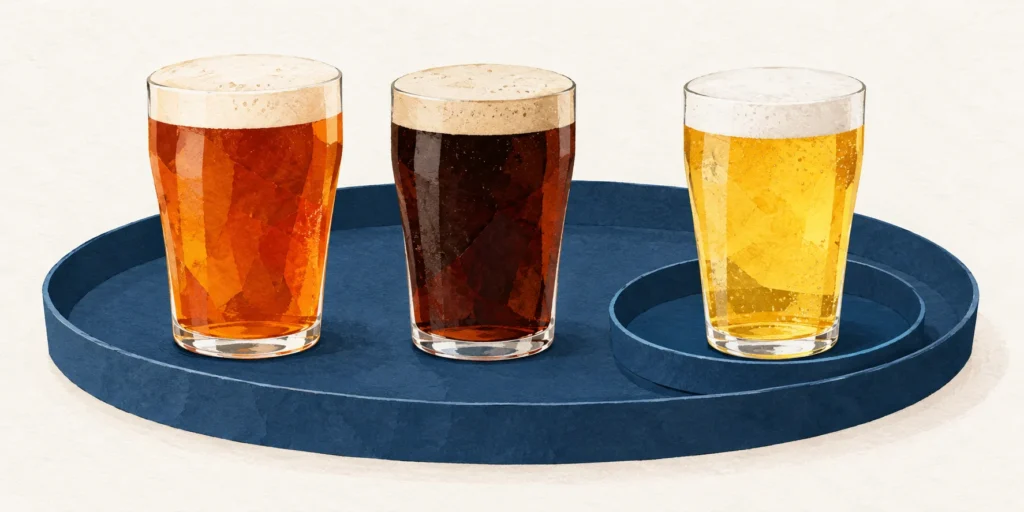
A golden drink is not automatically lager, and a dark drink is not automatically ale. A dark lager is the straightforward counterexample to the second assumption; a lager-like appearance does not settle how a beer was fermented. Read the style description rather than identifying it by sight. [1] [4]
Likewise, cask-conditioned describes beer that continues conditioning in its cask. “Live beer” is a broader expression for continuing conditioning in the final container. Those descriptions concern what happens after the main fermentation and how the beer reaches the drinker. They answer a different question from the ale–lager distinction. [3]
A worked pub-menu example
Imagine a fictional menu listing pilsner, bitter and dark lager. Put all three under the menu heading “Beer”. Pilsner and dark lager can then sit together under “Lager”; bitter sits on the ale side. Calling only the bitter “beer” would hide the relationship the menu is trying to explain. [1] [2] [4]
A clearer menu has a broad heading, a style label and any extra information in separate fields. For example: “Beer — dark lager — bottled”. The style and container each add information without replacing the category. If a label gives an alcohol percentage, use that stated figure rather than guessing strength from the word lager.
Try three label checks
A dark beer is labelled lager. Is that a contradiction?
No. Brown and black lager styles exist. Colour is not the defining distinction. [4]
A customer asks for beer but not lager. What could they mean?
They probably want a non-lager beer, often an ale. Ask which style they mean rather than assuming lager is outside the beer category.
Does cask-conditioned mean the same thing as ale?
No. It describes continuing conditioning in the cask. It is a different kind of description from a fermentation-family label. [3]
Frequently asked questions
Is pilsner a beer or a lager?
Both: pilsner is within the lager family, and lager is beer. The labels become more specific rather than cancelling one another. [1]
Can I tell whether a beer is stronger just from these names?
No. Neither the broad word beer nor the family name lager supplies a numerical alcohol percentage. Read the individual product’s stated strength.
Sources
Source pages checked on 18 October 2026. The worked examples and self-checks were written for this article with AI assistance and checked against the listed material.
- Lager, Pilsner — CAMRA.
- The Magic of Mixed Fermentation — CAMRA.
- What is live beer? — CAMRA.
- Dark Lager — CAMRA.
The featured image is an AI-generated editorial illustration, not a photograph, measurement or current observation.