In British cooking, casserole can name a lidded vessel or the food cooked in it. Stew names food cooked slowly in a little liquid; the terms often overlap.
In British cooking, casserole can mean a heavy, lidded cooking vessel or the food cooked in it. Stew means food cooked slowly in a small amount of liquid, and to stew names that cooking process. The words overlap: a stew can be cooked in a casserole, including in the oven. The shortcut “casserole in the oven, stew on the hob” is therefore a convention, not a reliable rule for every recipe. [1][2][3]
The food itself, cooked slowly with a little liquid [1][2]
Does it also name the cooking process?
Most useful here as a vessel or dish name
To stew is a verb for gentle, slow cooking in liquid [2]
Must the heat source decide the name?
Often associated with an ovenproof pot, but read the method
Can start on the hob and finish covered in the oven [3][4]
What is shared?
Can be a slow-cooked combination of ingredients in liquid
Can be the same kind of moist, slow-cooked dish [1][2]
What cannot be inferred?
Exact ingredients, liquid quantity, topping or cooking time
Those details are not fixed by the word stew either
Original example
Put the covered casserole in the oven.
The stew is cooking inside that casserole.
Why the oven-versus-hob rule breaks down
A dish called beef stew can begin on the hob in a casserole and then finish under a lid in the oven. Moving the vessel does not change the food into an entirely different category. It shows that one word can describe the food while the other describes the container. [3]
This is why a menu and a recipe can seem to disagree without either being wrong. A menu might call the meal a beef casserole; the method might describe stewing the meat. Read the sentence’s purpose: is it naming the finished dish, naming equipment, or describing what the cook does? [1][2]
A recipe-reading path
Identify the noun: does casserole mean the pot or the finished food?
Read every cooking stage: a hob start may be followed by an oven stage.
Match the vessel: check its size, lid and compatibility with each required heat source.
Keep the recipe’s instructions: its liquid amounts and timings cannot be recovered from the title alone.
A worked kitchen decision
Imagine a recipe headed beef stew. It tells you to start the ingredients on the hob, then cover the pot and transfer it to the oven. You own an ovenproof casserole with a lid. The useful question is whether it is also suitable for the hob stage, rather than whether the recipe title says “stew” or “casserole”. [3][4]
If it is suitable for both, the same vessel can follow the two stages. If the dish is ovenproof but not hob-compatible, a separate frying pan may be needed for the initial stage, with the ingredients then transferred as the full recipe directs. That is a change in equipment handling, not evidence that stew and casserole are mutually exclusive foods. [4]
Do not turn that example into an automatic conversion for every recipe. A lid, pan shape and heating method affect how the dish cooks, and the recipe may rely on a particular sequence. Retain its stated method unless you have a specific, reliable adaptation. The names alone do not supply a replacement temperature, duration or quantity of stock.
What the illustration does and does not show
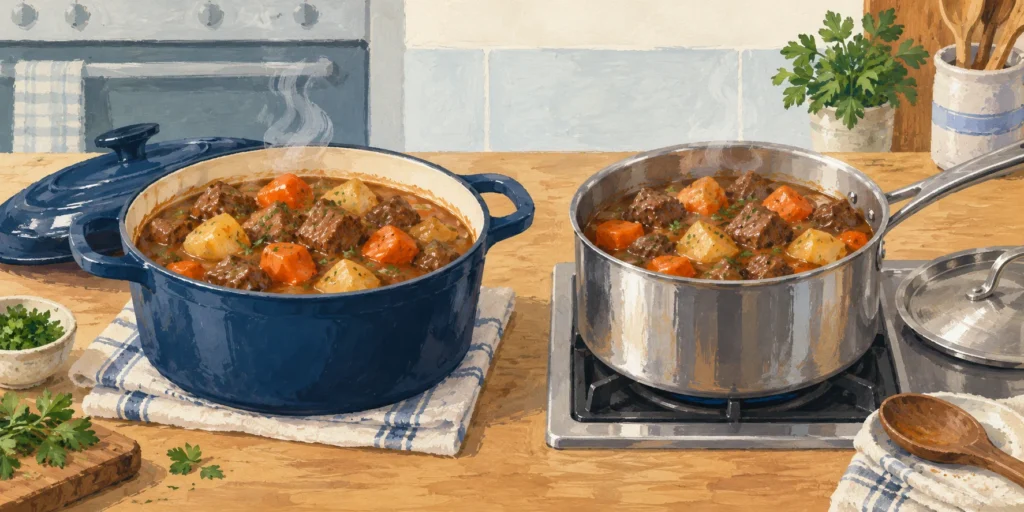
The two pots contain similar beef and root-vegetable dishes because the British meanings can overlap. The oven and hob suggest familiar cooking contexts. They do not establish that every casserole must be oven-cooked, every stew must stay on a hob, or either word requires a crust, cheese or a particular vegetable.
Check three practical assumptions
1. The recipe is called stew but finishes in the oven: is that contradictory?
No. An oven-cooked stew is a valid use of the term. The food can be stewed in a covered casserole. Follow the actual sequence of cooking stages. [2][3]
2. I have a casserole dish: can it always go straight on the hob?
No. The name does not certify the material, base, handles or lid for every heat source. Match the vessel to the method; an ovenproof-only dish may need a separate pan for the hob stage. [4]
3. Does changing the title let me reuse another recipe’s timings?
No. A title does not determine the quantities, ingredient sizes or sequence. Use the instructions for the actual recipe rather than treating the words as a time-conversion formula.
Frequently asked questions
Can a stew be meat-free?
Yes. Bean stew is an ordinary use of the word; meat is not a requirement built into every stew. The recipe supplies the ingredients. [2]
What does stewed fruit mean?
Here stew is the cooking verb: fruit is cooked slowly and gently in a little liquid. It is another reason not to define stewing solely as a particular meat dish. [2]
Sources
Sources checked on 16 October 2026. The worked examples and exercises were written for this article.
AI tools assisted with drafting and the featured editorial illustration. The illustration is not a photograph, a measured diagram or evidence of an actual test.
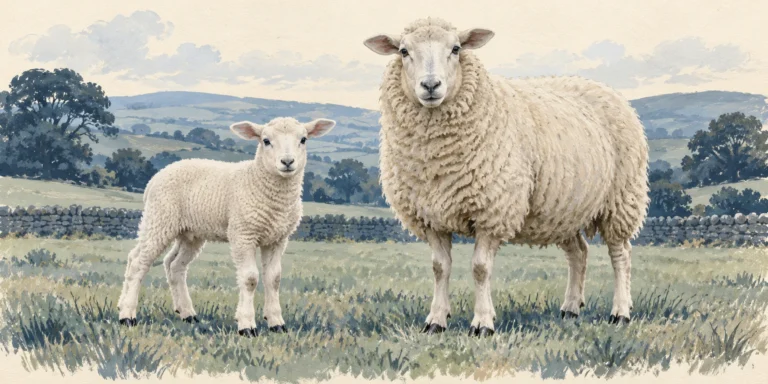
Lamb and mutton are sheep meat from different age groups. Mutton comes from older sheep and has a fuller flavour; the cut, provenance and cooking method matter alongside age.
Cognac is a specific member of the broader brandy family, defined by its French origin and production requirements. The word brandy alone does not establish Cognac origin or age.
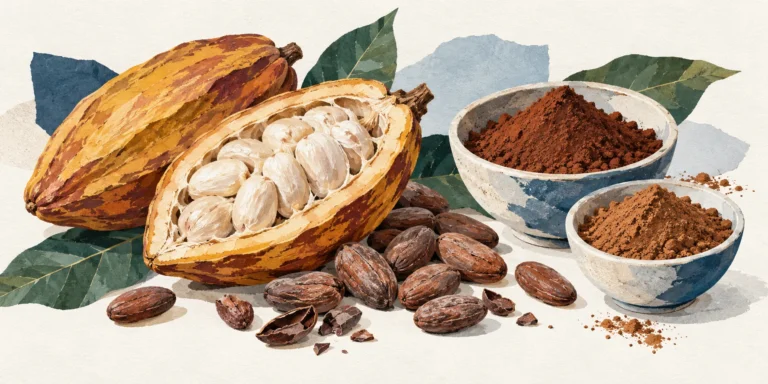
Cacao and cocoa come from the same plant, and the names overlap. For cooking, the useful distinction is the actual product: nibs or powder, and natural or alkalised cocoa.