Islam names the religion; a Muslim is a person who follows it. Muslim can also be an adjective, while Islamic describes a connection with the religion.
Islam is the name of the religion. A Muslim is a person who follows Islam. The words therefore describe a faith and its followers, rather than two different religions. In English, Muslim can also be an adjective, as in “Muslim neighbours”; Islamic is an adjective for something connected with Islam. [1][2][3]
If the subject is the religion, use Islam: “The exhibition introduces Islam.” If the subject is a follower, use the countable noun: “One participant is a Muslim.” In the plural, add s: “Several Muslims took part.” These are original grammar examples, not reports about a particular event. [1][2]
You would not normally write “She is an Islam” to identify someone’s religion. A natural form is “She is Muslim” or “She is a Muslim.” The first uses the adjective; the second uses the noun. Both are standard uses of Muslim. Capitalise Islam, Muslim, Muslims and Islamic in ordinary English writing. [1][2][3]
A sentence-choice path
Naming the faith? Use Islam: “a question about Islam”.
Naming a follower or followers? Use a Muslim or Muslims.
Describing people? Muslim often fits: “Muslim residents”.
Describing a religious connection? Islamic often fits: “Islamic art”. Read the whole phrase; the adjective uses can overlap.
Muslim and Islamic are not a rigid either–or pair
Muslim often describes people and communities: Muslim friends, Muslim residents or a Muslim family. Islamic often describes a connection with the faith, its ideas or cultural traditions: Islamic beliefs, Islamic studies or Islamic art. [2][3]
That is a useful guide for a clear sentence, not an absolute rule that one adjective can never appear where the other does. Both words have adjective uses. Choose the phrase that expresses what you actually mean: people participating, the religion being studied, or a particular tradition or practice. [2][3]
A worked community-notice example
Imagine drafting a library notice: “Learn about Muslim and meet local Islam people.” The intention is friendly, but the two words have been assigned the wrong roles. A clearer version is: “Learn about Islam and meet Muslim neighbours.” If the event includes an art display, a second sentence could say: “Explore examples of Islamic art.”
The revision does three jobs. Islam identifies the subject of learning. Muslim describes the neighbours. Islamic explains the art’s connection with the tradition. It does not imply that every neighbour has identical beliefs, interests or personal practices.
Religious identity is not nationality
Muslims in Britain come from a wide range of national and cultural backgrounds, and include people who have converted to Islam. A person can be both British and Muslim; these words answer different questions. Arab, for example, is not a substitute for Muslim when the intended information is religion. [4]
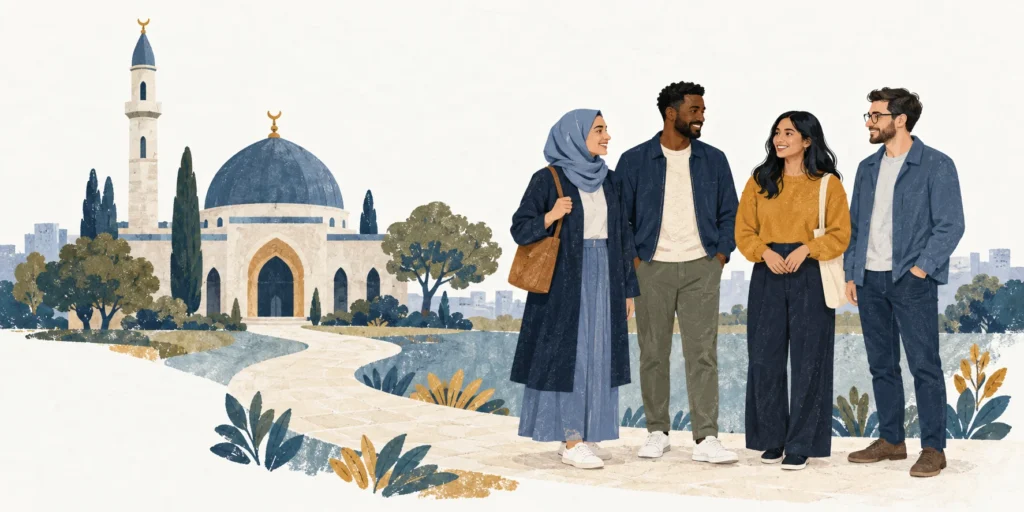
For a real person, use the identity they give you when it is relevant. A name, appearance or item of clothing is not enough to supply a missing statement about someone’s faith. The illustration represents faith and followers together; it does not offer a visual test for identifying who is Muslim.
Check three sentence choices
1. “We discussed Islam” or “We discussed a Muslim”?
Both can be grammatical, but they mean different things. The first concerns the religion; the second concerns a person. Decide which subject you intend before choosing the noun. [1][2]
2. “She is Muslim” or “She is a Muslim”?
Both work. Muslim is an adjective in the first and a countable noun after “a” in the second. Neither sentence names a different religion. [2]
3. Should I write “three Islams” for three followers?
Use three Muslims. You are counting people, not naming the faith. In this ordinary meaning, Islam is not the countable noun you need. [1][2]
Frequently asked questions
Does Muslim mean someone from a particular country?
No. It names a religious identity, not a nationality. The range of British Muslim backgrounds is one practical reason to keep those ideas separate. [4]
Are Islam and Islamic interchangeable?
No. Islam is the noun naming the faith; Islamic is the related adjective. Compare the original phrases “learning about Islam” and “studying Islamic art”. [1][3]
Sources
Sources checked on 15 October 2026. The worked examples and exercises were written for this article.
AI tools assisted with drafting and the featured editorial illustration. The illustration is not a photograph, a measured scientific diagram or evidence of a product test.
In Church of England usage, a christening is a baptism, commonly the name for a child’s service. Baptism also includes adults; thanksgiving is a different service.
Shia and Sunni are traditions within Islam. Their central historical difference concerns succession and authority after Muhammad, with diversity within both.
Catholic and Protestant traditions are Christian. They differ in church authority, Scripture and tradition, and sacramental teaching; Protestant churches also differ from one another.