Brown and white hen eggs differ in shell pigmentation, which depends on the hen’s breed and genetics. Brown shells do not make an egg more nutritious than white shells. Colour also does not tell you whether the hens were kept organically, free range, in a barn or in cages: that is separate label information. [1][2][3][4]
The useful comparison is between ordinary chicken eggs of a similar size and production method. A brown large egg and a white medium egg differ in more than colour; so do two packs with different farming labels. Keep those variables separate before attributing a difference to the shell.
Brown and white eggs compared
One colour contrast and shared properties at a matched size
Brown colour is produced by pigments deposited as the egg develops. The main brown-shell pigment is called protoporphyrin. The genetic background of the hen matters; a darker shell is not a score for the nutrients inside it. Shell shades can also vary among birds of the same breed. [1]
The everyday association of white-feathered hens with white eggs and brown hens with brown eggs is a broad pattern, not a dependable way to identify every breed. For a shopper, it is easier to read the actual pack than to infer an egg’s qualities from a picture of a hen. [1]
Use size when comparing nutrition
Typical nutrition figures illustrate why a matched-size comparison matters. The published table gives 6.4 g of protein for a medium egg on its 58 g size basis, and 7.5 g for a large egg on its 68 g basis. These are typical values, not measurements of the eggs in your carton, and neither figure is assigned to a shell colour. [2]
A matched-size protein illustration
Two medium eggs: 6.4 g + 6.4 g = 12.8 g typical protein. The arithmetic applies whether their shells are brown, white or one of each. It does not prove that two individual eggs have exactly identical composition. [1][2]
Read the code for the farming method
On an ordinary stamped shop egg, the first digit of the producer code identifies the farming method: 0 organic, 1 free range, 2 barn, 3 cage. The following country code and producer number provide other identification information. This explanation uses the producer-code guidance for England and Wales; it is a consumer reading guide, not a complete set of selling rules. [3]
A code beginning 1UK therefore tells you something that a brown or white shell cannot: the method is free range and the origin code is UK. The digits do not encode a nutrition rating. Direct farm sales can have different stamping requirements, so do not treat an unstamped egg as proof of a particular method. [3]
A worked supermarket comparison
Suppose, purely as an example, a six-pack of medium white eggs costs £1.80 and a six-pack of medium brown eggs costs £2.40. Both packs state the same production method. Divide by six: the white eggs cost 30 p each and the brown eggs 40 p each. The brown pack costs 60 p more, or 10 p more per egg.
If your sole reason for paying that premium is “brown means more nutritious”, the colour does not support it. You might still choose a particular producer or other labelled feature; identify that reason explicitly. These prices were invented for the calculation and are not current shop prices. [1][2]
Check three shopping assumptions
1. A brown shell means free range: true?
No. Look at the production-method code and pack. Shell pigment and the farming method describe different things. [1][3]
2. Is a large white egg automatically lower in protein than a medium brown egg?
No. Colour is not a protein ranking. The typical table gives 7.5 g for large and 6.4 g for medium, so size changes the comparison. [1][2]
3. What is the premium in the two hypothetical six-packs?
60 p per pack, or 10 p per egg. £2.40 − £1.80 = £0.60; dividing by six gives £0.10. The colour itself does not explain a nutritional advantage. [1][2]
Frequently asked questions
Is a white shell the same thing as egg white?
No. White shell describes the outside; egg white is the albumen inside an egg. A brown-shelled egg also contains egg white. [2]
Should brown eggs always cost more?
There is no universal price rule in this comparison. Compare the actual pack’s count, size, stated method and price. The worked example demonstrates the calculation, not a market survey.
Sources
Sources checked on 14 October 2026. Worked examples and exercises were written for this article.
AI tools assisted with drafting and the featured editorial illustration. The illustration is not a photograph, a measured technical diagram or evidence of an actual test.
Lamb and mutton are sheep meat from different age groups. Mutton comes from older sheep and has a fuller flavour; the cut, provenance and cooking method matter alongside age.
Cognac is a specific member of the broader brandy family, defined by its French origin and production requirements. The word brandy alone does not establish Cognac origin or age.
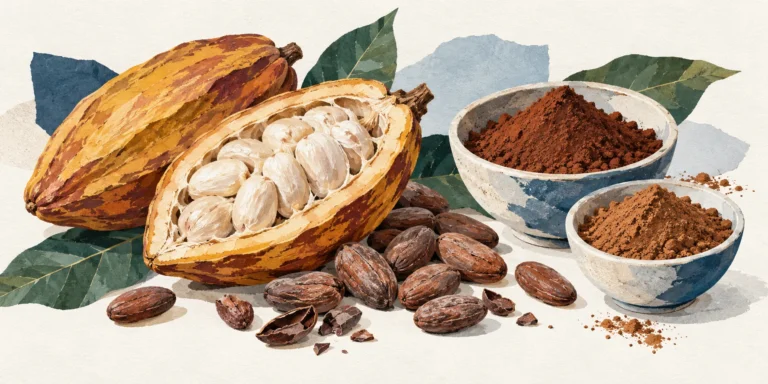
Cacao and cocoa come from the same plant, and the names overlap. For cooking, the useful distinction is the actual product: nibs or powder, and natural or alkalised cocoa.