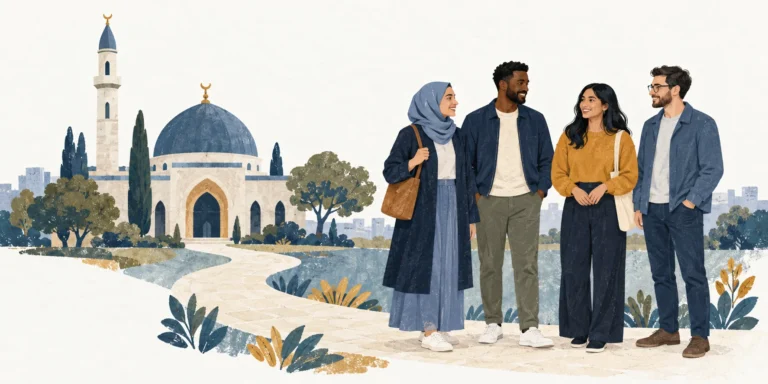
Shia and Sunni are traditions within Islam. Their central historical difference concerns succession and authority after Muhammad, with diversity within both.
Shia and Sunni are traditions within Islam. Their central historical difference concerns who should lead the Muslim community after Muhammad and what authority that leadership carries. Sunni tradition accepted Abu Bakr’s succession; Shia tradition held that rightful authority belonged to Ali and the Prophet’s family. Both have developed diverse interpretations and communities. [1][2][4]
The comparison concerns religious traditions, not nationalities or two different gods. Both affirm one God and Muhammad’s role as messenger, and the Qur’an is their central scripture. Sharing that foundation does not mean agreeing on every interpretation. [2][3][4]
Shia and Sunni compared
The main contrasts, with shared foundations stated
Question
Shia traditions
Sunni traditions
Historical succession
Ali and designated authority within the Prophet’s family are central
In the Shia understanding, Ali’s authority was not simply a preference for a familiar political candidate. It involved the Prophet’s designation and the continuing spiritual guidance of the community through the Imams. The family relationship and the claimed authority belong together in that account. [1][4]
Sunni tradition developed a different understanding of succession and scholarly authority. The caliph’s community leadership and the scholars’ interpretation of religious teaching were not the same role. Saying Sunni Muslims have no religious authority would therefore be as misleading as saying every Shia community follows an identical succession line. [1][4]
These are summaries of the traditions’ positions. They do not mean every later Sunni ruler was democratically elected, or that the entire distinction appeared in its fully developed modern form at one moment. Ideas about succession were elaborated over time. [4]
Why Twelver needs its own name
Twelver Shia recognise a line of twelve Imams. They believe the twelfth is in occultation — hidden from ordinary public presence — and will return. This is a statement of that tradition’s belief, not a claim that every Shia group has the same account. [1][4]
Ismaili and Twelver communities have different succession histories. That distinction makes the broad label Shia insufficient when the question concerns the number or continuing role of Imams. Sunni traditions also contain different schools of legal interpretation; neither column describes a single uniform opinion on every subject. [2][4]
Three questions for a fair comparison
Shared belief or disputed interpretation? The Qur’an is shared; understanding authority can differ.
Which branch? Specify Twelver when discussing the twelve-Imam teaching.
Tradition or individual? Ask a person how they identify instead of inferring beliefs from nationality or appearance.
A worked discussion example
Suppose a classmate says, “My family is Shia,” and someone replies, “Then your tradition must teach exactly twelve Imams.” The reply jumps from a broad identity to a branch-specific doctrine. A better question is, “Are we discussing Twelver teaching, or another Shia tradition?”[1][4]
Once the scope is Twelver, the twelve-Imam explanation is relevant. If the scope is Ismaili, the succession history needs its own account. You have improved the comparison by narrowing the question, without asking anyone to justify their faith or assuming the answer from their country of origin.
Check three common assumptions
1. Does a shared Qur’an mean identical interpretations?
No. A common scripture can coexist with different approaches to interpretation and authority. [2][3]
2. Does Shia automatically mean Twelver?
No. Twelver is a particular Shia tradition. Other Shia communities have different succession histories. [1][4]
3. Does Sunni mean there are no religious scholars or schools?
No. Scholarly interpretation and schools of jurisprudence are important. Their authority differs from the distinctive Shia Imamate model. [1][2][4]
Frequently asked questions
Do the terms name nationalities?
No. They identify religious traditions. Nationality alone cannot establish a person’s beliefs or which community they belong to.
Does recognising shared Islam remove the differences?
No. Shared foundations and real differences in succession, authority and interpretation can both be described accurately. [1][2][4]
Sources
Sources checked on 13 October 2026. Worked examples and exercises were written for this article.
AI tools assisted with drafting and the featured editorial illustration. The illustration is an explanatory representation, not a photograph, measurement or test result. Claims were checked against the linked sources; no independent human expert review is claimed.
Islam names the religion; a Muslim is a person who follows it. Muslim can also be an adjective, while Islamic describes a connection with the religion.
In Church of England usage, a christening is a baptism, commonly the name for a child’s service. Baptism also includes adults; thanksgiving is a different service.
Catholic and Protestant traditions are Christian. They differ in church authority, Scripture and tradition, and sacramental teaching; Protestant churches also differ from one another.