Dark soy sauce vs light soy sauce: what’s the difference?
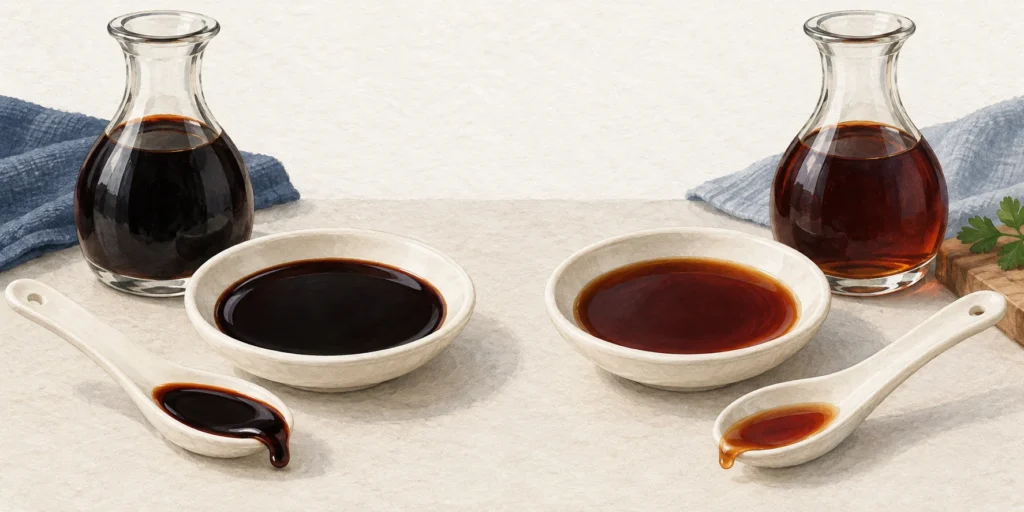
In Chinese cooking, dark soy sauce mainly adds deep colour and light soy sauce mainly seasons. “Light” is a style name, not a promise of reduced salt.
In this comparison
The concrete product comparison here is Lee Kum Kee Premium Dark Soy Sauce versus Premium Light Soy Sauce on their UK product pages. Those names identify the compared products. Other brands and Japanese-style sauces need their own comparison. [1] [2] [3]
Dark and light soy sauce compared
| Feature | Dark soy sauce | Light soy sauce |
|---|---|---|
| Main role | Build deep colour in cooked dishes | Add savoury seasoning and umami [1] [2] |
| Colour | Very dark brown | Clearer reddish brown [1] [2] |
| Consistency | Thicker and clingier | Thinner [1] [2] |
| Flavour emphasis | A sweet hint; subtler soy-bean taste | Delicate, savoury soy-bean flavour [1] [2] |
| Typical applications | Braises, stews, gravies and dark noodle dishes | Marinades, dipping sauces, dressings and stir-fries [1] [2] |
| Published salt per approximately 5 g serving | 0.97 g in the named product | 0.86 g in the named product [1] [2] |
Seasoning and colour are different jobs
A noodle sauce may use both styles because deepening the colour is not the same task as adjusting the savoury flavour. Adding more light soy to imitate dark colour changes the seasoning as well. Replacing all the light with dark changes the intended colour and flavour balance. [1] [2]
Treat the recipe’s two quantities separately. If a recipe names a particular style, keep that information when making a shopping list; a bottle described only as soy sauce gives less certainty. Japanese shoyu belongs to a different naming and product tradition, so the Chinese contrast should not be applied to every bottle. [3]
What the salt figures actually show
For the named pair, the published figures are 0.97 g for dark and 0.86 g for light per serving described as approximately 5 g. In this pair, dark contains more salt at that stated serving size. This does not create a universal ranking across brands or make light a reduced-salt product. Check the bottle’s current nutrition panel. [1] [2]
Dark: 0.97 g salt
Light: 0.86 g salt
Both bars use a 0–1 g scale. These are published product figures, not a measurement made for this article. [1] [2]
As an arithmetic example, two stated servings give 1.94 g of salt from dark or 1.72 g from light. That calculation assumes the same product and serving weight; it is not a suggested amount to use.
A worked recipe decision
Suppose an illustrative noodle recipe calls for 2 teaspoons of light and 1 teaspoon of dark. The light supplies the seasoning role and the dark the colour role. For a double batch, use 4 teaspoons of light and 2 of dark: double each separately, rather than replacing the mixture with 6 teaspoons of either style.
Those quantities are an example for learning the distinction, not a tested recipe. If dark sauce is missing, expect a paler result rather than assuming extra light will recreate it. If light is missing, follow a recipe designed for the sauce you have instead of treating dark as an identical replacement.
Try three kitchen choices
1. You want a savoury dip without a very dark finish: which style fits the usual role?
Light. Dipping and seasoning are among its usual applications in the scoped comparison. [1]
2. A stew needs deeper colour: which style addresses that job?
Dark. Add it progressively for colour, while keeping the recipe’s seasoning balance in mind. [2]
3. Does “light” mean reduced salt?
No. It names a style. The named products have different published salt figures, but neither word guarantees a reduced-salt formulation. [1] [2] [3]
Frequently asked questions
Can I use both in one dish?
Yes. Their different roles can complement one another; follow the particular recipe rather than a universal ratio. [1] [2]
Is dark soy the same as every sweet soy sauce?
No. Choose the stated product style. A dark colour alone does not show that two sauces have the same flavour or intended use. [3]
Sources
Sources checked on 13 October 2026. Worked examples and exercises were written for this article.
- Premium Light Soy Sauce — Lee Kum Kee UK.
- Premium Dark Soy Sauce — Lee Kum Kee UK.
- Light vs. dark soy sauce — Kikkoman UK.
AI tools assisted with drafting and the featured editorial illustration. The illustration is an explanatory representation, not a photograph, measurement or test result. Claims were checked against the linked sources; no independent human expert review is claimed.