Gelato is an Italian style of ice cream, typically denser and often made with more milk and less cream. Recipes, air content and serving temperatures vary.
Gelato is an Italian style of ice cream, typically denser, often made with more milk and less cream, and commonly served softer and warmer than industrial ice cream. Recipes overlap: the name alone does not guarantee a fat percentage, an egg-free recipe or a particular nutritional value. [1][2][3]
For a UK shopper, separate three questions: what is in the recipe, how much air was incorporated, and how it is served. Those explain more than whether the seller uses an Italian or English name. This comparison focuses on typical dairy versions.
Gelato and ice cream compared
Common patterns, with important overlap
Feature
Typical gelato
Ice cream
Milk and cream
Often more milk and less cream
Cream-rich recipes are common; formulas vary [1][2]
Air incorporation
Usually lower in artisanal gelato
Often higher in industrial products; dense low-air ice cream also exists [2][3]
A generally lower-fat gelato recipe can still feel creamy. Fat is only one contributor: the balance of water, sugars, milk solids and the frozen structure also affects texture. Some gelato contains both cream and eggs, so “gelato is only milk” is too rigid. [1][2]
Artisanal gelato is commonly served around −12 to −14°C, while an industrial ice-cream comparison may use around −18 to −20°C. These are teaching examples for those production styles, not compulsory temperatures for every product. They describe service, not instructions to raise your home freezer temperature. Follow the product’s storage directions. [3]
What overrun actually means
Overrun is the percentage increase in volume relative to the starting mix. It is not the percentage of the finished bowl that is air. Ice cream can have low overrun too, so density is not an exclusive gelato property. [2]
One litre of mix: two hypothetical volume outcomes
Calculation: (finished volume − starting volume) ÷ starting volume × 100. These invented examples illustrate the definition; they are not measured products. [2]
For the first example, (1.30 − 1.00) ÷ 1.00 × 100 = 30%. In a simplified model that attributes the volume increase to air, 0.30 ÷ 1.30 ≈ 23% of the final volume is added air. For the second, 0.90 ÷ 1.90 ≈ 47%. That is why 90% overrun does not mean a tub is 90% air.
The practical consequence is that equal-volume scoops need not contain equal amounts of original mixture. To compare nutrition, use the product’s information on the same basis, such as per 100 g, then account for the portion. A scoop’s apparent size cannot supply that calculation. [1][2]
Choose by the information you need
1. You want a dense, soft serving: is gelato a useful starting point?
Yes, as a style clue. Ask about the actual texture; some ice creams are dense too. The label is a starting point, not a guarantee. [2][3]
2. A tub says gelato: can you assume it has no eggs?
No. Recipes differ, and some traditional versions contain eggs and cream. Read its ingredients and allergen information or ask the seller about that product. [1][2]
3. A mix grows from 1.00 to 1.30 litres: is it 30% air by final volume?
No: it has 30% overrun. The added volume is 0.30 litre; 0.30 ÷ 1.30 is approximately 23% of the finished volume in this simplified model.
Frequently asked questions
Is gelato always lower in calories?
No. Fat, sugar, other ingredients and the actual portion determine the result. A lower-fat style does not establish the calories in a particular serving. [1]
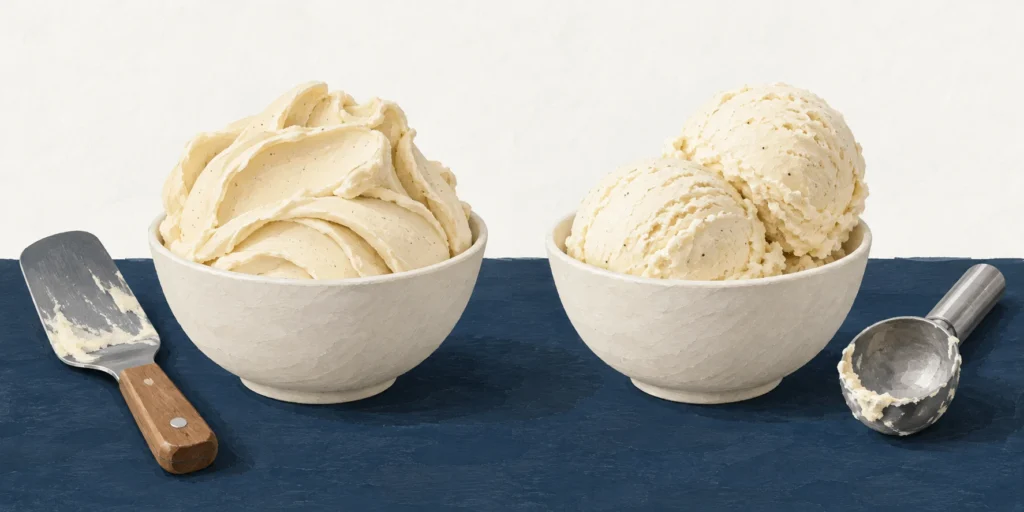
Does a spatula rather than a scoop prove it is gelato?
No. Serving shapes are useful visual conventions, not ingredient or process tests. The illustration represents those customary shapes; it does not measure either dessert.
Sources
Sources checked on 10 October 2026. Worked examples and exercises were written for this article.
AI tools assisted with drafting and the featured editorial illustration. The illustration is not a photograph, measurement or test result. Claims were checked against the linked sources; no independent human expert review is claimed.
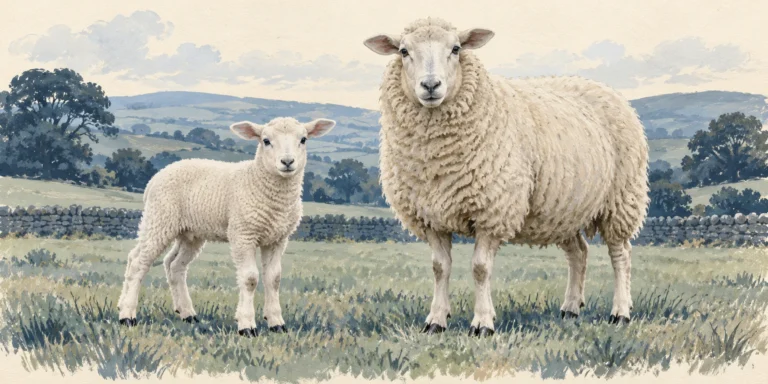
Lamb and mutton are sheep meat from different age groups. Mutton comes from older sheep and has a fuller flavour; the cut, provenance and cooking method matter alongside age.
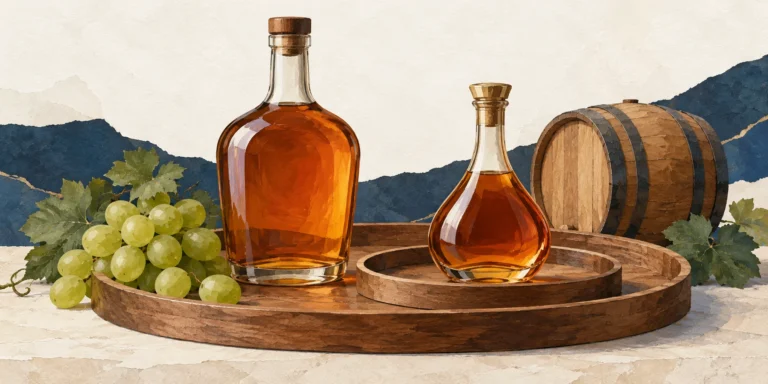
Cognac is a specific member of the broader brandy family, defined by its French origin and production requirements. The word brandy alone does not establish Cognac origin or age.
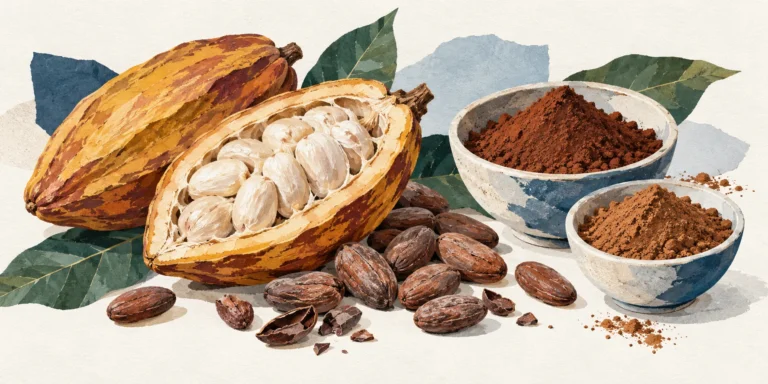
Cacao and cocoa come from the same plant, and the names overlap. For cooking, the useful distinction is the actual product: nibs or powder, and natural or alkalised cocoa.